Reporting unusual water events without guessing the cause
What should you do when you see an oily-looking sheen, unexplained foam, unusual colour or dead fish? Keep clear, note the location and time, and report the observation through the appropriate official route. If there is an immediate threat to people, call the local emergency service. You do not need to identify a chemical before raising a concern.
This guide helps you make an accurate report while avoiding exposure and unsupported accusations. It is not a spill-response manual, a wildlife-handling guide or a method for deciding that suspicious material is safe to touch.
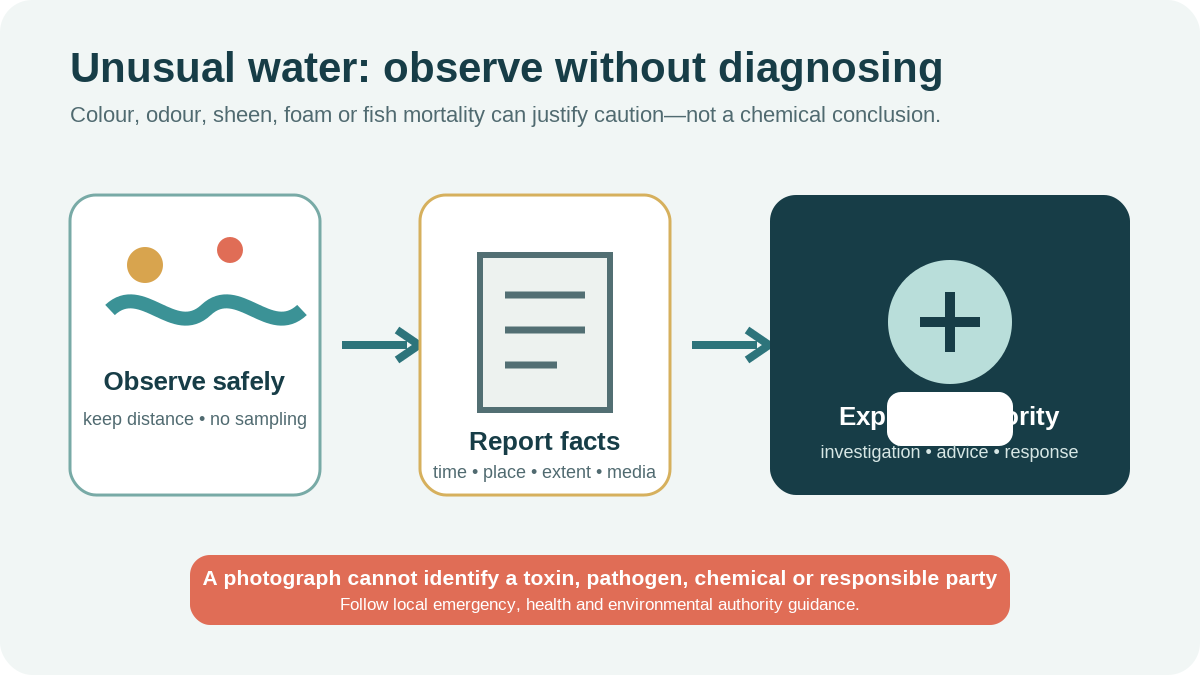
Appearance can trigger a cautious report, but a photograph cannot identify a chemical, toxin, pathogen or responsible party.
Atlas71 editorial illustration · Atlas71 original · Evidence basis: WHO – Recreational waters ↗
What you will learn
- Keep away from unknown material and do not sample it casually.
- Record observable facts such as time, location, extent and appearance.
- Leave causal diagnosis and hazard instructions to competent authorities.
Observation is the starting point
Describe what you can see: a rainbow-like surface film, a white foam band, dark water leaving an outlet, fish floating motionless or animals behaving unusually. Use the ordinary description first. “Oil-like sheen” honestly records an appearance; “diesel from that boat” adds an identity and source that may not be established.
Colour can have several causes. USGS explains that suspended material and dissolved substances, including naturally derived organic compounds, influence water colour. That means a brown plume can be important without being proof of sewage. [1]
Possible bloom signs also vary, and some harmful conditions are not readily visible. Do not use a photograph alone to distinguish harmless material from a harmful algal bloom. Uncertainty is a reason to avoid contact and obtain advice, not a reason to perform a closer hands-on test. [2]
Protect yourself before documenting
Stay on secure ground away from the material and any fumes, splashes or active discharge. Do not touch, taste, deliberately sniff, stir or collect an unknown substance. Keep children and animals away and respect barriers or instructions from responders.
Unknown containers and large debris require particular caution. NOAA's handling guidance advises leaving unidentified or potentially hazardous items alone and contacting the relevant authority. Do not open a drum, roll a cylinder, pull on buried wreckage or attempt to move an object out of the tide yourself. [3]
If you feel unwell, leave the affected area if you can do so safely and seek medical advice. Severe breathing difficulty, collapse or another immediate medical emergency requires emergency help. Do not return to obtain a sample or rescue equipment from the hazard area.
Dead fish have more than one possible explanation
Fish mortality can be associated with low dissolved oxygen, temperature stress, harmful blooms, disease or chemical contamination. FWC describes several such mechanisms in Florida, including the role of decomposition in consuming oxygen. The list explains possibilities; it does not diagnose a new event elsewhere. [4]
An oxygen problem can itself have several contributing factors. A photograph of fish at the surface does not measure dissolved oxygen, and the presence of a factory upstream does not establish its involvement. Record behaviour and distribution without treating them as a laboratory finding.
Do not handle, eat or feed stranded dead fish to animals. Leave wildlife assessment and any collection to authorised responders. For a live animal in distress, use the local wildlife response service rather than trying to move it between water bodies or disentangle it without guidance.
Make the first report useful
Give the water body's name, exact access point or map pin, and the time of observation. Say whether you are still there, whether the event appears ongoing and whether anyone is in immediate danger. If a location is difficult to reach, describe the nearest safe public access for responders.
Then give a short factual description. Include approximate extent, colour, visible material and affected animals as far as you can observe. If counting is possible from a safe position, say what you counted and over what visible area. Otherwise use an honest estimate such as “dozens visible along the near bank”, not a manufactured exact total.
Distinguish observation from inference. “I saw liquid leaving the pipe” is different from “the pipe must be the source because it is nearby”. If you did not see the beginning, do not invent a start time. If someone else supplied information, identify it as a second-hand report.
Enlarge diagram
Scroll sideways to read all labels in the original illustration.
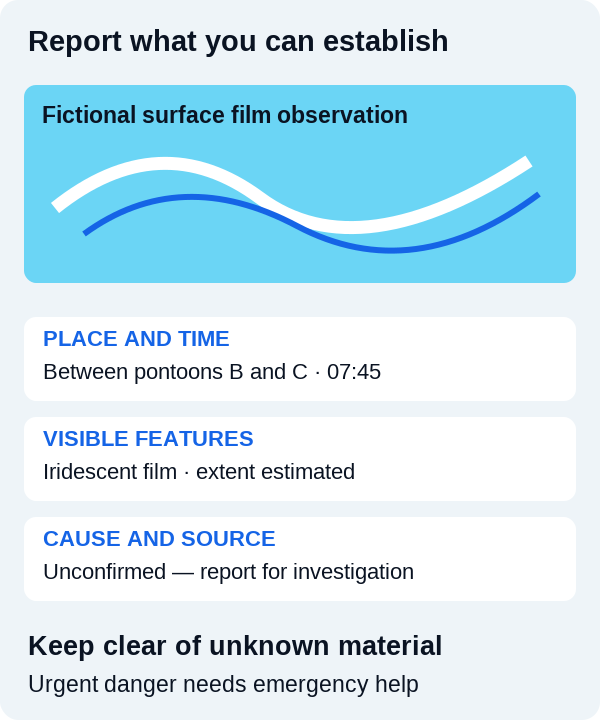
Figure 1. A fictional unusual-event report puts location, time, observed features and immediate exposure concerns ahead of a cause field marked unconfirmed. The diagram shows an evidence structure, not an actual event or an Atlas71 reporting function.
Atlas71 editorial illustration · Atlas71 original
Photographs can help without proving everything
From a safe place, take an overview that shows the relationship to landmarks and a closer view using zoom if useful. Include a scale reference already present in the scene, such as a known structure, rather than placing an object into the material. Keep the original images and avoid colour filters.
A photograph cannot identify most chemicals, measure their concentration or establish who released them. It may also miss extent beyond the visible frame. Captions should say what is pictured and when, not upgrade an uncertain observation to confirmed pollution.
If you record several photographs over time, keep their timestamps and locations distinct. Do not present different views of one event as independent incidents. If the material moves out of view, say that; it does not necessarily mean the event ended or the environment recovered.
Route the report to the right responder
Use the local environmental agency for suspected pollution, the site manager for immediate access information and the appropriate wildlife authority for animal incidents. In England, GOV.UK provides routes for water pollution and other environmental concerns, with different services in Scotland, Wales and Northern Ireland. [5]
In the United States, EPA encourages witnesses to report oil or hazardous-substance releases to the National Response Center, even when they are not responsible for the release. Use its current official reporting information and any applicable state or local route. An immediate danger still requires the local emergency service. [6]
Do not delay while trying to determine whether an operator's legal reporting threshold has been met. Your role as a witness is to report a concern accurately, not calculate an unknown spill volume or issue an enforcement verdict. Likewise, a social-media post may raise awareness but does not ensure the correct responder receives the details.
Example 1 A sheen beside moored boats
Fictional worked example. The harbour and observations are invented.
A walker sees an iridescent film between two pontoons at 07:45. A blue boat is closest, but no discharge is visible. The walker considers posting its name with an accusation of dumping fuel.
Instead, they remain on the public quay, photograph the area and report “oil-like surface sheen between pontoons B and C, source unknown”. They describe the approximate visible extent using the pontoon spacing and alert the harbour office through its official route.
This provides a starting point for investigation without identifying the liquid or assigning blame. If the film later disappears from the view, the walker updates that observation rather than announcing the spill has been cleaned. The harbour or environmental responder can assess what further action is necessary.
Example 2 Fish mortality after a storm
Fictional worked example. The estuary, quantities and weather are invented.
After a storm, a volunteer sees approximately 30 dead fish along the accessible side of a small inlet and several live fish near the surface. A group chat attributes the event to chemicals because a warehouse is visible across the water.
The volunteer reports the observed fish, approximate count, shoreline extent, recent storm and location. They keep the warehouse out of the causal description because they have not observed any connection. They do not enter the inlet, collect fish or try to aerate it with improvised equipment.
The authority may investigate oxygen, temperature, salinity, blooms, contamination or other factors. FWC's account of post-storm fish kills illustrates why several mechanisms can be involved. Until findings are available, the group's update says the event has been reported and the cause is unconfirmed. [7]
Preserve the follow-through
Save the report reference and provide significant new observations through the same route. Record any authority response separately from your own conclusions. An acknowledgement means the report was received; it does not confirm the suspected cause or promise a particular response time.
If official advice changes, share the current link and its geographical scope. Correct earlier public statements if later findings show they were wrong. Accurate follow-through protects both public understanding and the usefulness of the original evidence.
A quick unusual-event checklist
- Keep clear of unknown material, animals, containers and unsafe access
- Use emergency services first for immediate danger to people
- Record place, observation time, appearance, approximate extent and exposed people or animals
- Photograph only from a secure position and retain original files
- Report promptly to the responsible local service without guessing substance or source
- Do not sample, treat, disperse, remove or handle the material yourself
- Keep the reference and distinguish acknowledgement, investigation and confirmed findings
The most valuable report is often a concise, careful one. It gives responders a place and time to investigate while keeping you out of danger and leaving unsupported conclusions out of the record.
Source links reviewed on 2 October 2026. Both worked examples and Figure 1 are original educational illustrations, not actual incidents or findings.