Reporting possible algal blooms and reducing nutrient pollution
What can you usefully report when water suddenly turns green or develops a surface scum? Record the location, time and visible features from a safe place, then use the responsible authority's reporting route. A clear observation can help investigation without claiming that you have identified a species or toxin. Avoid contact and keep people and animals away from suspected bloom material. [1, 2]
This Protect guide focuses on useful evidence and prevention. The companion guide to harmful algal blooms addresses recreation decisions. Reporting and stewardship do not require you to collect suspicious water, diagnose its chemistry or attempt to clear a bloom yourself.
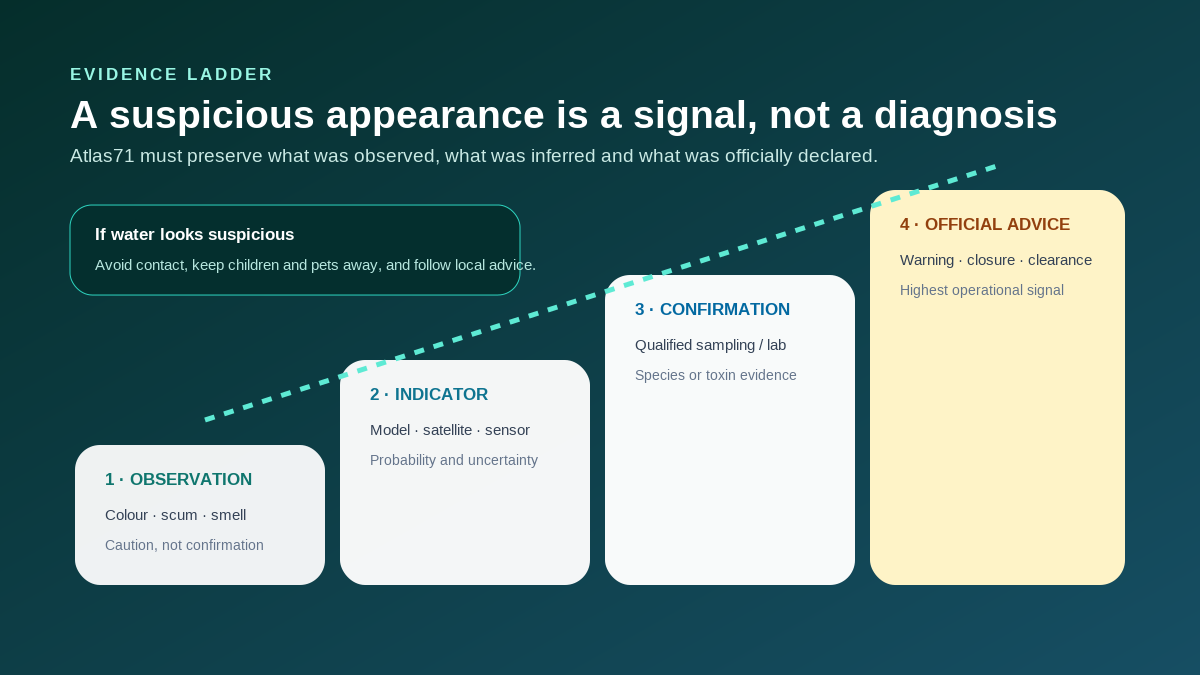
Colour, scum and smell can justify caution, but they cannot identify a toxin or species; official advice remains the highest operational signal.
Atlas71 editorial illustration · Atlas71 original · Evidence basis: CDC – Harmful Algal Blooms and Your Health ↗
What you will learn
- Appearance alone cannot confirm whether a bloom is toxic.
- Keep people and pets away from suspicious water and follow local advice.
- Atlas71 must label observations, models and official warnings separately.
Understand the problem before naming it
A bloom is an increase or accumulation of algae or cyanobacteria. Some blooms produce toxins, while dense growth can cause other ecological harm. Organisms and impacts vary by region and water type, so “green water” is not a complete diagnosis. [3]
Nutrients are part of the wider picture. Excess nitrogen and phosphorus from sources such as fertilisers and waste can enter waterways and contribute to conditions that support blooms. The presence of a bloom alone does not establish which landowner, outfall or activity supplied those nutrients. [4]
For a community report, separate three statements: what was observed, what an authority has confirmed and what remains possible. “A green surface layer covered the eastern inlet” is an observation. “The council confirmed cyanobacteria in a sample” is a sourced finding. “Runoff from this particular business caused it” requires further evidence that neither statement supplies.
Record enough to find the event again
Choose a location description that someone unfamiliar with the site can use: water-body name, nearest public access point, bank or shoreline section, and a map pin where available. Record the observation time and time zone. If you report later, keep the observation time distinct from the submission time.
Describe the extent without entering the water to measure it. A comparison with visible landmarks may be more honest than an exact area. Say whether material appears as streaks, isolated clumps, a continuous surface layer or a shoreline accumulation. Record any change you actually witnessed rather than inferring when it began.
EPA's bloomWatch guidance asks for location, surface conditions, apparent size and information about public access. It also describes photographs showing wider extent and closer appearance. Use zoom from a safe position when possible; none of those evidence goals justifies stepping into affected water or leaning over an unsafe bank. [1]
Preserve uncertainty in the record. If glare prevents you seeing the far shore, say so. If you cannot distinguish algae from floating plant material, use a neutral description. A qualified report gives investigators a more faithful starting point than a confident but unverified label.
Make photographs interpretable
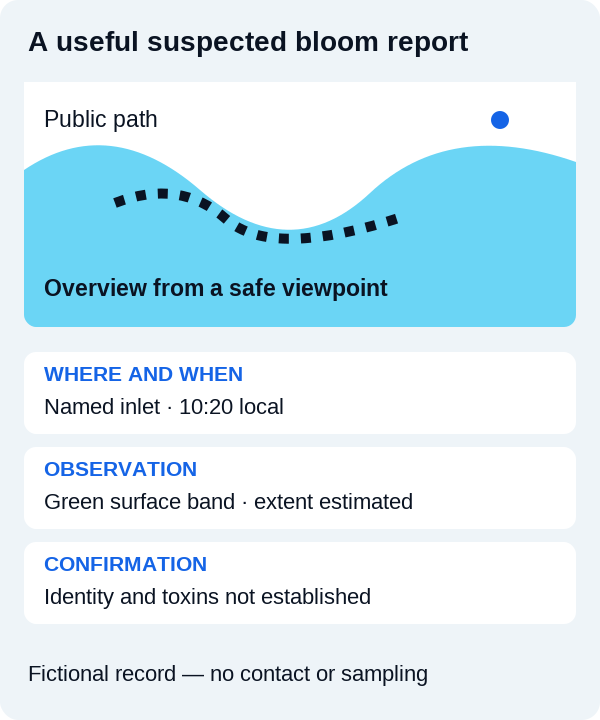
Take an overview first, if safe: include a recognisable shoreline feature and the affected patch. A second image can show the texture or pattern at a closer scale without moving into danger. Keep original files where possible and avoid filters that alter colour.
In a caption, identify the direction of view and which part of the image contains the observation. Do not draw an exact boundary around water that you could not see. If several people submit the same photograph, make clear it is one observation rather than several independent sightings.
A photograph cannot establish toxin concentration. EPA notes that cyanotoxins can occur before or after visible bloom conditions. That is why a visual report should be labelled suspected or observed, and confirmation should come from the appropriate investigation. [2]
Enlarge diagram
Scroll sideways to read all labels in the original illustration.
Figure 1. A fictional shoreline-report layout separates a location overview, an observation description and a confirmation field. It illustrates an evidence record, not an actual event or a diagnosis of the pictured material.
Atlas71 editorial illustration · Atlas71 original
Send the report where it can be acted on
Use the local environmental agency, public-health department, park manager or recognised bloom-reporting programme. Check that the route covers the actual water body and the type of event. A community map entry can supplement an official report, but do not assume it automatically reaches the responsible responder.
When someone is ill, medical or veterinary care takes priority over documentation. Reporting an environmental observation and reporting a possible illness are different tasks. CDC advises reporting suspected bloom-related illness to the health department, including illness in animals. Share only relevant details through the appropriate official route. [5]
Save the report reference and any reply. If the situation changes materially, provide a concise update tied to that reference rather than creating several apparently separate events. Quote later findings accurately and keep their sampling date and geographical scope attached.
Example 1 A volunteer sees a shoreline scum
Fictional worked example. The lake, people and distances are invented.
During a litter survey, a volunteer sees a green band beside a public slipway. From the path, it appears to extend between a bench and a jetty, roughly 30 metres apart. No current sign is visible from that position. The volunteer does not know whether the material is cyanobacteria.
They stop the survey near the water, keep the group away and take an overview from the path. The report says: “Green surface accumulation along the eastern bank between the bench and jetty, observed at 10:20 local time. Approximate extent judged from landmarks; identity unknown.” It includes the map pin and the original photograph.
The volunteer sends this to the park's stated environmental reporting route. They do not announce a confirmed toxic bloom in the group's public post. When an authority later issues advice, they share the official link and its time, keeping the earlier observation distinct from that confirmation.
Example 2 A smaller patch on the next visit
Fictional worked example. The observations and monitoring project are invented.
A community group photographs the same inlet on two consecutive weekends. The first image shows a broad surface band; the second shows only a small patch near reeds. A member proposes reporting a 90 percent reduction in toxicity.
The photographs do not measure toxicity. They may not even support a precise area change because light, viewing angle and the visible water surface differ. The group records the narrower claim: less surface material was visible from its usual viewpoint at the second observation time.
It retains both dates and checks whether the authority has changed its advice. No reopening claim is made from the photographs. For future visits, the group agrees to use the same safe viewpoint and record conditions consistently. Better comparability improves the observation record without turning it into a substitute for testing.
Prevention begins before material reaches the water
Household nutrient prevention is practical even when a specific bloom's cause is unresolved. EPA recommends applying fertiliser only when needed and at the recommended amount, avoiding application before rain, preventing overwatering and keeping fertiliser away from waterways. Collecting yard waste rather than letting it wash into drains also helps reduce avoidable inputs. [6]
Pet waste contributes nutrients and microorganisms when it is not properly disposed of. Pick it up and use the locally approved waste route. Septic systems also need appropriate maintenance; preventing wastewater escape is part of protecting receiving waters. These are source-control measures, not a promise to reverse an existing bloom immediately. [4, 5]
For a school, club or neighbourhood, choose a manageable action with a clear owner: review grounds-maintenance practice, improve waste disposal, or join a recognised catchment project. Record what was actually changed and when. Avoid claiming a measured reduction in bloom risk unless a suitable assessment supports it.
Do not improvise a bloom treatment
Pouring chemicals into a lake, raking scum or trying to flush an affected inlet is not an appropriate volunteer response. Control measures can have consequences for toxins and other organisms and require specialist assessment. FWC's account of Florida red-tide control illustrates why killing cells is not equivalent to removing their harmful effects. [7]
Report, follow restrictions and support authorised work. For long-term evidence, join a monitoring programme with training, a defined protocol and arrangements for safe sampling. Enthusiasm and a household test kit do not establish that a public swimming area can reopen.
A useful Protect checklist
- Stay away from suspicious material and prioritise people and animals over photographs
- Record exact place, observation time, visible features, approximate extent and uncertainty
- Use wide and closer photographs only from a secure position without contact
- Send the report through a verified local route and retain its reference
- Separate community observations, laboratory findings and official advice in every update
- Make practical nutrient-prevention changes and record actions without inventing ecological outcomes
- Leave sampling, treatment and reopening decisions to appropriately trained and authorised people
Good reporting makes uncertainty visible rather than hiding it. That gives investigators usable evidence and helps a community act without spreading an unsupported diagnosis.
Source links reviewed on 2 October 2026. Both worked examples and Figure 1 are original educational illustrations, not records of actual events.