Bathing water quality and what the evidence means
Does an excellent rating settle today's swim? No. It summarises past performance. Check current official advice for the exact site and note when samples were collected. Clear water can still contain contamination. [1]
This guide explains the different pieces of evidence you might find on a bathing-water page. It is about recreational water quality, not drinking-water safety or a complete assessment of swimming conditions. A favourable water-quality result cannot remove the risks from waves, currents, cold water or difficult access.
Three different kinds of information
Why indicator bacteria are used
A clear-looking beach can still have a problem
Three article-specific ideas from this guide. They explain the topic; they do not represent measured local conditions.
Atlas71 editorial illustration · Atlas71 original · Evidence basis: WHO – Guidelines on recreational water quality ↗
What you will learn
- A laboratory sample describes conditions at a specific place and time.
- Indicator bacteria help assess faecal contamination; they do not identify every possible hazard.
- Microbiological contamination cannot be judged reliably by water colour or clarity alone.
Four kinds of information answer four questions
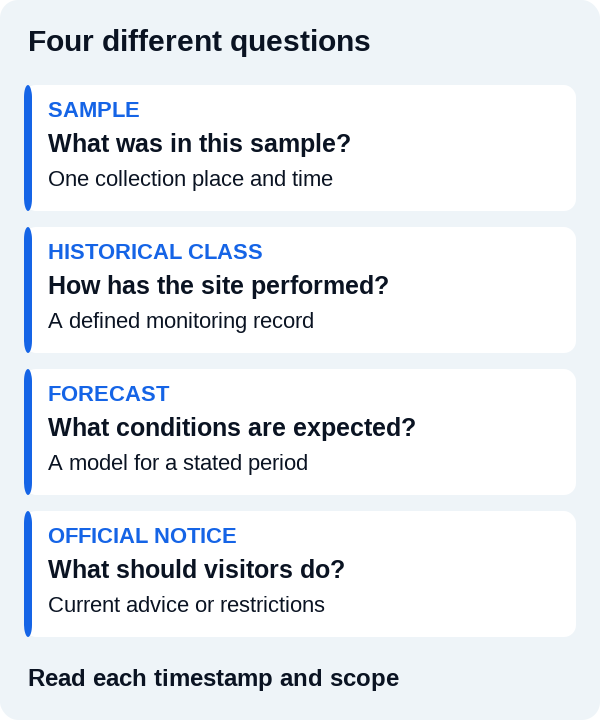
A sample result describes material collected at a particular place and time. A long-term classification summarises a defined monitoring record. A forecast estimates conditions using a model and its inputs. An advisory or closure tells you what the responsible authority wants people to do. These can appear together without being interchangeable. [1, 3]
Start with the action currently required. If the beach is closed, an older favourable sample is not permission to enter. If an advisory advises against bathing, use that advice rather than averaging it mentally with a reassuring photograph. Check the geographical area, the activities covered, the issue time and whether the notice remains in force.
Next, ask what supports the message. Was a sample collected after an incident, or before it? Is the forecast valid this afternoon, or was it issued yesterday for yesterday? A website refresh time is not necessarily a sample time. Keeping those clocks separate prevents apparently recent information from becoming more reassuring than it should be.
What bacteria tests actually measure
Recreational monitoring often tests indicator organisms associated with faecal contamination rather than trying to count every pathogen. The Environment Agency in England, for example, tests E. coli and intestinal enterococci. Potential sources include people, livestock, pets and wildlife. An indicator result does not, on its own, identify which source contributed the contamination. [1]
Different programmes use different organisms, methods, units and decision rules. EPA recommendations include bacterial indicators for recreational waters, and state and Tribal authorities use the recommendations when developing their own standards. A value cannot be interpreted responsibly without the method and the applicable local rules. [3]
Read the organism name and the units beside the number. Keep the sampling date, site identifier and any qualification attached. If a report uses a less-than or greater-than sign, preserve it: the laboratory has not reported an exact count at that boundary. Do not replace a qualified result with zero, or compare numbers stripped of their units.
A routine bacterial result is also not a test for every possible hazard. Cyanotoxin guidance and testing are separate from the bacterial criteria described by EPA. An incident involving chemicals, an algal bloom or an unusual animal mortality event may require a different investigation. Ask which question a test was designed to answer before treating a favourable result as an all-clear. [3]
Why the sampling clock matters
A sample is a snapshot, while the sea, river or lake keeps changing. Rainfall, discharges and water movement can alter conditions between collection and publication. WHO therefore recommends a wider management approach that includes risk assessment, monitoring, controls and timely public information, rather than relying on one isolated measurement. [4]
For a beach visit, make a short timeline: last collection, subsequent rain or incident, current official notice, planned visit. You do not need to calculate bacterial growth or transport to see a gap in the evidence. A sample collected before an overnight storm cannot demonstrate what the storm left behind.
An unpublished result is unknown, not favourable. Equally, a gap in monitoring is not evidence that contamination is present. It means the available information is insufficient for that particular claim. If conditions are concerning and current advice cannot be established, choose another activity rather than trying to fill the gap with the water's appearance.
Enlarge diagram
Scroll sideways to read all labels in the original illustration.
Figure 1. Four evidence types for one bathing place. The sample, historical record, forecast and official instruction describe different things. The layout is an interpretation aid, not a live beach status or a sequence that automatically leads to permission to swim.
Atlas71 editorial illustration · Atlas71 original
How to use a long-term classification
In England, annual classifications use four years of sample data and the categories Excellent, Good, Sufficient and Poor. This is useful for understanding a site's longer-term performance. It does not make each day within a class identical, and designation itself does not guarantee clean swimming water. Other jurisdictions use their own approaches and terminology. [1]
For planning a holiday, historical performance may help you compare sites and understand recurring problems. For deciding whether to enter this afternoon, add today's warnings and recent events. Those are complementary uses of information, not competing verdicts.
Do not translate a foreign rating into your home country's category simply because its colour looks familiar. Open the explanation. Check whether the grade combines bacterial results with an assessment of pollution sources, whether monitoring is seasonal, and which part of the shoreline the named station represents. The official page should be the starting point for these questions.
Example 1 An excellent rating after a wet night
Fictional worked example. The beach, dates, times and notices are invented.
A family plans a Saturday swim at North Cove. Its annual rating is Excellent. The latest laboratory result was collected on Tuesday morning, and rain fell heavily on Friday evening. At 09:00 Saturday, the local authority publishes advice against bathing because of likely temporary pollution.
The family has three pieces of information, not three votes. The annual rating describes history; Tuesday's sample predates the storm; Saturday's notice directly addresses the current visit. They make it a land-based outing and check the authority's later updates before planning another swim.
At noon, the water looks blue and a few people are swimming. Neither observation supersedes the notice. The family also avoids treating a forecast sunshine symbol as evidence about bacteria. The practical skill here is placing each source on the right timeline, then following the instruction relevant to now.
Example 2 Two apparently different results
Fictional worked example. All site details and readings are invented; these are not health thresholds.
A visitor compares a result of 25 for East Beach with 40 for River Steps. The first page gives a bacterial culture result for one organism collected yesterday. The second gives a different measure from a different programme collected last week. The visitor initially assumes 25 must indicate the better swimming choice.
That comparison is not yet meaningful. They check each page's organism, method, units, sampling location and interpretation. They also discover that River Steps is currently closed after an incident. No calculation involving 25 and 40 can cancel that closure.
For East Beach, they still need current notices, recent rainfall information and ordinary water-safety advice. The exercise does not identify a safe winner. It shows why a ranking made from bare numbers can create confidence without a valid comparison.
Personal precautions remain relevant
Natural recreational waters can transmit germs through swallowing water or exposure of open wounds. CDC advises checking monitoring and closures, avoiding water that is unusually cloudy, discoloured or foul-smelling, and staying away from draining pipes. People whose immunity is affected by illness or medicines should seek individual advice from a healthcare professional before swimming. [2]
Do not swim with diarrhoea or swallow water. Wash hands before eating after touching water or beach sand. These precautions reduce avoidable exposure; they do not make a closed site suitable. [2]
If you become unwell after swimming, seek medical advice and mention where and when you entered the water. A symptom alone does not prove which exposure caused it. Keeping the location and timing is more helpful than diagnosing the source yourself. [5]
Before deciding to enter
- Find the official page for the exact bathing place and read active advisories, closures and posted signs
- Separate the sampling time, publication time, forecast validity and period covered by any classification
- Check for rain or incidents after the last sample and look for current local advice
- Read organisms, methods, units and qualifications before comparing results
- Treat missing information as a gap, and unusual appearance as a reason to reassess
- Consider personal health, supervision, waves, currents, temperature and a safe exit as separate questions
- Recheck on arrival and change the plan if the conditions or instructions have changed
For England, GOV.UK links to the official bathing-water service and the corresponding services in the other UK nations. In other countries, start with the responsible environmental, public-health or beach-management authority. Information should help you make a better decision; no single number can guarantee an illness-free swim. [6]
Source links reviewed on 2 October 2026. Both worked examples and Figure 1 are original educational illustrations, not current site information.