How to report wildlife responsibly
What should you do when an animal appears injured, entangled or stranded? Keep your distance, contact the appropriate local wildlife response service and give clear observations. A prompt, findable report is usually more useful than getting close for a dramatic photograph. Do not touch, feed, move, refloat or attempt to free the animal while waiting for qualified advice.
This guide covers reporting, not rescue or treatment. Procedures vary by species and country. If a person is in immediate danger, contact the local emergency service first. For wildlife, use the official local reporting route rather than assuming a public social-media post will reach a responder.
Observe first, intervene only when authorised
Record evidence that responders can use
Species confidence matters
Three article-specific ideas from this guide. They explain the topic; they do not represent measured local conditions.
Atlas71 editorial illustration · Atlas71 original · Evidence basis: NOAA Fisheries – Marine Life in Distress ↗
What you will learn
- Keep a safe distance from injured, entangled, stranded or dead wildlife.
- Useful details include date and time, location, approximate number and size, behaviour, visible injuries or entanglement, whether the animal is alive or dead, and clear photos taken without approaching.
- If you are unsure of the species, say so.
Decide what kind of report is needed
An apparently injured, entangled, stranded or dead marine mammal or sea turtle warrants prompt contact with the relevant response network. NOAA provides a regional reporting directory for the United States. Elsewhere, use the national conservation authority, marine wildlife rescue service or park manager responsible for the site. [1]
A healthy-looking wildlife sighting may belong in a monitoring or citizen-science programme instead. Nesting, resting, moulting and feeding are not automatically emergencies. In particular, a seal ashore can be resting normally; a seal pup alone is not by itself evidence of abandonment. British Divers Marine Life Rescue advises keeping back and contacting its team when there are concerns. [2]
Do not delay an urgent report while trying to identify the exact species. “A seal-like animal with a line around its neck” is enough to start a useful conversation. Describe uncertainty honestly and let the responder ask follow-up questions. It is better to give a cautious observation than a confident but incorrect diagnosis.
Make space before making images
Stop approaching and keep dogs and other people away. Follow posted restrictions and the distance specified by the local authority; legal and recommended approach distances differ by species and region. Use binoculars or zoom rather than walking closer. NOAA's viewing guidance emphasises avoiding disturbance and allowing animals to behave naturally. [3]
Choose a stable place from which to observe. Do not stand below an unstable cliff, cross incoming water, enter surf or stop a vehicle dangerously for a photograph. A wildlife concern does not remove ordinary coastal hazards. Your location may also be unsuitable for waiting if the tide is rising.
Watch for whether your presence changes the animal's behaviour. If it becomes alert, moves away or interrupts what it was doing, increase distance. Do not surround it or block its route to the sea. A quiet crowd can still be a crowd, and the first visitor's restraint does not make later arrivals harmless.
Report observations rather than conclusions
Start with what you saw: an animal lying on its side, a visible line, repeated attempts to move, a wound or several birds showing no visible movement. Avoid assigning a cause unless you directly witnessed it and can describe that event. “Near a fishing buoy” does not prove entanglement; “near a boat” does not prove a strike.
If you cannot tell whether an animal is alive, say so. Do not prod it, turn it over or approach its head to check. What appears dead or unresponsive may be difficult to assess from shore, and a dead animal can still present hazards and carry valuable evidence for specialists.
For stranded whales, dolphins and porpoises, NOAA specifically advises against pushing them back into the water. They may be ill or injured, and moving them can worsen harm and prevent proper assessment. [4] Follow the responder's directions instead of repeating advice intended for another species or location.
Give a location someone can actually find
A useful report contains the following information, gathered without approaching the animal:
- Location: beach, harbour or coastal feature, nearest access point and a map pin or coordinates where available.
- Time: when you observed it, including the date and local time zone if relevant. Distinguish that from when you are sending the report.
- Animal: apparent type, approximate size, number present and any uncertainty about identification.
- Condition and behaviour: visible injury, gear, position, movement, breathing if observable, and whether it is on land or in water.
- Context: sea state, tide-related access, people or pets nearby and any immediate hazard.
- Contact: a way for responders to reach you and whether you can safely remain available.
Check that a phone's pin marks the animal's location rather than a distant car park or your current position after leaving. If you only know an approximate location, identify that uncertainty. A clear landmark description can be better than coordinates copied incorrectly with unwarranted precision.
Enlarge diagram
Scroll sideways to read all labels in the original illustration.
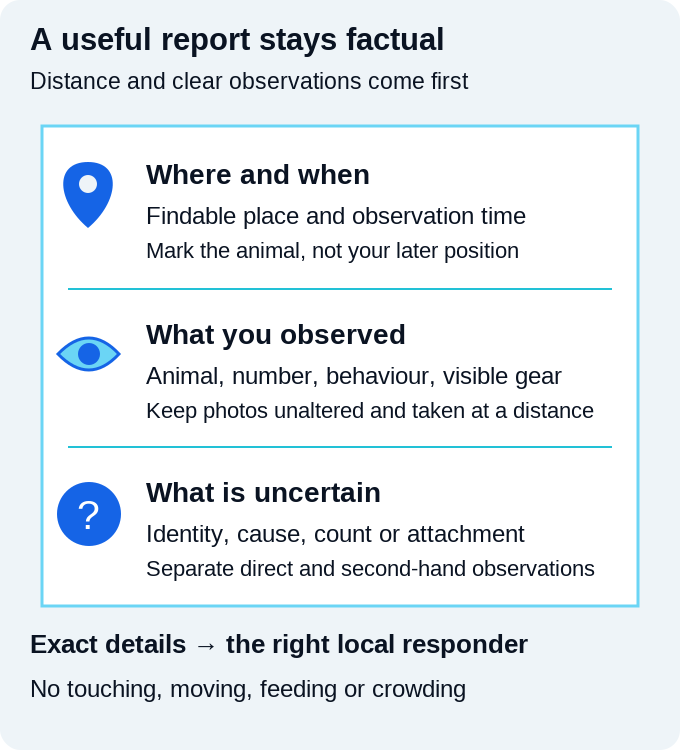
Figure 1. An original report layout separates where and when, what was observed, and what is uncertain. Exact locations go to the appropriate responder; public sharing should avoid drawing crowds or exposing sensitive wildlife. It is a communication aid, not a rescue protocol.
Atlas71 editorial illustration · Atlas71 original
Photographs can help without becoming the priority
If safe, take a wider image showing the setting and one or more zoomed images showing the animal and visible problem. Retain the original files and observation time. Tell the responder if a photograph is older, cropped or taken by someone else. Do not edit an image in ways that alter the apparent wound, gear or surroundings.
You do not need to stage a scale reference next to the animal. An approximate size with uncertainty is preferable to placing a bag or ruler beside it. Do not use flash, noise, bait or handling to make an animal turn towards the camera. Nor should a drone be used to obtain an angle without the necessary permission and knowledge of wildlife restrictions.
For an urgent incident, call first and follow instructions about sending images. A large upload or an attempt to obtain a better shot should not delay the alert. NOAA's distress guidance recommends photographs from a safe distance, alongside keeping clear and contacting the proper network. [5]
Dead animals and clusters need care too
Dead wildlife can contribute important information about disease, injuries and environmental change. Reporting does not mean that every carcass will be collected. In Great Britain, the official dead-wild-bird reporting service asks for location, type and count, warns people not to touch dead birds and explains that collection is selective. Northern Ireland has a separate route linked from that guidance. [6]
A cluster of affected animals does not prove poisoning, pollution or an infectious outbreak. Describe the number seen, the area checked and the observation time. Avoid collecting samples, handling carcasses or moving animals into a pile. Contact the relevant wildlife or environmental authority, which can decide whether investigation is appropriate.
Respect any cordon or temporary closure. If you accidentally contact an animal or contaminated material, follow current official hygiene and health advice and seek appropriate medical guidance if needed. Do not treat a reporting article as personal medical advice.
Example 1 A lone seal on a busy beach
Illustrative only. The beach, animal and observations are fictional.
A visitor sees a seal lying above the waterline. It occasionally raises its head, and no injury or entangling material is visible from the path. A family assumes it needs help reaching the sea and begins moving towards it with a towel.
The visitor asks the family to stay back, keeps their own dog away and contacts the local marine wildlife service because the crowded setting is a concern. The report describes a lone seal ashore, occasional head movement and no visible injury, rather than declaring it abandoned or stranded.
Responders explain the appropriate distance and whether further assessment is needed. Nobody pushes the animal into the water or offers food. The useful intervention is reducing disturbance and obtaining expert advice, even if the final assessment is that the seal is resting normally.
Example 2 Several birds and an uncertain count
Illustrative only. The birds, stretch of shore and times are fictional.
During a walk, someone sees three birds with no visible movement within roughly 100 m of shoreline. They take photographs from the path but do not approach to confirm death or identify each species. Later, another walker says there are five farther along.
The first observer reports the three animals they personally saw, gives the time and covered area, and labels the additional five as an unverified second-hand report. They do not add the figures into a confirmed total of eight because the sightings might overlap.
They use the appropriate official reporting service and keep pets away. Their public message, if any, avoids claiming a disease outbreak and does not direct people to gather at the site. Clear source separation makes the report more useful than a larger, less reliable number.
Before you send
- Is this an urgent wildlife concern, a human emergency or a routine observation?
- Have you chosen the correct official service for the country, region and animal?
- Can the recipient find the location and understand when the observation occurred?
- Have you separated what you saw, what someone else reported and what remains uncertain?
- Were photographs taken without touching, crowding or putting anyone at risk?
- Have you avoided a public call for untrained rescue or unnecessary disclosure of a sensitive location?
Sources reviewed on 2 October 2026. Both worked examples and Figure 1 are original educational illustrations, not reports of real wildlife incidents.