How plastic and marine debris affect wildlife
How does a discarded object harm an animal? The main routes are ingestion, entanglement and damage to the places where animals live. Which route matters depends on the object, species and circumstances. Removing litter can reduce opportunities for harm, but a bag of collected plastic does not tell us how many animals would otherwise have died.
Understanding those distinctions makes beach action more useful and its reporting more honest. This guide explains the mechanisms, what research can establish and how to help without disturbing wildlife or taking on hazardous removal work.
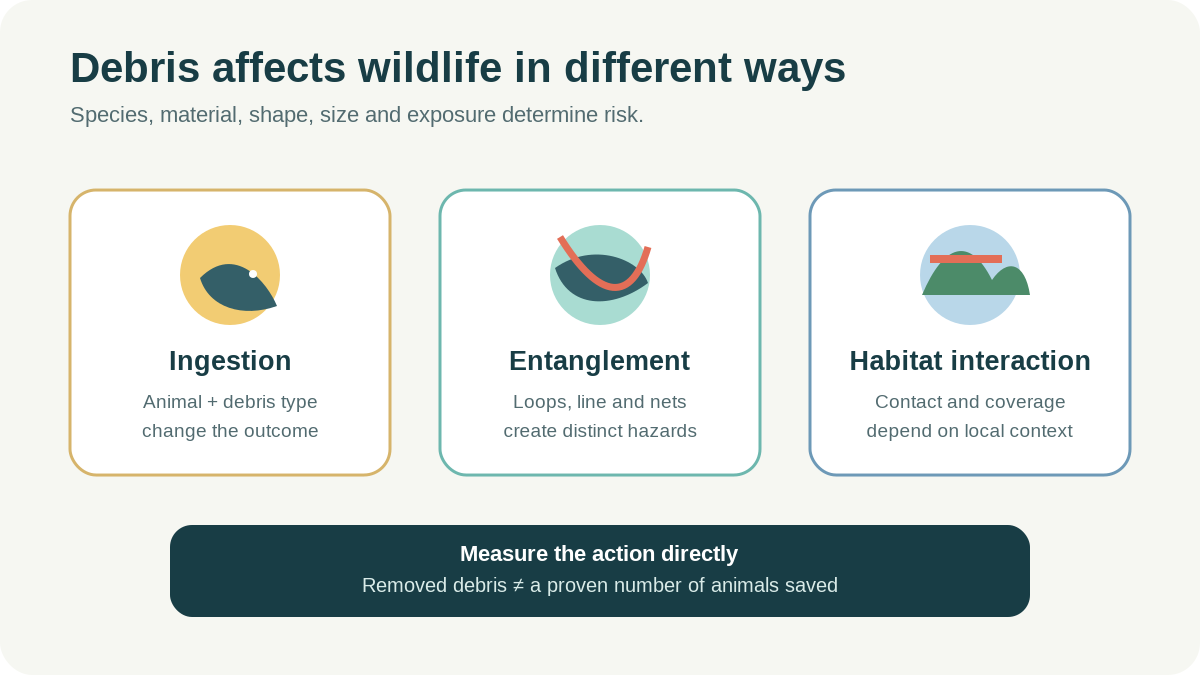
Wildlife risk depends on the animal, debris type and exposure pathway; a removed item is not proof of a specific avoided outcome.
Atlas71 editorial illustration · Atlas71 original · Evidence basis: Murphy et al. 2025 – PNAS macroplastic ingestion mortality risk ↗
What you will learn
- Ingestion, entanglement and habitat effects are different pathways.
- Risk varies by species, life stage, material and debris geometry.
- Report measured cleanup action separately from estimated ecological benefit.
Marine debris is broader than plastic
Marine debris includes persistent manufactured or processed solid material that ends up in marine and coastal environments. Plastic is important, but discarded metal, glass and other materials can also cause harm. Debris can arrive from land, vessels, fishing activity or major events, then move far from its origin. Finding an object beside a particular beach does not establish who lost it. [1]
Shape and use matter alongside material. A length of fishing line presents a different hazard from a smooth bottle, a flexible bag or a heavy trap. Counting all four as “one item” may be appropriate for a particular survey, but it does not mean they have the same effect on wildlife.
Size matters too. NOAA generally describes microplastics as plastic pieces smaller than 5 mm. They can come from larger items breaking into fragments as well as from small manufactured particles. Fragmentation is not the same as the material disappearing. [2] A beach that looks free of large litter therefore cannot be assumed to contain no plastic.
Ingestion means an animal takes debris inside
Animals may encounter plastic while feeding and swallow it intentionally, accidentally or with food. Larger pieces can obstruct or injure the digestive tract; other effects can involve feeding and nutrition. The presence of plastic in an animal does not by itself establish that it caused the animal's death. Investigators need evidence about the injury, the animal and other possible causes. [3, 4]
A 2025 study by Murphy and colleagues combined necropsy information for more than 10,000 seabirds, marine mammals and sea turtles to model acute mortality associated with ingested macroplastic. It distinguished plastic types and animal groups rather than treating every piece as equivalent. Its models concern material in the gastrointestinal tract, not debris counted on a beach. [4]
That distinction limits what a headline threshold can mean. A modelled probability for a specified animal group and ingested material is not a universal lethal dose for every animal. It is also not an instruction to divide a cleanup count by a number of pieces and announce “animals saved”. The study focuses on acute physical ingestion effects; it does not measure every entanglement, chronic effect or population consequence. [4]
Entanglement acts from the outside
Loops, straps, line and nets can catch around an animal. They may restrict swimming or feeding, cut into tissues or prevent an animal that breathes air from reaching the surface. Lost fishing gear can continue catching animals after it is no longer controlled by a fisher, a process called ghost fishing. [5]
An animal may still be moving when seriously entangled. A photograph cannot reliably show how deeply a line is embedded, whether it extends underwater or whether another animal or weight is attached. Pulling on visible material can tighten it or transfer force to the animal and the would-be rescuer.
Report an entangled animal to the appropriate wildlife response authority. Keep people and pets back and provide observations from a safe distance. Do not attempt to catch, restrain or cut free an animal unless the authorised responders specifically direct you and the action is within their guidance. Marine wildlife response belongs with trained teams. [6]
Enlarge diagram
Scroll sideways to read all labels in the original illustration.
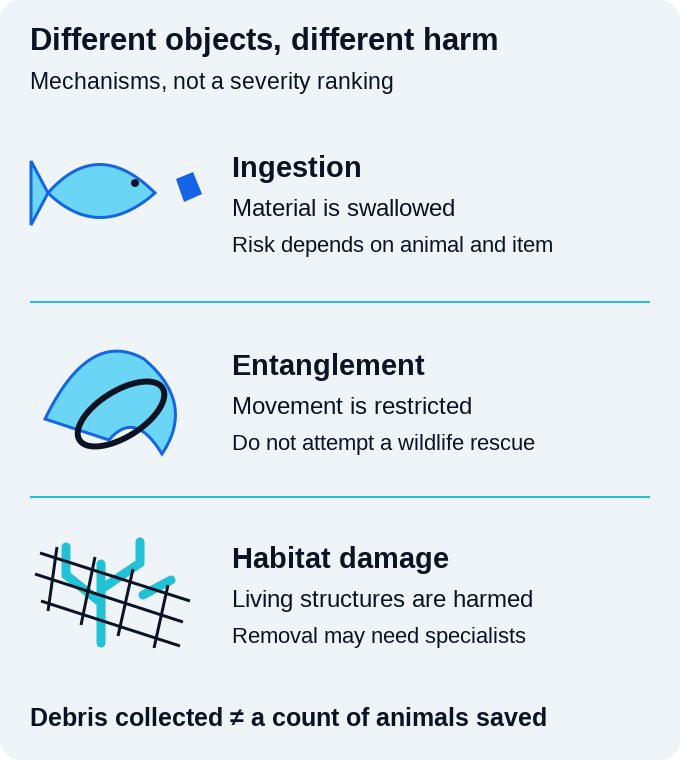
Figure 1. Three distinct pathways from debris to harm: an item is swallowed, an animal becomes caught, or debris damages habitat. The diagram shows mechanisms, not the frequency or relative severity of each pathway. One object can contribute to more than one pathway.
Atlas71 editorial illustration · Atlas71 original
Habitat damage can affect more than one animal
Debris can scour, break or cover living habitats. A net dragged across coral and a large object resting on a sensitive bottom can have consequences beyond the first animal that encounters them. NOAA identifies damage to habitats, including coral reefs, among the impacts of marine debris. [1]
The sensible removal method depends on what is attached and what lies underneath. Lifting a visible corner may drag a larger buried section or tear living growth. Material in the water, under tension or entangled in habitat can therefore require a trained, permitted recovery team rather than an enthusiastic tug from shore.
Avoid assuming that all material on a strandline is rubbish. Seaweed, driftwood and other natural material can be part of the coastal habitat. Follow the land manager's cleanup instructions, stay outside nesting or restoration areas and do not strip a beach to make a cleaner-looking photograph.
Record what you actually removed
Useful cleanup information includes date, location, area or length covered, time spent, number of participants, item categories and the measurement method. Separate counted items from measured mass. If a bag was weighed wet, say so; do not present it as dry plastic mass. If volunteers estimated rather than counted, label the estimate.
A structured survey is different from a casual cleanup. NOAA's Marine Debris Monitoring and Assessment Project uses consistent field methods so results can be compared across places and times. Opportunistic records can still reveal useful patterns, but changes in effort, coverage or method can change the apparent result. [7]
Risk calculators and educational tools require similar care. Read what the tool models, the categories it accepts and the assumptions behind its output. Ocean Conservancy's Wildlife Impact Calculator is an external educational resource; a calculated result is not direct observation of an animal's fate. [8] Keep the original cleanup data alongside any interpretation so someone else can understand how the conclusion was reached.
Example 1 More items does not mean more mass
Illustrative only. The teams, beach and figures are fictional.
A volunteer group collects 120 plastic bottle caps weighing 0.24 kg and one tangled net weighing 8 kg. By item count, caps dominate: 120 of 121 recorded objects. By measured mass, the net dominates: 8 of 8.24 kg. Both descriptions can be correct if the categories and weighing method are clear.
Neither result establishes which material posed the greatest total wildlife risk at that site. The net's geometry, whether it was still fishing, the species nearby and the likelihood that caps would be ingested are different questions. The group reports the counts and masses separately and describes the net's recovery by the authorised team.
They avoid turning either count into a death estimate. The credible achievement is material removed from a documented location, with a clear record and an appropriate method. That remains valuable without an invented animal-saving total.
Example 2 A cleanup total falls for the wrong reason
Illustrative only. The survey history and numbers are fictional.
In September, eight volunteers cover 800 m of beach for two hours and collect 240 objects. In October, four volunteers cover 300 m for one hour and collect 90. A social post proposes saying that local litter has fallen by 62.5 percent, because 90 is that much lower than 240.
The arithmetic correctly compares the totals, but the interpretation fails. The second event covered less shore with less effort, and the group has not controlled for tides, weather, previous cleanups or where it searched. The counts cannot isolate an environmental trend.
They instead report each event's scope and results, then join an established monitoring scheme if they want comparable evidence over time. They can still use the item categories to consider practical prevention, such as improving secure waste collection at an access point, without claiming that the underlying pollution rate has been measured.
Help without adding another risk
- Reduce avoidable disposable items, secure belongings and waste, and use the correct local disposal or recycling route.
- Join an organised cleanup where the land manager has approved the location and volunteers receive a safety briefing.
- Collect only ordinary litter that is safe and practical to handle, using suitable gloves and equipment under the organiser's guidance.
- Leave unknown containers, chemicals, sharp or suspicious items, heavy objects and material under tension for the appropriate authority. NOAA advises not touching unknown or potentially hazardous debris. [9]
- Keep natural habitat and wildlife undisturbed. Report injured or entangled animals rather than making an improvised rescue.
- Describe the result with honest units and limits: items counted, mass measured, area covered and hazards reported.
Prevention and removal address different stages of the problem. Cleanup can remove existing hazards; better handling of materials can stop more entering the water. Neither needs an exaggerated claim to be worthwhile. The strongest account is clear about what was done, what was measured and what remains uncertain.
Sources reviewed on 2 October 2026. Both worked examples and Figure 1 are original educational illustrations. Cleanup quantities do not represent observed wildlife outcomes.