How to describe environmental impact without inventing a number
A cleanup removes material from a place. A restoration project may improve habitat. How much can you responsibly claim from the evidence you have? Begin with what was directly recorded, then separate calculations, observed outcomes and estimated benefits. A credible account can be specific without pretending to know an unobserved result.
The practical question is “what does this number actually measure?” Items collected, kilograms removed and volunteer hours describe an action. Animals saved, pollution avoided and ecosystem recovery describe further outcomes that need additional evidence or a defensible model. Do not let a dramatic label erase that difference.
Start with direct measurements
Derived impact needs a method
Avoid the seductive but unsupported number
Three article-specific ideas from this guide. They explain the topic; they do not represent measured local conditions.
Atlas71 editorial illustration · Atlas71 original · Evidence basis: Murphy et al. 2025 – PNAS macroplastic ingestion mortality risk ↗
What you will learn
- Examples include 31 items removed, 2.8 kg collected, 12 m of fishing line removed, 40 minutes spent, two participants and an approximate cleaned area.
- A model may later estimate potential wildlife-risk reduction or compare litter types, but a derived metric must carry method, model version, evidence scope and uncertainty.
- A statement such as “8 animals saved” sounds precise even when the actual counterfactual cannot be observed.
Start with the measured action
Record the action as clearly as possible: date, place, completed area, duration, participants, material categories and measurements. Preserve the method, units and any uncertainty. If an object was observed but left for trained removal, keep it separate from the collected total.
Counts and weights should remain distinct. A bag of small plastic fragments and one heavy metal object may have the same mass but different counts, materials and potential effects. NOAA's shoreline monitoring protocol illustrates the importance of defined item categories and documented survey methods. [1]
Do not add unrelated quantities to create an impressive score. Five kilograms and fifty items are two descriptions, not fifty-five units of impact. A conversion may be possible for a specific purpose, but the assumptions and validation would need to be stated. Keeping the original measurements makes those assumptions visible.
Separate output from outcome
An output is something the activity produced: material removed, a barrier dismantled under an approved project, people trained or a monitoring record completed. An outcome concerns what changed as a result, such as improved habitat function or reduced litter accumulation over time.
NOAA's restoration framework distinguishes implementation monitoring from effectiveness monitoring. One asks whether the project was carried out as intended; the other examines whether it functions as intended. Successful completion is important evidence, but it does not by itself answer every longer-term ecological question. [2]
A photograph of an empty collection area can support a limited statement about its visible condition after the cleanup. It cannot show that all material is gone from the surrounding water, that wildlife exposure has ceased or that no new litter will arrive. State the boundary of the observation alongside the result.
Understand the missing alternative
Impact often asks what would have happened without the action. That alternative is not directly observed at the same place and time. A bottle removed today might otherwise have remained, been removed by someone else, moved inland or entered the sea. The uncertainty matters when making a claim about avoided future harm.
A well-designed comparison can help. A project may use baseline measurements, repeated follow-up and appropriate reference locations, with specialist advice about whether the comparison is valid. Weather, season, other interventions and changes in sampling can still complicate interpretation. Planning the evaluation before the activity is stronger than selecting a favourable result afterwards. NOAA restoration monitoring guidance connects project objectives with defined parameters and follow-up measurements. [3]
For a small volunteer action, the answer may simply be that ecological impact cannot be quantified. That does not erase the recorded work. It means the report should describe the action and plausible purpose without presenting an estimate as a measurement.
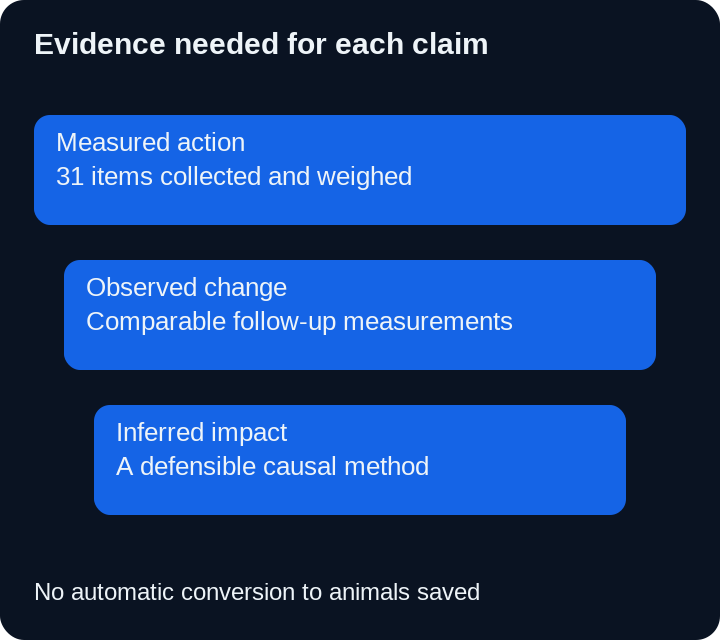
Enlarge diagram
Scroll sideways to read all labels in the original illustration.
Figure 1. An original evidence ladder separates measured action, observed change and inferred impact. Each step needs additional evidence. The steps do not imply that a count or weight automatically converts into animals saved, carbon avoided or ecosystem recovery.
Atlas71 editorial illustration · Atlas71 original
Use models only within their scope
A model combines information and assumptions to estimate something that is not directly measured. Its result should retain the method, version, applicable population or setting, inputs and uncertainty. “Estimated” should appear where the number is read, not only in a distant note.
Research can establish important relationships without supplying a conversion for every cleanup. For example, a 2025 study of macroplastic ingestion and mortality in marine wildlife analysed evidence about ingested plastic and death. That research does not mean a volunteer can equate each plastic item collected on a beach with one individual animal saved. Exposure, encounter, ingestion and outcome are separate parts of the question. [4]
Before reusing a coefficient, ask whether it applies to the same material, species, geography and exposure pathway. A relationship measured in one setting may not transfer to another. If the necessary input is absent, do not fill it with a convenient default and present the output as local fact.
Check aggregation and duplication
When combining contributions, ensure that the same action is counted once. Several participants may upload photographs of one collection, and a partner organisation may report the same event. Their participation can all be acknowledged without multiplying the material removed.
Keep periods consistent. A monthly total and a year-to-date total overlap; adding them double-counts part of the work. Distinguish cumulative totals from current conditions. A beach can have a large historical cleanup total and still contain new litter today.
Retain corrections and explain significant revisions. EPA's environmental-data guidance treats verification and validation as parts of a documented review process. A corrected total is more useful than a permanently inflated number protected for the sake of a previous announcement. [5]
Example 1 A useful cleanup claim
Illustrative only. All values and the event below are fictional.
Two volunteers collect 31 items weighing 2.8 kg during 40 minutes in a defined accessible shore section. Their record includes categories, a scale reading and photographs. They also report one hazardous object left untouched for the land manager.
A supported summary is: “31 items, measured at 2.8 kg, removed from the recorded section; one additional object reported for specialist handling.” If both volunteers worked for the full 40 minutes, the effort is 80 person-minutes, or one hour and twenty minutes. The event duration remains 40 minutes.
The record does not support “31 animals saved” or a quantified reduction in local disease risk. Those claims require evidence that the cleanup did not collect. The group can explain that removing debris is intended to reduce its availability to cause harm, while keeping the measured result as the headline.
Example 2 A lower count after an intervention
Illustrative only. The site, intervention and counts are fictional.
A community and land manager introduce a better waste-storage arrangement near a beach access. Using the same stated survey method, volunteers count 100 target items in one baseline visit and 60 in a later visit. The raw decrease is 40 items, or 40% of the baseline count.
That is an observed difference between two surveys. It does not yet prove a 40% reduction caused by the intervention. A storm, seasonal visitor change, another cleanup or ordinary variation could contribute. The project reports the two counts, dates and method, then continues the planned follow-up and comparison.
If repeated suitable evidence later supports an effect, the claim can become stronger. Until then, “a lower count was observed after the change” is more accurate than “the new arrangement cut pollution by 40%”. The distinction protects the credibility of the project while leaving room for genuine progress.
Choose metrics that help the next decision
Prefer a small set of measures connected to the project's purpose. A removal project may track material and completion of safe disposal. A prevention project may need repeated litter observations and evidence about the intended behaviour or infrastructure change. A habitat project requires ecological measures suited to that habitat and intervention. [2, 3]
Include limitations and unwanted effects. Did access restrictions reduce coverage? Did the action disturb habitat or shift waste elsewhere? Were some observations missing? A useful evaluation can identify a need to change the approach rather than merely celebrate a target.
Avoid making volunteer rewards depend only on mass or volume. That can make safe reporting, prevention and careful monitoring look less valuable than collecting a large object. The aim is effective, well-documented work, not a competition that encourages risky handling or inflated submissions.
Before publishing an impact number
- Name the quantity, unit, location, period and method
- Separate direct measurements from calculated totals and modelled estimates
- Distinguish completed action, observed outcome and causal impact
- Check duplicate contributions and overlapping reporting periods
- Show the assumptions and uncertainty of any model at the point of use
- Avoid wildlife, health, carbon or recovery conversions without suitable evidence
- Retain the original records and update the summary when a correction is verified
Sources reviewed on 2 October 2026. Both examples and Figure 1 are original educational illustrations. They do not describe measured outcomes from a real project.