Marine litter and plastic pollution
Why does litter on a street, boat or beach become a marine problem? Lost material can move through waterways, persist after it stops looking like the original object, and encounter wildlife far from where it escaped. The useful response combines preventing new losses, recognising how different debris causes harm, and arranging safe recovery. A tidy-looking beach is only one part of that picture.
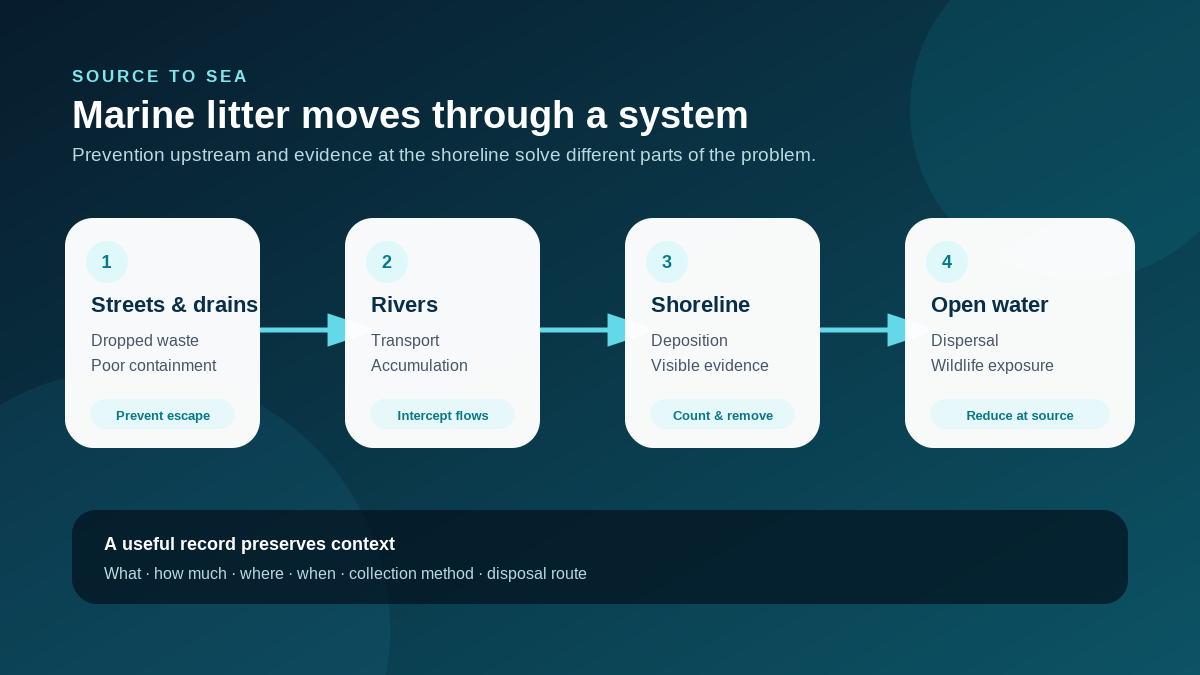
Marine litter is a source-to-sea system: prevention upstream and evidence at the shoreline both matter.
Atlas71 editorial illustration · Atlas71 original · Evidence basis: UNEP – From Pollution to Solution ↗
What you will learn
- Litter can enter the sea far from the beach where it is found.
- Material, count, location and time make cleanup records more useful.
- Prevention and removal solve different parts of the same system.
More than bottles on the sand
Marine litter, also called marine debris, includes manufactured or processed solid material that enters aquatic environments through deliberate disposal or accidental loss. Plastics are prominent, but the category also includes metal, glass, rubber, textiles and processed timber. Lost fishing gear, damaged vessels and construction materials can become debris alongside everyday packaging. Natural seaweed and unprocessed driftwood are different from manufactured waste. [1, 2]
Size changes what you can see and what encounters the material. A bottle is easy to recognise; fragments, fibres and industrial plastic pellets may be much less obvious. Microplastics are plastic particles smaller than 5 mm. Some are manufactured at that size, while others form when larger products break apart. Synthetic textiles can also shed small fibres. [3]
For a beach visitor, this means an absence of obvious objects cannot establish an absence of plastic. Nor should unfamiliar natural material be collected simply because it looks untidy. Check the land manager's instructions before disturbing a strandline or protected habitat.
Persistence and fragmentation are different
Plastic's durability makes it useful in products but troublesome after loss. Sunlight and physical wear can break an object into smaller pieces without removing the plastic from the environment. Small fragments are harder to recover than the intact object. NOAA cautions that plastics may never fully disappear, including products labelled biodegradable or compostable when they enter marine environments rather than the conditions intended for their disposal. [4]
Avoid a universal countdown such as “this bottle is gone after a fixed number of years”. A material's changing appearance is not a reliable measure of complete breakdown. The practical lesson is to prevent escape and recover accessible debris appropriately, rather than waiting for weathering to solve the problem.
Inputs from land and sea
Wind and runoff can carry poorly contained waste from inland streets and land into waterways. Coastal recreation creates opportunities for direct losses. Boats, fishing activity and offshore operations can release equipment or other objects at sea, while storms and disasters can introduce building materials and large debris. These are different pathways, so a prevention plan cannot assume all marine litter comes from beach visitors. [5]
The place where an object is found is not necessarily its source. A branded wrapper beside a business does not identify who discarded it. Report the observable concentration and possible route, while leaving attribution open unless stronger evidence establishes it.
Movement creates changing accumulation areas
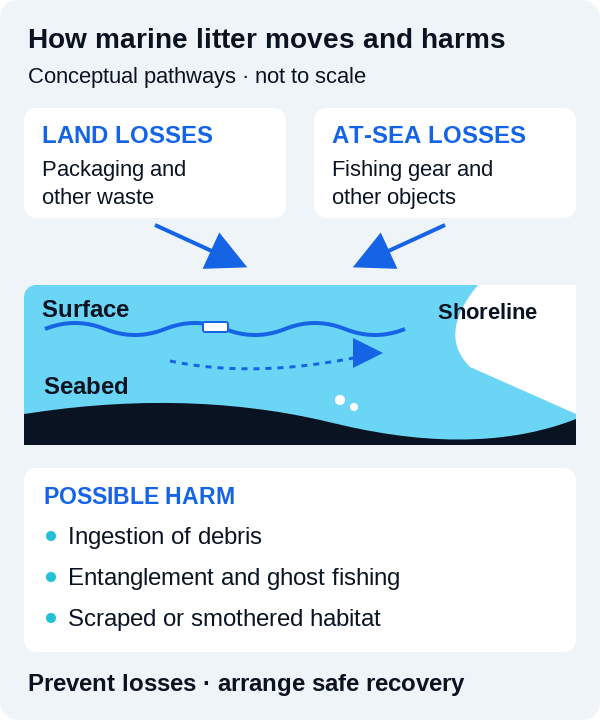
Currents, wind and waves move floating debris; other material occurs below the surface or on the seabed. Ocean circulation can concentrate debris over broad areas. NOAA explains that ocean garbage patches are dispersed accumulations, not solid islands that could simply be lifted out. Their boundaries and contents move, and much of the material is too small to notice from a boat. [6]
Near shore, tides and storms can repeatedly deliver and move debris through wetlands and other habitats. [7] A beach that looks clean today may receive more material later. A sheltered corner may accumulate debris without being the place where it first entered the water.
Enlarge diagram
Scroll sideways to read all labels in the original illustration.
Figure 1. A conceptual marine-litter pathway connects losses on land and at sea with changing surface, shoreline and seabed accumulations. Ingestion, entanglement and habitat damage are different possible effects. Arrows show potential movement, not a traced route, measured quantity or confirmed local impact.
Atlas71 editorial illustration · Atlas71 original
When animals swallow debris
Animals may mistake debris for food or ingest it accidentally while feeding. Potential consequences include internal injury, digestive blockage and reduced nutrition. Feeding behaviour, debris size and shape, and whether the material passes through or remains inside all matter; swallowing plastic does not produce one identical outcome in every animal. [8]
Plastic may also carry environmental contaminants or release additives. NOAA notes that chemical effects and impacts on wild populations still need further research. [8] It is reasonable to describe ingestion as a recognised harm pathway without claiming that a photograph reveals an animal's internal exposure or that every collected fragment prevented a particular death.
Entanglement and continued fishing
Line, netting, straps and loops can catch around wildlife, restricting movement or feeding and causing injury or death. Fishing gear lost from its owner's control can continue catching animals, often called ghost fishing. The problem includes traps and other gear as well as nets. [9]
The shape and position of debris therefore matter alongside its material. A light loop of line near animals can present a different concern from a heavier, compact object. Do not try to free entangled wildlife yourself. Keep back, report the location to the appropriate wildlife responder and follow their instructions. A litter-picking activity does not provide the training or authority needed for animal rescue.
Debris can damage the habitat itself
Marine debris can crush, scrape or smother living habitat. Nets and other objects can damage corals; trapped material can affect mangrove roots; heavy debris can shade or damage seagrass. Movement during storms may extend the area affected. These physical mechanisms matter even when no animal is visibly trapped in an object. [7]
Recovery also needs care. Pulling an embedded net across living habitat may worsen damage, and entering a sensitive area to retrieve litter can introduce new disturbance. Ask the site manager or specialist removal team to decide how an attached or partly buried object should be handled.
Example 1 A windblown cup at a riverside event
Fictional worked example. The event, observations and decisions are invented.
At a riverside market, organisers see a gust lift lightweight cups from an overflowing open bin. Some land on the path; one reaches the water and drifts out of safe reach. Volunteers initially suggest concentrating all effort on the downstream beach at the weekend.
The organisers instead deal with the loss they can directly observe. They secure the remaining waste, arrange prompt collection and place spare capacity where vendors need it. Nobody enters the river after the cup. Before the next event, they review the serving system and whether reusable items with a workable return arrangement can reduce loose packaging.
The example shows two intervention points: stopping escape before transport, and safely recovering accessible material. It does not establish where every cup found downstream originated. The team can report the observed bin failure and its correction without claiming to have traced an entire catchment's litter.
Example 2 A net over a shallow reef
Fictional worked example. The reef, debris and response are invented.
A snorkelling group notices part of a net moving against coral in a shallow bay. Nobody sees an animal caught in it. One visitor proposes pulling it free immediately because it appears to be only a small bundle.
The guide recognises that absence of visible entanglement does not remove the habitat concern. The net may extend beyond the visible section, and pulling it could drag across the reef or catch the person attempting removal. The group leaves it undisturbed and reports its location, observation time and visible condition to the site manager from a safe place.
A specialist team can assess access, wildlife and removal options. The group's useful decision is to connect the object with the right response, rather than treating every piece of litter as a hand-pickup task. Its record says “reported for assessment”, not “removed” or “reef restored”.
Prevention needs more than a different bin
EPA recommends reducing unnecessary waste, reusing and repairing items, and disposing of remaining waste through the correct local system. Keep bins closed and avoid leaving bags beside overflowing containers. Recycling instructions vary by municipality, so check what the receiving service actually accepts. [10]
For organisations, pair product choices with collection and containment. A reusable item still needs a practical return system; replacing one disposable material does not justify letting the replacement escape. At sea, maintaining control of equipment and using local lost-gear reporting arrangements address a different pathway from street litter.
Capture devices and cleanups have limits. A drain screen or floating barrier needs suitable design, servicing and a waste destination; EPA notes that performance depends on site conditions and maintenance. [3] A device aimed at floating objects is not a complete solution for all sizes and depths. Prevention reduces new inputs while appropriate removal addresses material already present.
A safe and useful response
Leave unknown, hazardous or very large debris alone and contact the responsible authority. Do not open chemical containers or move gas cylinders, wreckage or objects that could roll or trap someone. NOAA's handling guidance distinguishes ordinary safely recoverable litter from items requiring specialist attention. [11]
For an organised cleanup, follow access permissions, tide and weather planning, handling rules and agreed disposal arrangements. Keep out of surf and unstable or protected areas. Gloves do not make every item safe. Finish the collection arrangements so recovered waste cannot blow or wash back into the water.
A brief record of place, time and material can help identify recurring problems. Comparing trends needs consistent survey methods; collected mass alone does not establish ecological benefit. [2] The dedicated guides on why cleanup data matters and measurable impact cover that evidence in depth.
Before acting on marine litter
- Identify the material if possible without touching an unknown item
- Consider its position, shape and possible interaction with wildlife or habitat
- Keep source attribution separate from where the object was observed
- Reduce avoidable losses and contain remaining waste before it reaches water
- Report hazardous, embedded or wildlife-associated debris for the appropriate response
- Follow local removal and disposal rules, and describe only what was actually done
Understanding the pathway helps choose the action. Sometimes that is safe collection; sometimes it is fixing waste containment or alerting a specialist. The aim is to reduce new losses and existing harm without creating another problem during the response.
Source links reviewed on 2 October 2026. Both worked examples and Figure 1 are original educational illustrations, not observations of an actual incident or place.