Ghost gear: lost fishing nets, lines, traps and hooks
What should you do when you find fishing gear that appears lost? Keep yourself clear, document it from a safe position and report it through the appropriate local route. Gear can continue catching wildlife, but pulling, cutting or diving after it can create additional danger. First establish whether an animal or navigation hazard needs an urgent response.
Ghost gear is commonly used for abandoned, lost or otherwise discarded fishing gear, often abbreviated ALDFG. It includes nets, lines, pots, traps and associated equipment. “Ghost fishing” describes the continued catching of animals by gear that is no longer under a fisher's control. The problem concerns commercial and recreational gear. [1, 2]
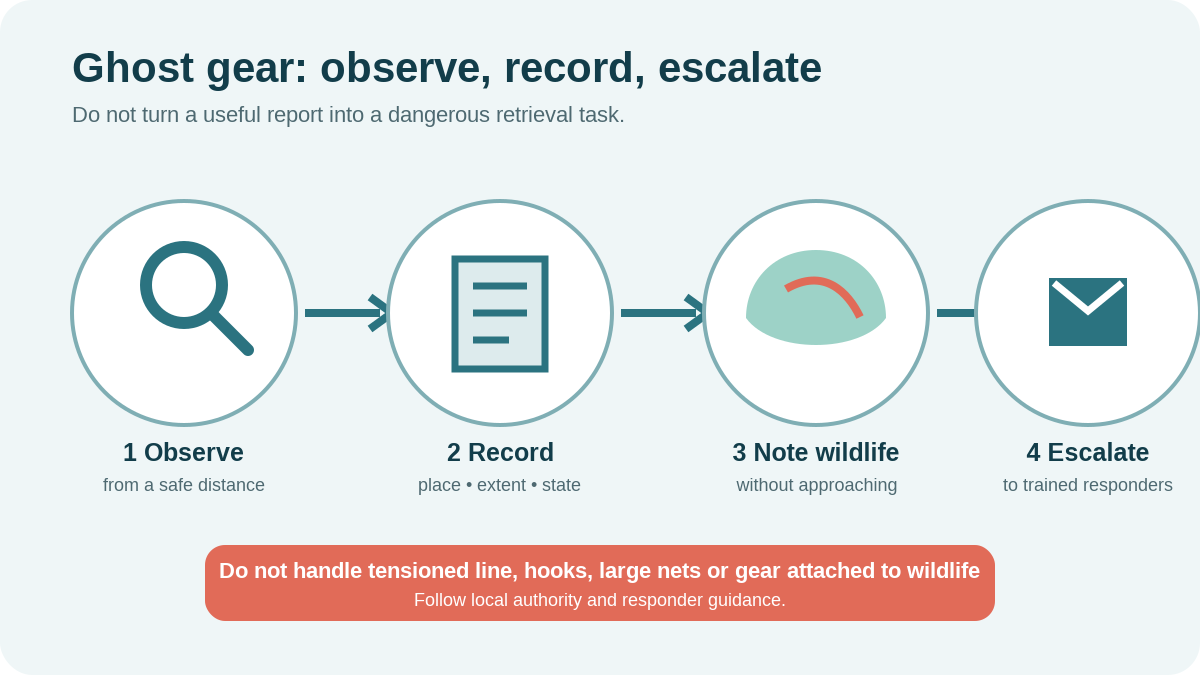
Large, submerged or tensioned gear can be hazardous; useful reporting does not require volunteer retrieval.
Atlas71 editorial illustration · Atlas71 original · Evidence basis: FAO – Abandoned, lost or otherwise discarded fishing gear ↗
What you will learn
- Lost nets, lines, traps and hooks can continue interacting with wildlife.
- Do not retrieve unstable, submerged or wildlife-entangled gear without training.
- Location, gear type, extent and photographs can support a safe response.
How fishing gear becomes lost
Gear may be damaged by weather, snag on the seabed or other equipment, lose its marker or become impossible to recover safely. Some is abandoned or discarded, but its appearance alone rarely establishes which process occurred. FAO identifies loss prevention, marking, reporting and recovery as connected parts of responsible gear management. [1, 3]
That matters when reporting an object. “A green line and a damaged float observed at this position” is evidence. “A local boat dumped this net” is an allegation requiring evidence you may not have. Markings can help an authority investigate ownership or origin, but they should not become a reason to approach a hazard or publicly accuse someone.
An unattended pot is not necessarily abandoned. Many kinds of fishing gear are meant to remain in the water between visits. Do not lift, cut or remove apparently active gear. Ask the relevant fisheries, harbour or land-management authority how suspected lost gear should be reported and who is permitted to recover it.
Why it can keep causing harm
A lost net may still entangle animals, while a trap can continue catching after the original bait is gone. The duration and scale vary with the gear, its condition and where it comes to rest. Some gear collapses or becomes buried; other pieces retain an effective catching shape. A photograph cannot establish how long any particular object will keep fishing. [2]
Gear can also damage habitats and create hazards for vessels. Nets and lines can snag coral or seagrass, and rope can catch around propellers or rudders. Material may move, tangle with more gear or fragment rather than remaining where it was first seen. NOAA describes these effects alongside the economic costs to fisheries. [2]
An animal can become entangled in active gear as well as lost gear. Therefore, a sighting of an entangled whale is not automatically proof of ghost gear. NOAA's large-whale response guidance explicitly covers active, lost and discarded material. Report what you can see and let responders assess the configuration and evidence. [4]
Why pulling on a loose end is risky
The visible part may be connected to something heavy, sharp or alive. A line that seems slack can tighten with a wave, moving vessel or animal. Hooks may be hidden in a tangle. Wet nets can be much heavier than expected, and a partly buried object may resist until it moves suddenly.
A shore visitor should not enter surf, climb an unstable edge or wade into an inlet to reach gear. A recreational diver should not turn an ordinary dive into an improvised recovery. Lifting, cutting and managing loaded lines underwater require specialist planning and competence. An apparently successful extraction can also damage the habitat beneath it.
These are reasons to report rather than a request to ignore the problem. A precise location and description can let the right team assess access, permits, equipment, tide and disposal before attempting recovery. NOAA's removal programme works through organised projects that combine appropriate methods with local partners. [5]
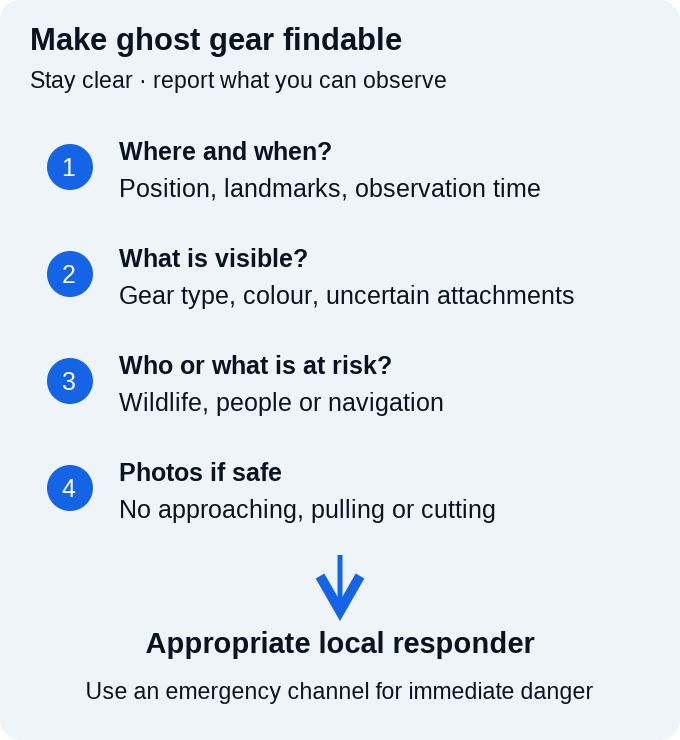
Enlarge diagram
Scroll sideways to read all labels in the original illustration.
Figure 1. A fictional lost-gear report separates location and time, visible gear, observed hazards and photographs. The connecting lines show information flowing to an appropriate responder, not instructions to touch or retrieve the gear.
Atlas71 editorial illustration · Atlas71 original
If an animal is entangled
Contact the local wildlife emergency or marine-mammal response authority promptly. Stay back, keep people and pets away and avoid blocking the animal's movement. Do not feed, tow, restrain or try to cut it free. For large whales in particular, NOAA warns that response is inherently dangerous and belongs to trained, authorised teams. [4, 6]
Removing a trailing line or buoy can seem helpful but may make it harder for trained responders to find, assess or assist the animal. What looks like an easy cut may leave the damaging part attached. The animal's movement can endanger people even when it appears tired or calm. [6]
Provide the time, position, apparent species if known, behaviour and visible gear. If safe and lawful, remain available to update responders from the distance they specify. Do not chase an animal to improve a report or wait for a perfect photograph before alerting the response service. Follow stricter local approach rules and the responder's directions.
Make a useful gear report
A practical report starts with a location that another person can find. Include coordinates if available, their map source and the time observed. On shore, add the beach, nearest access point and useful landmarks. At sea, say whether the object was drifting or fixed and whether your position marked the object or merely where you observed it from.
Describe the visible extent without pretending to know the hidden part. “About 2 m visible on the sand; remainder enters the water” is clearer than an unmeasured claim that an entire net is small. Include colour, floats, trap shape or markings visible without handling. State uncertainty plainly: an apparent hook, possible net or unidentified line is still worth reporting.
Identify urgent consequences first: an entangled animal, a threat to people or a navigation hazard. Use the relevant emergency channel when there is immediate danger, rather than relying on a routine litter-reporting form. For non-urgent gear, local fisheries managers, harbour authorities, park staff or established lost-gear programmes can identify the right route. Reporting systems differ by country and site.
Example 1 A rope on the beach leads into surf
Illustrative only. The beach, object and observations are fictional.
A walker finds approximately 4 m of thick rope across the upper beach. One end disappears under sand and the other enters breaking surf. A float nearby has markings, but the walker cannot tell whether it belongs to the same line. They consider pulling everything above the high-water mark.
They cannot establish the attachment, load or ownership from the visible section. Instead, they keep clear and record the location, time, visible rope and float from stable ground. Their report says that the connection between rope and float is uncertain and that the seaward end is not visible.
The land manager arranges an assessment with the appropriate authority. The walker has helped by making the hazard findable without transforming a strandline discovery into a surf rescue. They do not claim the report confirms a specific fisher or a specific number of animals at risk.
Example 2 An entangled animal keeps swimming
Illustrative only. The boat, animal and events are fictional.
A small boat crew sees what appears to be a seal carrying a loop of line. The animal dives and resurfaces normally, and someone suggests cutting the trailing section because it looks accessible. Another person starts drafting a social post asking nearby boats to gather and help.
Normal-looking movement does not establish that the entanglement is harmless, but it also does not make an improvised rescue appropriate. The crew contacts the regional wildlife response authority, gives its position and observation time, and follows distance instructions. It does not summon a crowd or pursue the animal.
The report distinguishes observation from inference: line appears attached, the species identification is tentative and no hook is visible. Responders decide how to assess the animal. A useful outcome is an accurate, timely report, even if the crew never learns whether intervention was needed.
Prevention includes working with fishers
Reducing loss starts before gear enters the water: suitable marking, maintenance, weather-aware operations, conflict reduction and accessible end-of-life disposal all have roles. Recovery and recycling programmes need the involvement of the people who use and manage gear. FAO and the Global Ghost Gear Initiative provide guidance for those operational systems. [3, 7]
For recreational fishers, use the current local guidance on gear, disposal and lost-line reporting. Secure loose material and take damaged line and packaging to the designated waste route. Never create risk by trying to recover snagged tackle beyond your abilities. Responsible reporting should make prevention and recovery easier rather than encouraging people to hide an accidental loss.
Before you act
- Keep yourself out of surf, current, sharp material and loaded lines.
- Check whether wildlife, people or navigation face an immediate hazard and contact the appropriate response service.
- Record the exact observation time, findable location, visible gear and what remains uncertain.
- Take photographs only from a safe, lawful distance; preserve original files for responders.
- Leave active-looking gear and specialist recovery to the relevant authority or trained team.
- Report outcomes accurately: gear reported or recovered is not an automatic count of animals saved.
Sources reviewed on 2 October 2026. Both worked examples and Figure 1 are original educational illustrations, not records of real entanglements or recovery operations.