Reporting sewage and runoff concerns responsibly
What should you do if you see suspicious water flowing towards a bathing place? Keep clear, record what you can safely observe and report it through the appropriate official route. You do not need to prove the chemical or microbial contents before raising a concern. Equally, a photograph of a pipe does not establish its operator, its contents or a breach of a permit.
This guide focuses on prevention, reporting and evidence. The bathing-water and rainfall guides address whether to enter the water. Here, the aim is to help a concern reach the people who can investigate it, while keeping observations distinct from results and conclusions.
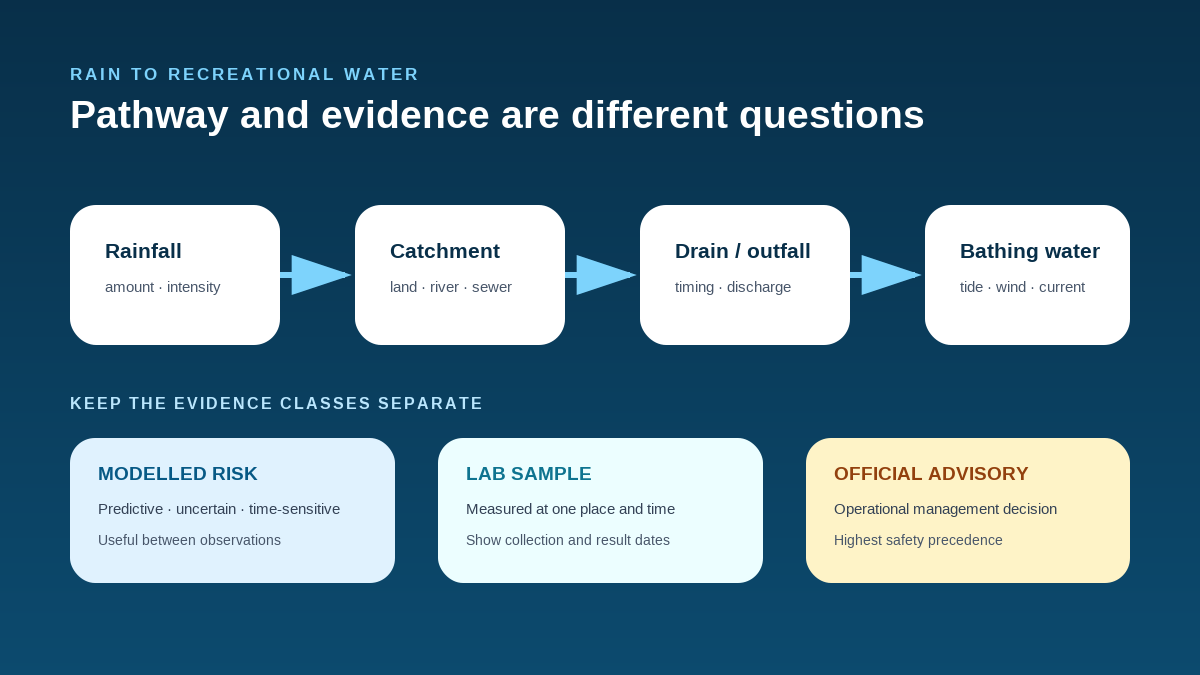
Rainfall can connect a catchment to bathing water quickly, but a modelled risk, a laboratory sample and an official advisory remain different evidence classes.
Atlas71 editorial illustration · Atlas71 original · Evidence basis: WHO – Guidelines on recreational water quality ↗
What you will learn
- Rainfall risk depends on the local catchment and wastewater pathways.
- A recent sample does not describe every hour before or after collection.
- Official advisories take precedence over general guidance and models.
Several pathways can affect the same coast
Recreational water receives inputs from a catchment, not only from the most visible pipe. Potential pathways include urban and agricultural runoff, wastewater systems and activities on the water. The mixture and importance of those sources vary between places. [1]
Combined sewers carry rainfall runoff and wastewater together and may overflow when capacity is exceeded. Separate sanitary sewers are designed differently but can also release sewage through failures such as blockages, damaged pipes or power loss. EPA distinguishes those system types and their failure mechanisms. [2, 3]
Stormwater drainage is another category. Do not assume a flowing outlet is a combined sewer, or that a dry-looking outlet means the wider catchment has no pollution problem. A useful report identifies the physical feature and observation first, leaving system identification to verified records or investigation.
Keep a chain of evidence rather than a single label
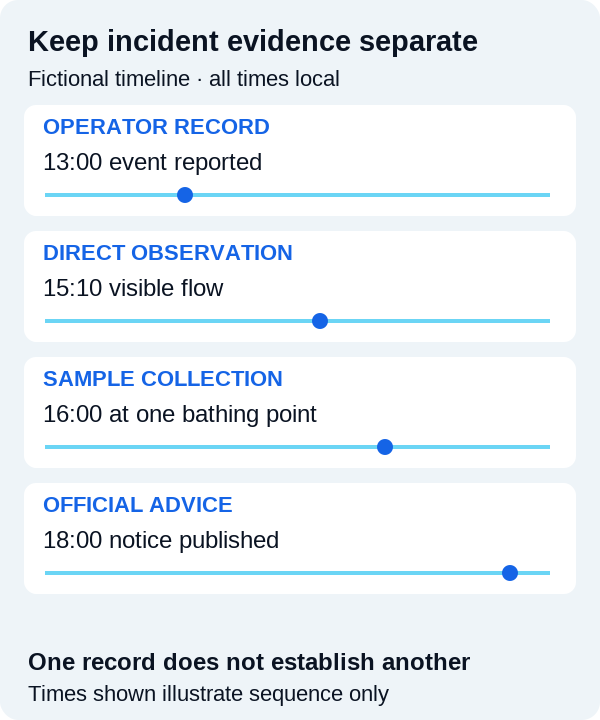
A report can contain several evidence types. Your photograph records appearance. An operator's notification records what that source says about an event. A laboratory result reports a measurement from a sample. An authority's notice states its advice or decision. Label each one and keep its date and location attached.
For example, “flow was visible at 15:10” does not establish when it started. “The operator reported an event from 13:00 to 14:00” does not by itself measure the concentration at a bathing point. “No active incident was shown” may describe a website, rather than prove that every potential pathway was inactive.
WHO's recreational-water framework combines surveillance, risk assessment, monitoring and controls with timely public information. That wider approach explains why one observation or test rarely resolves the whole problem. [4]
What to include in an initial report
Give the exact water body and a usable location, such as a named access point and a map pin. Record the observation time, whether you are still present and whether the flow or visible effect appears ongoing. Separate things you saw from information supplied by someone else.
Describe colour, approximate extent, floating material and direction of movement only as far as you can observe safely. If you noticed an odour from your existing position, describe it without approaching to smell more closely. Include relevant photographs from stable ground and a wide view showing landmarks.
State whether people or animals appear to be immediately exposed, without collecting unnecessary personal details. If there is an urgent threat to life, use the local emergency service first. Do not delay a report because you lack a sample, a precise volume or a confirmed source name.
In England, GOV.UK routes water-pollution reports and other environmental incidents to the appropriate service, with separate routes for the other UK nations. Elsewhere, use the responsible local environmental or public-health authority. Reporting routes and jurisdiction matter; a public social-media post is not a substitute. [5]
Enlarge diagram
Scroll sideways to read all labels in the original illustration.
Figure 1. A fictional incident timeline keeps observation, operator information, sample collection and official advice on separate lines. Their times can differ. No event on one line automatically establishes the contents or status represented by another.
Atlas71 editorial illustration · Atlas71 original
What not to do while investigating
Do not enter an outfall, open a manhole, cross a barrier or step into affected water to gather evidence. Do not trace a suspected discharge across private land without permission. A clear location and an honest description are more useful than an unsafe attempt to obtain a dramatic photograph.
Do not collect water casually in a household bottle and treat the result as a definitive bathing-water test. A meaningful monitoring programme needs a defined sampling and analysis method, appropriate handling, quality checks and interpretation. EPA's recreational sanitary-survey guidance stresses planned data collection to support source assessment and management decisions. [6]
If you want to contribute regularly, work with an established programme that supplies training and a protocol. Agree what the project can establish and how results will be shared. Community evidence can be valuable without being presented as an official closure, clearance or enforcement finding.
Example 1 The pipe and the nearby business
Fictional worked example. The location, people and observations are invented.
A visitor sees cloudy water leaving a pipe below a row of restaurants. There is a strong smell noticeable from the public path. They plan to post that a named restaurant is dumping sewage, because its building is nearest.
The observation supports a report of suspicious flow at that location, but not the accusation. The drainage connection and contents are unverified. The visitor takes a wide photograph from the path, records 16:40 local time and describes the visible flow and smell to the environmental authority.
They include the nearest public access point rather than guessing ownership. If the authority later identifies the source, that finding can be added with attribution. The careful first report preserves useful evidence and avoids assigning responsibility on proximity alone.
Example 2 A discharge notice and a volunteer sample
Fictional worked example. The times, records and monitoring group are invented.
An operator reports an event ending at 05:30. A trained community group collects a sample at a different beach at 11:00 under its agreed protocol. The result is later reported as meeting the group's comparison criterion. Members propose announcing that the whole bay was clean by mid-morning.
The sample supports a narrower statement about its collection place, time, method and result. It does not show the full route of discharged water, conditions earlier that morning or the state of every beach. The group's criterion also needs to be distinguished from the authority's official decision rules.
They publish the qualified result and link the current official advice. If a restriction remains active, they do not override it. They retain the records for the monitoring project and ask its technical lead how, if at all, the sample can contribute to assessing the event.
Prevention at home and in the community
Wastewater prevention includes appropriate use and maintenance of the systems you control. EPA's septic guidance emphasises professional inspection and servicing, efficient water use, proper waste disposal and drainfield care. The appropriate service schedule depends on the system and use, so follow local requirements and qualified advice rather than a universal calendar. [7]
Do not pour oils, solvents or other inappropriate waste into drains, and follow local disposal guidance. Report leaks or recurrent backing-up to the responsible operator promptly. A household should not attempt repairs that require specialist access to a sewer or septic tank.
For runoff, community prevention may involve waste containment, pet-waste collection, suitable land management and professionally designed drainage measures. Choose an action that matches an observed problem and an accountable owner. A voluntary cleanup cannot repair infrastructure capacity, but it can help reduce some avoidable inputs and document where further work is needed.
Follow through without overstating the outcome
Keep the incident reference and send material new information through that route. Record when an authority acknowledges, investigates or closes a report. Those are different milestones: acknowledgement does not prove the cause, and administrative closure does not necessarily establish that water is suitable for every activity.
If an authority publishes a finding, preserve its qualifications and dates when sharing it. A statement about one pipe or event should not expand into a claim about all local water. If no cause is established, say that rather than filling the gap with the most plausible story.
A Protect reporting checklist
- Keep clear of suspicious water and unsafe infrastructure
- Record exact place, observation time, appearance, extent and whether the effect is ongoing
- Preserve photographs and distinguish direct observations from other people's reports
- Use the verified environmental reporting route and retain the reference
- Keep samples, notifications, forecasts and official instructions separate
- Join a trained programme for systematic monitoring instead of improvising tests
- Record prevention measures and verified outcomes at the scale the evidence supports
A useful pollution report does not need certainty about every cause. It needs enough reliable detail for someone with the right tools and authority to investigate.
Source links reviewed on 2 October 2026. Both worked examples and Figure 1 are original educational illustrations, not actual incident records.