Harmful algal blooms and safer water visits
Can you tell whether a bloom is harmful by looking at it? No. Discolouration, scum or mats can be reasons to avoid contact, but appearance cannot establish toxin concentration. Some harmful conditions are difficult to see. Check official local advice, stay out of suspicious water and keep children and animals away. [1, 2]
This guide is for choosing whether and how to visit a lake, river, estuary or coast when blooms are a concern. It explains why a normal-looking patch or a favourable bacterial result cannot settle the question. It is not a field identification key or a treatment guide.
Algae, cyanobacteria and toxins
When to stay out
Why Atlas71 separates observation from warning
Three article-specific ideas from this guide. They explain the topic; they do not represent measured local conditions.
Atlas71 editorial illustration · Atlas71 original · Evidence basis: CDC – Preventing illnesses caused by harmful algal blooms ↗
What you will learn
- Algal blooms are increases in algae or cyanobacteria in the water.
- Follow official swimming advisories.
- A satellite signal, community photo or model can indicate possible bloom conditions.
A bloom describes growth and accumulation
Algae and cyanobacteria occur naturally in water. Under favourable conditions they can become abundant enough to form a bloom. Cyanobacteria are photosynthetic bacteria, often called blue-green algae. They commonly cause freshwater blooms; marine harmful blooms frequently involve other groups, including dinoflagellates and diatoms. Brackish waters can share characteristics of both settings. [3]
Not every bloom produces toxins. Harm can also result from dense growth, oxygen depletion or other effects on an ecosystem. The word harmful therefore covers more than one mechanism, and a fish mortality event does not automatically identify a particular toxin. [3, 4]
For a visitor, the important consequence is uncertainty at the shoreline. A photograph may show a change that deserves attention without telling you which organism is present or what exposure is involved. You do not need to solve that uncertainty yourself before choosing to avoid contact.
Why conditions can change across a water body
Bloom development and persistence depend on interacting factors such as nutrients, light, temperature, salinity and water movement. NOAA stresses the regional differences among bloom organisms and impacts. There is no single warm-water temperature, calendar month or weather pattern that rules every harmful bloom in or out. [4]
A warning for one water body cannot be transferred automatically to every neighbouring lake. Equally, a report from the opposite side of a large bay may not describe your launch point. Read the location and extent stated by the authority, and avoid making the warning area smaller because one part looks clear.
Short-term forecasts and broad seasonal outlooks serve different purposes. A seasonal outlook is background for planning, not a guarantee for a particular afternoon. A local monitoring result is still tied to a collection place and time. Read the product description before treating a coloured map as a complete, current boundary.
Recognise reasons to stay out without diagnosing
Possible bloom signs include unusual colour, paint-like streaks, surface scum, floating mats or unexplained dead fish. Blooms can also occur beneath the surface. CDC's recognition guidance illustrates different appearances rather than offering one dependable colour test. [1]
An ordinary-looking surface does not override an advisory. EPA explains that cyanotoxins may be present before or after a visible bloom and recommends laboratory testing to establish toxin levels. A clear photograph cannot establish that a warning has expired. [2]
Do not touch material to test its texture, deliberately smell it at close range, or collect a sample as part of an informal beach visit. Step away and tell the appropriate local authority what you observed. Photographs from a safe position may help, but leaving without photographs is the right choice if getting them would increase exposure.
Enlarge diagram
Scroll sideways to read all labels in the original illustration.
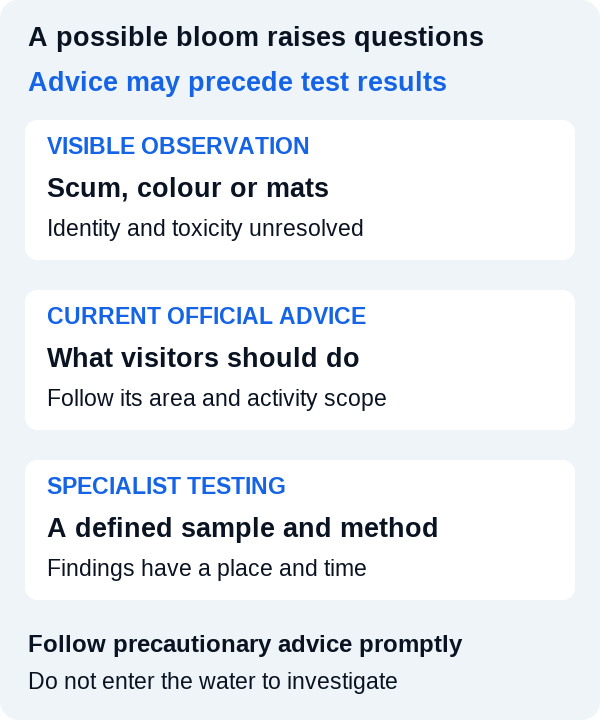
Figure 1. Three separate questions during a possible bloom: what is visible, what visitors are advised to do and what testing establishes. Advice may precede test results; the panels are not a sequence that visitors must wait through.
Atlas71 editorial illustration · Atlas71 original
Water contact is not the only exposure
Swimming, wading and water sports can involve swallowing water, skin contact or inhaling spray. Contaminated fish and shellfish are another route of exposure. The activity matters, so read the exact advice for swimming, shoreline visits, fishing and harvesting rather than assuming one notice covers all of them. [3]
Florida red tide provides a specific regional example. The organism Karenia brevis produces toxins that wave action can release into airborne spray, causing respiratory irritation. FWC notes particular concern for people with chronic respiratory conditions. That mechanism should not be generalised to every discoloured lake, but it explains why staying dry may not remove every risk at an affected coast. [6]
Food precautions also need their own notice. CDC warns that cooking or preserving contaminated seafood does not remove algal toxins. Follow official harvest restrictions and fish-consumption advice; do not taste an item to decide whether it is acceptable. A beach opening notice is not automatically a shellfish-harvesting approval. [5]
Plan for animals as well as people
Dogs can swallow affected water or material, eat stranded algae or dead fish, and lick contamination from their fur. CDC advises keeping pets away from suspected blooms and seeking veterinary help promptly if they become ill after exposure. Do not let a dog enter first as a test for the rest of the group. [7]
Bring drinking water and choose an alternative walk where the animal can be kept away from affected shorelines. A lead can help you control access, but it does not change the condition of the water. Check the route before letting a dog approach a lake edge hidden by vegetation.
If a pet has entered suspected bloom water, prevent licking and rinse with clean water while seeking the advice appropriate to the exposure. An animal that seems sick needs a veterinarian immediately. Do not wait for an environmental laboratory result before asking for care. [7]
Example 1 The clear gap between green patches
Fictional worked example. The lake and observations are invented.
A group arrives at Willow Lake to paddle. They see green material gathered along one bank, while the launch ramp looks clear. A friend suggests launching through the clear strip and avoiding the visible patches. The official park page reports a current bloom advisory covering the lake.
The clear strip answers only a visual question at that moment. It does not measure toxins or establish that the advisory excludes the ramp. The group cancels the water activity and moves its picnic to an area permitted by the park's current advice, away from the affected shore.
They record the location of the visible material from a path without approaching it. Their report says “green surface material observed” rather than naming a toxin. They can make a useful observation and a cautious recreation decision without pretending to know the organism.
Example 2 A swimming result and a shellfish notice
Fictional worked example. The bay, test details and notices are invented.
At West Bay, a recent bacterial monitoring result meets the local programme's criteria. A separate notice prohibits shellfish harvesting because of an algal-toxin concern. A visitor assumes the newer bacterial result has cancelled the older notice and plans to collect mussels.
The notices address different measurements and exposures. Bacterial monitoring does not establish the toxin concentration in shellfish. The visitor checks the harvesting authority's page and finds that the restriction is still active, so does not collect them.
Before a beach visit, the group also checks current water-contact and respiratory advice. The lesson is to follow each relevant notice through to its own official update. A timestamp comparison alone cannot reconcile information about different hazards.
If exposure or symptoms occur
CDC advises rinsing off with tap water after contact with water that may contain a harmful bloom. [5]
If you feel unwell, contact a healthcare professional or the local poison-information service and describe the location, time and type of exposure. Severe symptoms such as difficulty breathing require emergency help. Do not use this article to identify a toxin or choose a treatment. [8]
Keep details of any official notice available for the clinician, but do not delay care to gather evidence. Symptoms can have several causes; a professional assessment is more useful than trying to match a rash or cough to an online picture.
Before a bloom-sensitive visit
- Check current official notices for the exact site and intended activity
- Read the warning area, date and reopening conditions rather than relying on colour alone
- Stay out of suspicious water and keep children and animals away
- Check separate advice for fish, shellfish and shoreline exposure when relevant
- Choose another activity if the evidence is uncertain or local instructions advise against contact
- Report concerns safely and seek prompt medical or veterinary advice after illness
A bloom-free-looking photograph is not an all-clear. The safest useful interpretation combines the limits of what you can see with the testing and instructions provided locally.
Source links reviewed on 2 October 2026. Both worked examples and Figure 1 are original educational illustrations, not current warnings or diagnoses.