How to organise a safer shoreline cleanup
A useful cleanup ends with people back safely, collected material in an agreed disposal system and an honest record of what was done. The first question is “can this group work here without creating another problem?” The size of a litter pile does not justify entering dangerous water, disturbing protected habitat or handling unknown material.
This guide is for ordinary volunteer litter collection on accessible shores. It is not training for hazardous waste, wildlife rescue, heavy gear recovery or underwater removal. Joining an established local event is often the most straightforward way to learn the site's arrangements, equipment and limits. National Park Service cleanup guidance emphasises safety requirements and checking the organiser's conditions before arrival. [1]
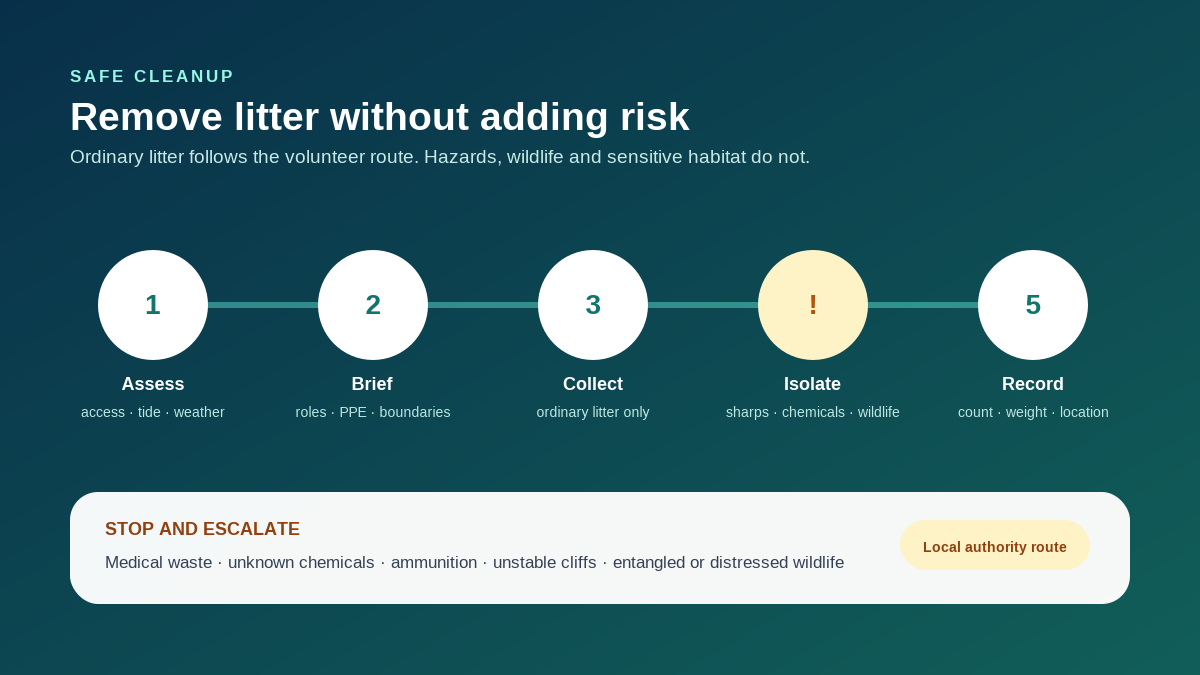
A useful cleanup starts with a site check and keeps hazardous items, wildlife and sensitive habitat outside normal volunteer handling.
Atlas71 editorial illustration · Atlas71 original · Evidence basis: NOAA Marine Debris Monitoring and Assessment Project ↗
What you will learn
- Assess access, weather, tides and local rules before collection starts.
- Do not ask volunteers to handle sharps, chemicals or distressed wildlife.
- Record what was removed so the cleanup creates reusable evidence.
Define the area and the work
Choose a clearly bounded stretch with lawful access, suitable ground and a dependable exit. Confirm with the land manager whether permission, booking, permits or special arrangements are required. A publicly accessible beach does not mean every activity or part of it is unrestricted.
Describe what the group will collect and what it will leave. Ordinary visible litter on firm ground is a different task from pulling netting out of rocks or collecting material in tidal mud. Decide the limits before enthusiasm and a large object make them harder to maintain. NOAA advises respecting closures, habitat exclusions and local disposal rules, and stopping if conditions become unsafe. [2]
Match the plan to the participants. Consider mobility, experience, supervision, communication, transport and the ability to carry supplies and return. Give people a way to contribute without handling litter, such as recording counts from a suitable location. Do not make participation depend on carrying a heavy bag or crossing difficult ground.
Check the whole working window
Review weather, water level and waves for the approach, cleanup and departure. Identify any point that could be cut off as the tide rises. Do not derive an access window just from the time of high water; use the local route information. Keep the working area away from breaking waves and reassess if conditions change. [2, 3]
Locate shelter and a place to regroup. A beach umbrella or open-sided shelter is not suitable lightning protection. If thunder is heard, leave the exposed area for a substantial building or enclosed hard-topped vehicle. Follow local emergency guidance and the organiser's cancellation procedure. NWS recommends waiting at least 30 minutes after the last thunder before resuming outdoor activity. [4]
Set a finish time and a check-out process. Explain who makes a stop decision and how it reaches everyone. A group spread along a noisy, windy shore should not depend on one person shouting from the start point.
Prepare equipment without overstating protection
Follow the organiser's equipment requirements, including suitable gloves and footwear. Bring clothing for the conditions, drinking water, sun protection and any agreed litter-picking tools. A charged communication device and knowledge of the local emergency procedure belong in the plan. [1, 2]
Gloves are not permission to touch an unknown object. Sharp fragments can puncture unsuitable material, and protection intended for ordinary litter does not make a person trained to handle chemicals or medical waste. Keep bags light enough for the person and route; avoid compressing them by hand or against the body.
Brief everyone before work begins. Show the area boundaries, collection points, items to leave, wildlife restrictions and how to report a problem. If children take part, the organiser must arrange appropriate supervision and tasks. Do not assume an adult's presence somewhere on the beach amounts to supervision of each collection group.
Leave hazardous or uncertain material alone
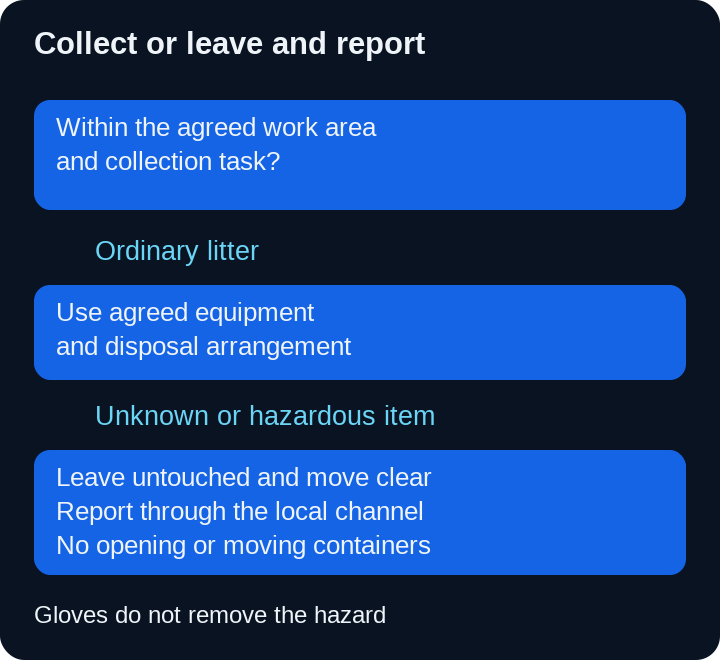
Do not touch, open, sniff, empty or move an unknown container. NOAA specifically advises reporting possible hazardous materials and leaving them untouched. Large debris and derelict vessels also require an appropriate response rather than improvised volunteer removal. [5]
Sharps, medical waste and fragile chemical-contaminated objects should be left for the responsible service. Padre Island National Seashore's guidance, for example, tells participants not to collect medical waste or approach sealed containers and to alert park staff. Follow your own site's reporting instructions rather than importing another park's handling procedure. [6]
Do not pull on material that is buried, under tension, entangled with animals or attached to the seabed. Report its position from a safe place. A visible length of rope may be part of something much larger. A cleanup bag, knife and determination are not an adequate recovery plan.
Enlarge diagram
Scroll sideways to read all labels in the original illustration.
Figure 1. An original decision aid separates ordinary litter within the agreed task from unknown, sharp, heavy or wildlife-entangled material. The latter is left in place and reported through the appropriate local channel. The diagram does not authorise handling an item merely because it resembles a familiar object.
Atlas71 editorial illustration · Atlas71 original
Protect the shore while cleaning it
Natural strandline material supports the coastal environment. Seaweed, driftwood, shells and vegetation are not automatically litter. England's litter code, for example, distinguishes manufactured or processed discarded items from natural seaweed and twigs. Local ecological guidance should determine what is left undisturbed. [7]
Stay out of dunes, sensitive vegetation, nesting areas and unstable surfaces. Avoid lifting natural objects simply to search beneath them. Do not chase wildlife away to reach debris. If material is intertwined with habitat, ask the land manager how to proceed instead of assuming removal is always the better environmental choice. [2]
Use the same care when staging filled bags. Keep access routes clear and do not place bags where wind, waves or animals can scatter their contents. The removal is not complete while the material can readily return to the water.
Arrange disposal before collection
Agree who will receive the material, where it will go and when it will be removed. Confirm which items the local service accepts. Coastal material can be wet, dirty or mixed, so a recyclable-looking object is not automatically suitable for the local recycling stream. NOAA recommends researching disposal options and ensuring available bins will not overflow or release collected litter. [8]
Do not leave bags beside a full bin with an assumption that someone else will collect them. If the planned disposal route becomes unavailable, contact the organiser or land manager and follow their instructions. Never burn the collection or release liquids from containers to reduce its weight.
Record the actual result: area worked, duration, participants, categories and counts where practical, weight and its method, plus any items left and reported. Keep a cleanup record distinct from a formal monitoring survey. The record should say what the group did, not claim the entire beach is free of hazards.
Example 1 A drum changes the task
Illustrative only. The event and object below are fictional.
A group collecting bottles finds a sealed metal drum near the high-water line. Its label is faded. One volunteer suggests rolling it away so the next tide cannot reach it.
The group leaves it untouched, moves clear and tells the organiser. From a safe position, the organiser records its location and visible description, then uses the appropriate local authority reporting route. The group does not open it, rely on the label or include its estimated weight in the cleanup total. If it presents an immediate danger, they use the local emergency process.
A useful result may be a safe report and an excluded section of beach. Removing the drum themselves is not necessary for the event to count as worthwhile.
Example 2 The exit and collection point fail
Illustrative only. The times and arrangements below are fictional.
A cleanup is planned for 10:00–12:00. On arrival, waves are washing the narrow path to the western section, and the waste-service contact says the planned collection point is unavailable. The eastern accessible area still contains ordinary litter.
The organiser removes the western section from the plan. Before starting elsewhere, they confirm an alternative disposal arrangement and revise the briefing. If either a dependable exit or disposal cannot be secured, they postpone. They do not begin collecting in the hope those problems will resolve later.
The final record covers only the area actually worked. It explains why part of the original plan was excluded and avoids presenting the smaller total as a failed environmental effort.
Before starting
- Confirm land-manager permission, boundaries and habitat restrictions
- Check tide, waves, weather, access and a reliable exit for the whole visit
- Agree supervision, equipment, communication and stop decisions
- Identify items that must remain untouched and the correct reporting channel
- Secure a practical disposal arrangement before filling bags
- Count only what was actually collected or observed, with the method stated
- Check everyone out, remove your own supplies and record unresolved items for the responsible service
Sources reviewed on 2 October 2026. Both examples and Figure 1 are original educational illustrations. Local permissions, collection procedures and emergency arrangements must be checked for the actual site.