What water clarity and turbidity can tell you
Can you judge water quality by seeing the bottom? You can learn something about visibility, but you cannot establish microbiological safety. Clear, cloudy and coloured water describe aspects of appearance. A bathing-water sample, a bloom warning and a visibility observation answer different questions, and one should not replace another. [2]
Clarity is useful when planning snorkelling, observing habitat or understanding a change after a storm. Use it alongside the official advice and the requirements of your activity. This guide explains what the measurements mean and how to avoid turning an attractive view into an unsupported safety claim.
Clarity is an optical property
Clear does not automatically mean safe
Use clarity as context
Three article-specific ideas from this guide. They explain the topic; they do not represent measured local conditions.
Atlas71 editorial illustration · Atlas71 original · Evidence basis: US EPA – Water clarity indicator ↗
What you will learn
- Suspended particles and algae can scatter or absorb light and reduce visibility.
- Microbiological contamination is not reliably visible to the eye.
- For snorkelling, diving and habitat observation, visibility is useful activity context.
Light has to travel through the water
Water clarity concerns how far light penetrates a water column. Suspended particles and algae can absorb or scatter light, reducing how clearly objects can be seen. Winds, tides, storms and changes in illumination can all affect clarity. Some waters are naturally less clear than others. [1]
Turbidity is an optical measurement related to light scattered by material in the water. Instruments commonly report nephelometric turbidity units, or NTU; the measurement is not simply a count of particles or a direct concentration of pathogens. USGS describes sediment, organic matter and microscopic organisms among the materials associated with turbidity. [3]
Think of clarity as a viewing question and turbidity as a particular kind of optical measurement. They are related, but a snorkeller's estimate in metres is not the same quantity as a sensor reading in NTU. Avoid turning one into the other using a universal rule. A conversion would need a suitable method and evidence for the water being measured.
Colour and cloudiness are different
Dissolved material can colour water even when little sediment is suspended. Organic compounds from plant material can produce tea-coloured water. Suspended sediment, algae and the water itself also contribute to the colours people see. Brown does not identify sewage, and green does not establish a harmful algal bloom. [4]
That distinction matters when describing an observation. “Brown water with low visibility” records two features. “Sewage pollution” asserts a cause. Unless an authority has confirmed that cause, the second description goes beyond what the colour proves.
Natural appearance is not a safety verdict either. A familiar seasonal colour can coexist with an unrelated contamination event. Conversely, a visible change deserves attention without a premature accusation. Record what changed, where and when, then look for information that can test the possible explanations.
Why the water can change during one outing
Rainfall can wash particles from land, while stronger flow can suspend material from a river bed. A turbidity reading may therefore rise after a storm even without identifying the material's origin. Particles can also carry other contaminants, so an optical change may be important context rather than merely a cosmetic difference. [3]
At the coast, a fresh wind, breaking waves or changing tidal conditions can alter what is visible. EPA notes that clarity has natural variability as well as sensitivity to excess sediment and nutrient inputs. The local baseline matters: compare like places and conditions rather than assuming that every healthy coast should look like a tropical photograph. [1]
For a planned activity, ask whether the observation belongs to the same part of the water body. A sheltered harbour corner, open beach and river mouth can have different conditions at the same hour. A report from one should not be silently copied across the whole bay.
Enlarge diagram
Scroll sideways to read all labels in the original illustration.
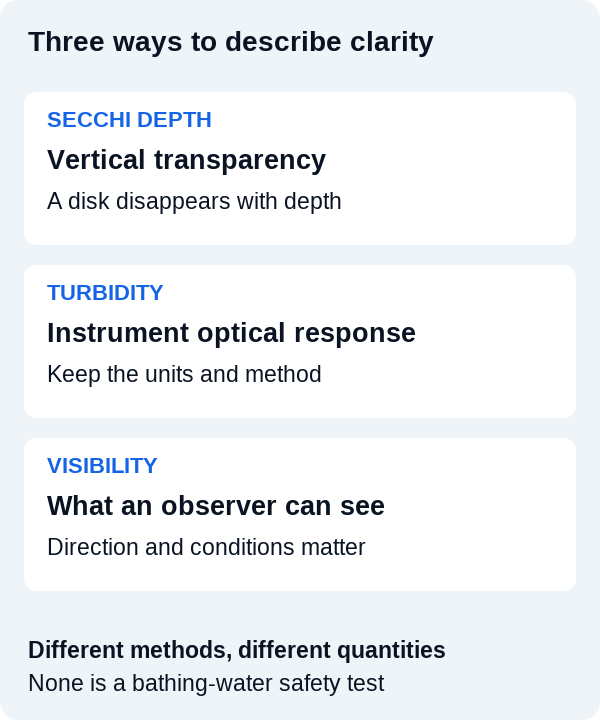
Figure 1. Three different observations: a vertical Secchi-disk depth, a turbidity sensor and horizontal visibility. Each uses a different method or viewing geometry. They can support a clearer description of conditions, but none of the three certifies bathing-water safety.
Atlas71 editorial illustration · Atlas71 original
Read the measurement method
A Secchi disk is a contrasting disk lowered into water to assess transparency. EPA lists it alongside instrument methods for measuring clarity. A reported Secchi depth concerns a particular vertical observation, rather than an automatic horizontal seeing distance for a swimmer. [1]
For any number, retain the method, units, location and time. Ask whether the reading was measured directly, estimated by a person or derived from a model. If two reports disagree, investigate those differences before deciding that one must be wrong.
A useful record also says what the observer could and could not establish. If the bottom was visible throughout a shallow site, an observation may be limited by depth rather than by the greatest possible viewing distance. Do not claim a transparency limit beyond what the observation actually tested. Follow the monitoring programme's protocol rather than improvising an unofficial measurement.
Remote sensing adds another perspective. Satellites and other instruments infer properties from light leaving the water. USGS explains that particles, dissolved organic material, water and bubbles influence the optical signal. A map derived from that signal needs its own method, timestamp and uncertainty; it is not a laboratory test of every hazard at every beach. [5]
Example 1 The clear bay with a current warning
Fictional worked example. The bay, observations and notices are invented.
A swimmer arrives at Glass Bay and can see stones on the bottom in shallow water. A friend sends a photograph of the same bay looking cloudy after last week's wind. Today's scene appears much more inviting. However, the official page advises against bathing after a recent wastewater incident.
The photographs support a limited conclusion: appearance differs between the two visits. They do not establish what happened to microorganisms, nor whether today's water meets the authority's criteria. The current advice directly addresses the intended swim.
The friends stay out and choose an activity on land. They do not “test” the water with a short dip. If they describe the scene to someone else, they say the water looks clear but an advisory remains active. Keeping those facts together avoids inadvertently encouraging another person to rely on the photograph alone.
Example 2 A lower sensor reading and poorer snorkelling visibility
Fictional worked example. All numbers and conditions are invented and are not entry thresholds.
A coastal sensor reports 4 NTU in the morning and 2 NTU at noon. A snorkeller reports seeing less far horizontally at a different part of the bay at noon than during a previous visit. Someone concludes that the snorkeller must be mistaken because the instrument value halved.
The comparison mixes quantities, sites and reference times. The sensor records an optical response at its installation. The snorkeller describes horizontal visibility elsewhere. Changes in the material, viewing geometry or conditions may matter, and the observations are not simultaneous measurements of the same thing.
The valid arithmetic is only that this instrument's reported value fell by half, assuming comparable and reliable measurements. It does not establish that every location became twice as clear or that swimming risk halved. For planning, the group seeks current activity-specific advice and changes the outing if visibility is unsuitable for its skills and supervision.
Keep ecological meaning separate from bathing advice
Light availability influences underwater vegetation and habitat. Excess sediment can also bury or smother communities, while nutrient enrichment can alter algal growth. Those are important ecological reasons to monitor clarity over time. A clear-water photograph alone cannot describe the whole condition of an ecosystem. [1]
A community monitoring project can be useful if observations follow a consistent protocol. Keep the site, method and effort comparable, and record missing visits rather than substituting guessed values. An unusual observation is worth noting even when the cause is unresolved.
For bathing, health guidance remains a separate source. CDC advises avoiding natural water that is unusually cloudy, discoloured or foul-smelling, and checking current monitoring and closures. That precaution does not mean every turbid water body has the same cause; it means appearance can be a reason to stay out without being a diagnostic test. [2]
A clarity checklist for a coastal visit
- Identify whether the information is a visual estimate, Secchi depth, turbidity reading or remotely derived product
- Keep the units, method, timestamp and actual measurement location attached
- Compare similar observations instead of treating NTU, metres and photographs as interchangeable
- Check current bathing-water notices independently of how attractive the water looks
- Reassess unusual changes, runoff, scum, odour or dead animals without approaching to investigate
- Match visibility to the activity, group, supervision and exit plan; no general number guarantees suitability
- Report an unusual event with neutral descriptions and clear location information when appropriate
You do not need to diagnose cloudy water to make a cautious decision. The useful skill is recognising what your evidence can answer, keeping the other questions open, and changing the plan when local advice or the conditions call for it.
Source links reviewed on 2 October 2026. Both worked examples and Figure 1 are original educational illustrations, not measurements or advice for a real site.