Avoiding contact with stingrays urchins and reef hazards
Can protective footwear make an unfamiliar reef safe to walk across? No. Footwear may be part of local advice, but it cannot identify hidden animals, remove every puncture risk or make standing on living reef acceptable. Plan entries and exits that avoid unnecessary contact, follow the guide or patrol and leave marine life undisturbed. [2]
This guide covers bottom-contact hazards during shallow-water visits, snorkelling and reef activities. It does not claim that a species is present at your destination. It also avoids one-size-fits-all treatment instructions: an injury needs advice appropriate to the animal, wound and region.
Hazards are place-specific
Avoid unnecessary contact
Separate wildlife from first-aid advice
Three article-specific ideas from this guide. They explain the topic; they do not represent measured local conditions.
Atlas71 editorial illustration · Atlas71 original · Evidence basis: Florida Museum – Skates & Rays FAQ ↗
What you will learn
- Stingrays, sea urchins, coral and rocky reef structures are not distributed uniformly.
- Do not handle unfamiliar marine animals or stand on living reef.
- Atlas71 can explain the hazard and point users to local emergency or medical guidance.
Different contact mechanisms need different thinking
A stingray injury, an urchin puncture and a scrape against reef are not the same mechanism. Stingrays with defensive tail spines can injure someone who steps on or handles them. Sea urchin spines can penetrate skin. Hard reef surfaces can also cause physical injury, while some reef organisms have stinging structures. [3, 4, 5]
The practical common ground is avoiding contact. Do not test an animal with a foot, reach into a hole to see what is inside or hold onto a reef while looking through a camera. A calm-looking patch of shallow water can still contain surfaces or organisms you have not identified.
Distinguish habitat knowledge from current presence. A guide saying a species occurs in a region is useful background; it does not mean that every sandy patch contains one. Conversely, failing to see an animal does not establish an empty seabed. Local observations and advice are needed for the actual site.
Stingrays can be difficult to notice
Some stingrays rest partly buried in sand or close to seagrass. University of Florida extension guidance describes accidental stepping as one route to a defensive injury in local grassbed habitats. That is a more useful model than imagining a ray seeking out swimmers to attack. [3]
At places where local authorities recommend a particular wading technique, follow that location-specific advice. Do not generalise a sandy-bottom technique into permission to shuffle across coral, seagrass or an unknown bottom. If the route cannot be used without disturbing habitat or placing feet where you cannot assess contact, choose another access point or remain ashore.
Leave rays room to move. Do not corner, feed, grab or stand over them for a photograph. If you see one, tell companions calmly and follow the guide's direction rather than crowding it. No wildlife photograph is improved by creating an avoidable injury or disturbance.
Urchins and reef structure reward deliberate movement
An urchin's visible spines are an obvious reason not to touch it, but visibility can be limited by crevices, surge or the angle of view. Healthdirect identifies pain and retained spines among possible urchin-injury features. A shoe is not evidence that every spine or surface can be stepped on safely. [4]
Corals are living animals, and reef-building corals create hard calcium-carbonate skeletons. Their apparent rock-like structure does not make them a suitable handhold or standing platform. NOAA's coral explanation and viewing guidance support leaving both corals and other marine organisms untouched. [5, 6]
For snorkellers and divers, position and equipment control matter. The Great Barrier Reef Marine Park Authority advises practising buoyancy control, securing equipment and avoiding contact with reef or wildlife. A camera or dangling accessory can cause contact even when hands and feet seem clear. [2]
Enlarge diagram
Scroll sideways to read all labels in the original illustration.
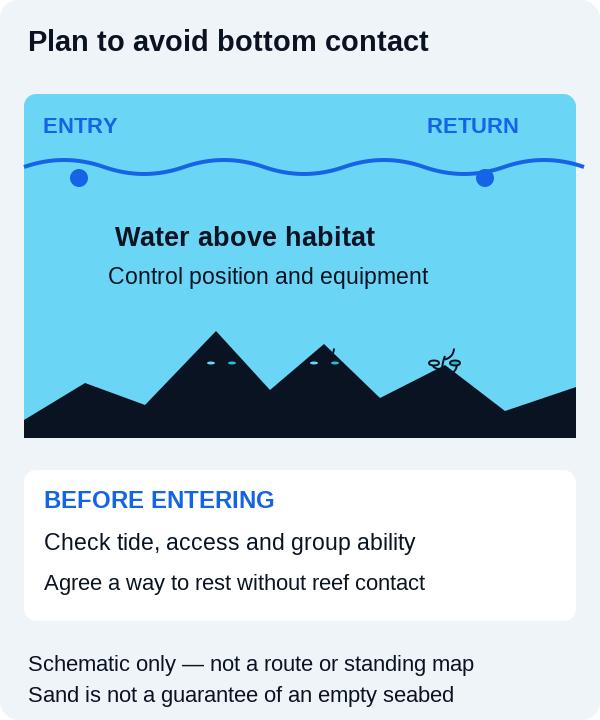
Figure 1. A conceptual reef cross-section marks a planned entry, clear water above the habitat and a separate return point. It illustrates planning to avoid contact, not a real route, permitted standing area or guarantee that sand is free of animals.
Atlas71 editorial illustration · Atlas71 original
Plan the return before the first step
Identify an entry and exit suitable for the tide, waves and group. A route that works when water is deeper may become difficult later. If the plan relies on walking across reef to return, revise it before entering. Ask a qualified local guide to explain appropriate access and any protected areas.
Choose an activity within the least experienced participant's ability. Someone who expects to stand up whenever tired may need a different site, more support or a supervised introduction away from sensitive reef. Flotation and competent supervision should be arranged for the activity rather than assuming the seabed will provide a resting place.
If equipment needs adjustment, use the appropriate safe return or support arrangement. Florida Keys National Marine Sanctuary advises divers to return to the boat rather than stand on reef to adjust equipment. Site procedures should make this practical before a problem develops. [7]
Example 1 The tempting shortcut at low water
Fictional worked example. The beach, reef and route are invented.
A couple reaches a lagoon by a designated sandy access route. On the return, lower water exposes a reef flat that appears to offer a shorter walk. Both are wearing water shoes, and one proposes crossing because the surface looks firm.
They do not know which parts are living reef, what is hidden in crevices or whether local rules permit access. Footwear does not answer those questions. They use the designated route described in their briefing, provided it remains suitable, rather than treating the exposed flat as a path.
If their intended exit is no longer usable, they seek the guide's or local rescue service's help rather than improvising a hazardous crossing. The lesson is to plan the whole outing and preserve a valid return route, not merely buy equipment and assume any bottom can be walked on.
Example 2 An unfamiliar puncture while wading
Fictional worked example. The people and injury are invented; this is not a first-aid protocol.
A visitor feels sudden sharp pain in a foot while wading at an unfamiliar beach. They did not see the animal. A companion notices a puncture and wants to dig out a possible spine with a pocket tool because they remember a different injury from a previous trip.
They alert the lifeguard and get local medical advice instead. They describe the location, time, depth and symptoms without naming a species they did not see. They do not keep walking to test whether the pain will disappear, probe the wound or delay care to find the animal.
The clinician can assess injury depth, retained material and the relevant local hazards. A photograph of the wound may document appearance, but it cannot establish that a stingray, urchin or another organism caused it. Prompt appropriate assessment is the useful next step. [9]
If an injury happens
Get help from a lifeguard or local medical service. Deep punctures, persistent severe pain, retained material and injuries from stingrays or unfamiliar marine animals deserve prompt assessment. Difficulty breathing, collapse, chest pain, severe bleeding or other serious symptoms require emergency help. Follow the dispatcher's instructions. [1, 9]
Do not try to remove a deeply embedded spine or barb yourself. Do not assume that a small external mark means a superficial injury. Nor should an internet treatment for one species be applied automatically to an unidentified injury. Tell the professional what happened and where; regional hazards matter.
If you have an open wound, consider the separate risk from seawater exposure. CDC advises keeping wounds out of coastal waters to reduce Vibrio infection risk, especially for people with certain underlying conditions. Seek urgent medical attention for concerning wound symptoms and mention recent water contact. This is a different issue from identifying the original animal. [8]
Protecting habitat also reduces avoidable contact
Do not collect living animals or remove reef material as a souvenir. Local marine-park rules may also protect dead coral or particular shells. Check the actual site's requirements rather than assuming an object is available to take because it appears empty or detached. [2]
Use guides and operators who explain responsible access, equipment control and wildlife behaviour. A briefing should help you understand where to look and how to keep clear, rather than encouraging handling for photographs. An animal's tolerance of previous visitors is not consent to touch it or a guarantee that the next interaction will be harmless.
For a wildlife record, photograph from a suitable distance without repositioning the organism. Record the time and location with identification confidence. The observation can be valuable without turning a normal animal encounter into a beach-wide hazard claim.
Before a shallow-water or reef visit
- Check local wildlife advice, access rules, tides and the planned return route
- Ask how the group can rest or adjust equipment without standing on reef
- Use appropriate equipment and supervision without treating them as complete protection
- Avoid touching, feeding, chasing or cornering marine animals
- Keep hands and feet out of unseen crevices and avoid unnecessary bottom contact
- Seek local help promptly after an injury and emergency help for serious symptoms
- Preserve habitat and report observations with accurate place, time and uncertainty
The aim is controlled movement and informed access, not fear of every animal. Give marine life space, stay within the plan and let local expertise guide the parts a general article cannot decide.
Source links reviewed on 2 October 2026. Both worked examples and Figure 1 are original educational illustrations, not actual site conditions or treatment instructions.