Jellyfish and other stinging organisms at the beach
If you see jellyfish on the sand, is the water safe because they have washed out? That observation cannot establish what remains in the water, and stranded animals may still sting. Keep your distance, check current local warnings and ask the patrol before entering. Do not handle an unfamiliar animal to identify it. [1, 2]
This guide explains how to interpret sightings, reduce contact and find the right help. It deliberately does not give one universal sting-treatment recipe. Species, location and symptoms matter, and first-aid recommendations that apply in one region may be inappropriate in another.
Not every jellyfish report means the same thing
What makes a useful observation
Atlas71 safety rule
Three article-specific ideas from this guide. They explain the topic; they do not represent measured local conditions.
Atlas71 editorial illustration · Atlas71 original · Evidence basis: NOAA Ocean Service – Dangers at the Beach: Jellyfish ↗
What you will learn
- A single community sighting, a widespread bloom and an official beach warning are different evidence states.
- Time, precise location, estimated count, photos where safe and possible, species confidence and whether local authorities have issued advice all improve the value of a report.
- Prediction must never be shown as confirmed presence.
How a sting happens
Jellyfish and related animals have microscopic stinging structures called nematocysts. Contact with tentacles can deliver venom to skin. Severity varies with the organism and the exposure; some stings cause local pain, while certain species can cause life-threatening illness. [2]
A jellyfish does not need to chase a person for contact to occur. Swimming into tentacles or touching stranded material can be enough. NOAA also warns that detached tentacles can sting. The visible body therefore does not mark the entire possible contact area. [1]
The familiar blue float of a Portuguese man o' war is a different body arrangement from a typical jellyfish. NOAA describes it as a siphonophore, a colony of specialised units functioning together. Its tentacles can trail below the float, and wind and currents drive its movement. The biological distinction is interesting, but it does not change the visitor's basic rule to avoid touching it. [2]
A regional name is not a treatment decision
Words such as jellyfish, stinger and bluebottle are used in local beach advice, sometimes with different levels of precision. A casual identification from a distant photograph is weaker evidence than an assessment by the patrol or a medical professional familiar with local species.
Australia illustrates why place matters. Healthdirect distinguishes tropical stingers, including dangerous box jellyfish, from bluebottle and other non-tropical stings. It also notes that seasonality varies with location and conditions. A calendar date outside a typical season is not proof that stinging animals are absent. [3]
When travelling, learn the local warning system before the beach visit. Ask which organisms are relevant, whether a closure applies, where supervised swimming is available and what emergency procedure to use. The useful preparation is not memorising an internet photograph of every species; it is knowing where reliable local decisions and help come from.
Read a sighting as an observation
A useful sighting has a place, observation time, source and description. Was the animal afloat, underwater or stranded? Was it one individual or an accumulation? Is the species confirmed, suspected or unknown? Those details help you understand the record without turning it into a complete distribution map.
“No recent reports” is not the same as “none present”. People may not have visited, noticed or submitted observations. Clear water also does not guarantee that every tentacle is visible. A community report can prompt a check, but it cannot replace a current official warning or the patrol's instructions.
Likewise, a report from yesterday at a neighbouring beach does not prove the exact condition of your beach now. It may be relevant context. Check the current location-specific advice and make the decision with that uncertainty visible.
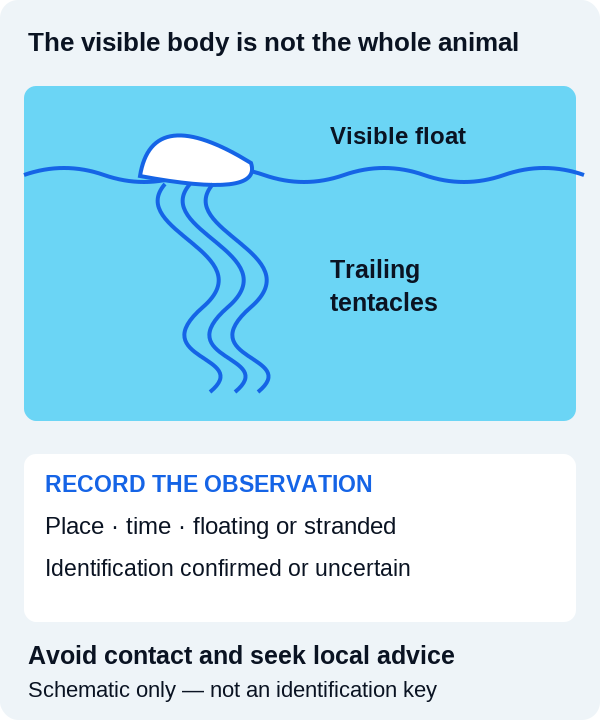
Enlarge diagram
Scroll sideways to read all labels in the original illustration.
Figure 1. A conceptual stinger observation separates the visible body, less obvious trailing tentacles and the location-and-time record. Shapes are schematic, not an identification key. The message is to avoid contact and seek local advice, not to estimate a safe distance from a drawing.
Atlas71 editorial illustration · Atlas71 original
Reduce contact before entering
Use a patrolled beach and read the signs. Stay out where marine-stinger warnings or closures advise it. Ask about locally recommended protective clothing and any designated swimming arrangement, then follow that advice. Clothing can reduce exposed skin, but it does not authorise ignoring a restriction. [4]
Check the actual supervision arrangements. A beach described as patrolled in a holiday guide may not have a lifeguard on duty at the time you arrive. Agree with companions how to attract help and where the first-aid point is. Keep children close enough for active supervision rather than sending them ahead to test the shallows.
Do not gather stranded animals into buckets, throw them at someone, walk barefoot through an accumulation or allow pets to investigate. Observation and photography are possible from a respectful distance. If the material is close to a busy entrance, tell the beach manager or lifeguard rather than moving it yourself.
Why this guide does not prescribe vinegar for every sting
First-aid guidance depends on the suspected organism and jurisdiction. Healthdirect's Australian guidance differentiates bluebottle treatment from tropical-stinger treatment, including different advice about vinegar. Applying a remembered remedy to every sting risks choosing the wrong approach. [3]
Seek help from a lifeguard or local medical service promptly. Explain where the sting happened, the time, symptoms and anything seen without claiming an identification you cannot support. Do not delay help while trying to catch or photograph the animal. Do not apply urine or improvised chemicals. [6]
This caution should not become indecision during an emergency. If the person has difficulty breathing, collapses, has chest pain, severe bleeding, seizures or other serious symptoms, call the local emergency service immediately and follow its instructions. If someone is unresponsive and not breathing normally, follow the dispatcher's CPR guidance. Australian tropical-water stings warrant the urgent response described by local medical authorities. [3, 5, 6]
Example 1 Blue floats on a holiday beach
Fictional worked example. The beach, people and observations are invented.
A family finds several blue, balloon-like objects along the strandline. A child wants to pick one up because it appears dried out. The parent remembers seeing a similar image online and assumes the animals are harmless once on land.
The family steps away and asks the lifeguard. The observation is enough to justify avoiding contact without relying on a confirmed species name. They also ask whether current swimming advice has changed and choose another activity while the patrol assesses the area.
They do not use the number on the sand to calculate how many must be offshore. Nor do they assume that clearing one patch would make wading suitable. The practical lesson is that a shoreline observation can guide a cautious decision while leaving the distribution and identification unresolved.
Example 2 A sting far from home
Fictional worked example. The trip and symptoms are invented; this is not a treatment protocol.
A visitor on a tropical Australian beach feels a sting but did not see an animal. A companion suggests using the remedy they learned for a different species at home. The visitor initially has only a small visible mark.
They alert the patrol and follow the local urgent-response instructions instead of selecting treatment from the appearance of the mark. They give the time and location and describe symptoms as they occur. They do not wait for a species identification or assume a small mark guarantees a minor exposure. [3]
The value of advance preparation is clear: knowing the local emergency route is more useful than an unqualified rule about vinegar, heat or rinsing. Care decisions belong with current regional first-aid guidance and the professionals assisting the person.
Keep perspective without dismissing a warning
Marine stingers are part of marine ecosystems. Their presence is not automatically evidence of pollution, and a sighting should not be used to vilify an animal or encourage people to harm it. At the same time, a calm tone should not minimise a specific warning or a serious symptom.
A sensible report uses accurate language: suspected stinger, confirmed species where verified, or current official warning. If you share a photograph, retain its observation date and place. Avoid recycling an old image as a live alert, since that can confuse both visitors and the people trying to manage the beach.
Before a stinger-sensitive beach visit
- Check current local signs, marine-stinger advice and patrol hours
- Learn the local emergency procedure and first-aid location before entering
- Avoid stranded animals, detached material and unfamiliar marine organisms
- Follow locally recommended protective measures without treating them as a guarantee
- Keep sighting time, location and identification confidence attached to any report
- After a sting, seek local help and describe the exposure; do not improvise a universal treatment
- Call emergency services promptly for serious symptoms and follow their instructions
The most useful protection is a combination of avoiding contact, respecting current local advice and getting the right help quickly. A global wildlife guide can explain the questions, but it cannot replace the regional response to an actual sting.
Source links reviewed on 2 October 2026. Both worked examples and Figure 1 are original educational illustrations, not species identifications or medical treatment instructions.