Shorebreak and injury at the waterline
Can a small-looking wave injure someone standing in shallow water? Yes. Shorebreak can collapse directly onto the beach, throwing a person against the bottom and causing serious head, neck or spinal injury. It can occur without a high-surf warning. Ask a lifeguard about the actual breaking waves and avoid entering where shorebreak is dangerous. [1]
The important question is not simply “How tall is the swell offshore?” It is where and how the waves break, what lies beneath them and whether you can enter and leave without being knocked down. Shallow water is not automatically a safer place to meet a forceful breaking wave.
Shorebreak happens where waves break abruptly onshore
Small-looking waves can still be forceful
Use local observation
Three article-specific ideas from this guide. They explain the topic; they do not represent measured local conditions.
Atlas71 editorial illustration · Atlas71 original · Evidence basis: US National Weather Service – Dangerous waves and shorebreak ↗
What you will learn
- On a steep beach, incoming waves can peak and break quickly close to the shoreline instead of spilling gradually farther out.
- The main hazard is the force of the breaking wave and impact with the bottom.
- Ask lifeguards about wave conditions where available and avoid diving head-first into breaking surf.
How shorebreak develops
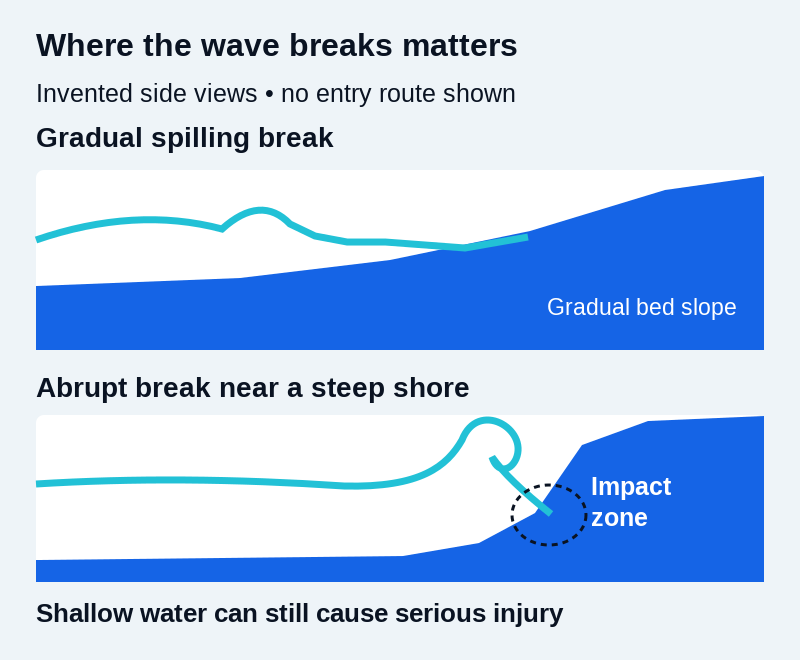
Waves change as they reach shallower water. On a gently sloping approach, some waves spill progressively. Where depth changes abruptly near a steep beach, an incoming wave can steepen and break very close to shore. NWS uses shorebreak for waves that peak and break quickly onshore at a relatively sharp slope. [1]
The resulting impact is concentrated near the waterline. A person may be lifted, turned or pushed down before they can recover their footing. Hard sand, rock and coral are impact surfaces, even when they are hidden beneath white water. Hawaii's Department of Health warns that wading in strong shorebreak can be dangerous as well as swimming. [2]
Beach slope is one influence, not a complete forecast. Incoming wave height, period and direction, local underwater shape and water level affect the break. A familiar beach can behave differently from one visit to the next. Evaluate the present conditions rather than relying on the memory of a gentle entry last summer.
Three different wave hazards
Shorebreak concerns waves collapsing close to the shore and the injuries or loss of control that follow. A rip current is a concentrated flow away from a surf beach. They can occur at the same place, but recognising one does not tell you that the other is absent. [1, 3]
High surf describes unusually large and energetic breaking waves under the local forecast criteria. Dangerous shorebreak does not need to reach that category. If a general forecast does not carry a high-surf warning, you still need local information about the entry and break. [1]
Unexpectedly far-reaching waves are another concern for people on land. A wave can run much farther up a beach than the preceding waves, including after a lull. It can move heavy logs or sweep a person into cold, turbulent water. Keep well back and avoid exposed debris and structures in hazardous surf. [4]
The categories help explain causes, but they should not become a checklist where passing one test cancels the rest. “I cannot see a rip” and “the offshore height is modest” do not establish a suitable waterline.
Enlarge diagram
Scroll sideways to read all labels in the original illustration.
Figure 1. An invented side view contrasts a gradual spilling break with an abrupt break near a steep shore. The highlighted area marks the potential impact zone against the bottom, not a safe entry or exit. The diagram is schematic and does not prescribe how to move through waves.
Atlas71 editorial illustration · Atlas71 original
Observe from a place the waves cannot surprise you
Read warning signs before approaching the edge. Watch where waves first break, how much water runs up the beach and how strongly it returns. Do this from a position well away from the active wash, with a usable route inland. Do not step into the break to assess its force. [2, 5]
A pause between waves is not a guarantee that the next one will be similar. Surf arrives irregularly and in groups. Avoid rules such as counting a fixed wave number to find a larger wave or a safe gap. Continue watching, and do not let taking a photograph distract you from the water. [4]
Ask the lifeguard a specific question: “Is this entry affected by shorebreak today, and where should we stay?” Explain if the group includes inexperienced swimmers, children or anyone with difficulty balancing or moving quickly. The appropriate advice may be to avoid water entry altogether. [6]
Never use the presence of experienced bodysurfers or board riders as a lesson in suitability. They may have skills you do not, and their participation does not certify the conditions. Formal instruction and locally appropriate equipment matter for wave-riding activities.
Avoid head-first entry and improvised techniques
Do not dive head-first into shorebreak or shallow, unfamiliar water. The United States Lifesaving Association emphasises feet-first entry as a spinal-injury prevention measure. That does not make feet-first entry appropriate through hazardous surf; staying out is the primary choice when the break is unsuitable. [7]
A short article cannot teach a dependable method for passing every breaking wave. Timing, depth, ability and the beach profile vary too much. Avoid treating an illustration of ducking under or moving with a wave as a universal instruction, especially near a hard bottom.
If unexpectedly caught in breaking water, protect your head and neck with your arms where possible, seek help and follow lifeguard instructions. Hawaii Ocean Safety gives this protective advice, but it is not a guarantee against injury or a substitute for avoiding the hazardous area. [2]
Stay aware of the exit throughout a swim. A place that looked easy to enter may be harder to leave when waves or water level change. Ask about the return before entering rather than discovering the difficulty when tired.
Children and shoreline visitors are exposed too
Someone does not have to plan a swim to be knocked over. Sitting at the edge, collecting shells or posing where the last wave stopped can place them within the active surf. Hawaii Ocean Safety advises shoreline visitors to account for powerful waves and slippery surfaces as well as hazards offshore. [5]
Keep children under close, attentive supervision and away from dangerous shorebreak. The Hawaii family-safety guidance specifically highlights the danger of shallow water where waves break heavily. A child who can stand at a given moment may still be destabilised by the next surge of water. [8]
Choose a place for play that remains well away from the active wash and complies with patrol instructions. If beach width or conditions make that impractical, choose another location or activity. A parent's hand, inflatable toy or strong swimming ability cannot remove the force of an incoming wave.
Example 1 A modest forecast and a steep entry
Fictional worked example. The beach, forecast and people are invented.
Two visitors see an offshore significant wave-height forecast of 0.8 metres and assume a short swim will be easy. At the beach, waves rise suddenly and collapse onto a steep strip of sand. The water looks shallow between them, and there is no high-surf warning on the forecast they checked.
The offshore value describes a sea-state statistic, not the force at that entry. The observed break is the more relevant clue for their immediate decision. They stay back and ask the lifeguard, who advises against entering that section. They follow the advice rather than trying one wave to see how strong it is. [1, 2]
The lesson is not that 0.8 metres is always too much. It is that a modest offshore number cannot overrule a dangerous local break. No numerical threshold in this example grants or denies entry at another beach.
Example 2 Pain after a knockdown
Fictional worked example. This is a response decision, not a rescue drill or diagnosis.
A person is knocked down at the waterline and reaches a dry, sheltered part of the beach with assistance. They report neck pain and tingling in one arm. A companion suggests standing them up and walking to the car because they are now out of the water.
Those symptoms after a forceful impact require urgent medical assessment. The companion alerts the lifeguard and emergency service, explains the mechanism and symptoms, and follows instructions. They do not encourage the person to stand, stretch or test their neck. Red Cross guidance advises avoiding unnecessary movement when a head, neck or spinal injury is suspected. [9]
If the person were still in danger from waves or unable to breathe, immediate life-saving needs would require trained rescue and dispatcher guidance. This example does not instruct an untrained bystander to enter hazardous surf or to leave someone exposed to further waves.
Know when to get urgent help
After an impact, concerning signs include head, neck or back pain, weakness, numbness, altered alertness or breathing difficulty. Call the local emergency service and obtain lifeguard assistance. Symptoms may not be obvious immediately. Do not diagnose a minor injury from the wave's apparent size or assume that walking rules out a serious problem. [9]
Protect yourself while raising the alarm. A rescue attempt in the same breaking water can create another casualty. Give rescuers the exact location and keep watching so you can point out anyone still in the water.
Before approaching the surf
- Read the current warning signs and ask about shorebreak specifically
- Check where waves break, observing from well back
- Consider the bottom, beach slope and the entire entry and exit
- Never dive head-first into shallow or breaking water
- Keep children and shoreline activities away from dangerous wash
- Stay out when the break is unsuitable, even without a high-surf warning
- Seek urgent help for concerning symptoms after an impact
Sources reviewed on 2 October 2026. Figure 1 and both examples are original educational illustrations. They are not entry instructions, a rescue procedure or an individual medical assessment.