Water temperature and cold water risk
Is the water warm enough to swim? A temperature reading helps you prepare, but it cannot answer that question for everyone. Cold water can disrupt breathing and movement before prolonged cooling becomes the main concern. Sunny weather and strong pool swimming do not remove those immediate risks. Read the temperature's source, then consider the activity, protection, exit and available help. [1]
This guide explains the reading and the main precautions; it does not prescribe a safe immersion time. If you have a health condition or are unsure whether cold-water activity is appropriate, ask a qualified healthcare professional before taking part.
Where the temperature came from matters
Cold water changes the risk profile
Use temperature as one part of the decision
Three article-specific ideas from this guide. They explain the topic; they do not represent measured local conditions.
Atlas71 editorial illustration · Atlas71 original · Evidence basis: RNLI – Cold water dipping and cold water shock ↗
What you will learn
- A beach sensor, buoy, satellite sea-surface temperature and model forecast can all report different values because they measure or estimate different locations, depths and times.
- Cold water can rapidly affect breathing, coordination and swimming ability.
- For open-water swimming, diving, paddling and prolonged immersion, water temperature belongs beside wind, waves, current, air temperature and access to assistance.
Ask what the number actually describes
A thermometer at a bathing site, an offshore buoy and a satellite-based map describe different parts of the water environment. Location, depth and time are essential context. A reading from sheltered shallows is not necessarily representative of the water beyond them, and a regional map should not be presented as an instrument placed at your entry point.
Satellite products also differ. Some use infrared observations of the surface and are adjusted or combined with other measurements. NOAA's OISST, for example, combines observations from several platforms on a regular global grid and fills gaps through analysis. It is useful environmental information, but it is not a direct measurement of each beach at each instant. [2, 3]
Look for the measurement or forecast time, units, source location and stated depth. Establish whether a value is an observation, an analysis or a prediction. An extra decimal place should not persuade you that the local water is known more precisely than the underlying information supports.
If two values disagree, resist averaging them immediately. First ask whether they describe the same place, depth and time. The disagreement may be a useful warning about how much local information is missing. For practical entry decisions, seek current information from the managed venue or lifeguard alongside the broader forecast.
Cold shock is different from hypothermia
Sudden skin cooling can trigger an involuntary gasp, rapid breathing and increases in heart rate and blood pressure. If the face is in water or breathing is uncontrolled, the immediate problem can be drowning. RNLI highlights water at 15°C and below, but that is a warning benchmark, not a boundary above which everyone is protected. [4]
As exposure continues, cooling can reduce useful movement in the hands, arms and legs. Tasks such as holding equipment, climbing an exit or swimming effectively can become harder. Core temperature may then fall enough to produce hypothermia. These are related dangers, but they should not be collapsed into a single countdown or a promise of a particular survival time. [1]
The familiar question “How long until hypothermia?” can distract from breathing control and flotation in the first moments. A person does not need to be profoundly hypothermic to get into serious trouble. Planning must account for an unexpected fall, not only a comfortable planned dip.
Enlarge diagram
Scroll sideways to read all labels in the original illustration.
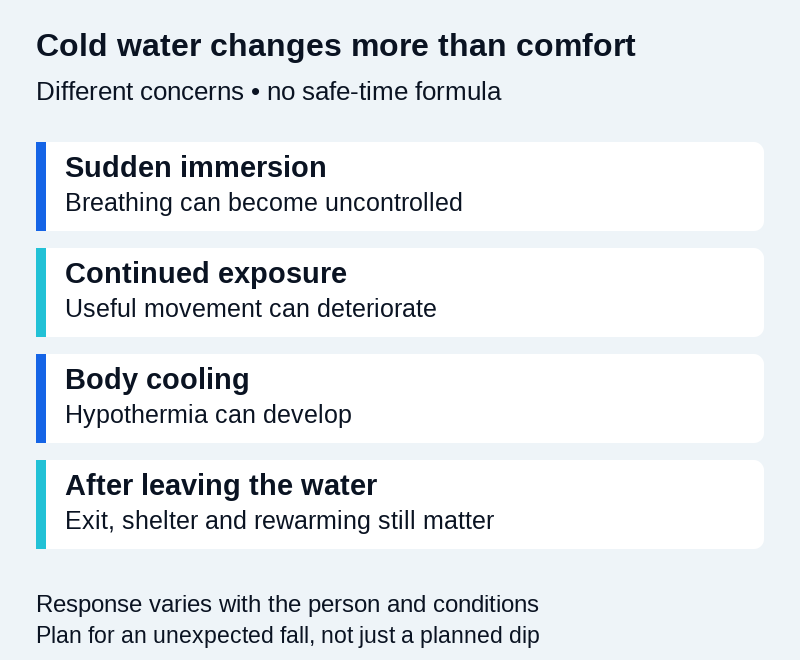
Figure 1. Different cold-water concerns, with no minute-by-minute survival scale. Sudden immersion can affect breathing; continued exposure can impair useful movement and cool the body. Exit and rewarming still matter after leaving the water. The sequence and severity vary between people and situations.
Atlas71 editorial illustration · Atlas71 original
Prepare the exit before the entry
Choose an appropriate supervised venue and learn its entry, exit and emergency arrangements. RNLI advises cold-water dippers to go with a companion, check conditions and enter gradually rather than jumping in. Stay near a usable exit; a short straight-line distance does not help if the bank is steep, the ladder is inaccessible or waves prevent landing. [5]
For paddling and boating, suitable flotation should already be worn, and clothing should account for immersion in the water rather than just the air temperature. A wetsuit, drysuit and buoyancy aid have different purposes and limitations. Get activity-specific advice on fit and use instead of assuming one item replaces the others. [1, 6]
Pool fitness does not automatically transfer to open water. RLSS UK's Pool to Pond programme explicitly develops the additional skills and knowledge needed for that transition. Training at a managed venue is a practical way to learn before adding cold, waves or current. [7]
Prepare dry layers and shelter close to the exit. Make it easy to call for help, and tell someone the plan. Acclimatisation and experience may change how cold feels, but feeling comfortable is not a certificate that continued exposure is harmless. Avoid competitions over duration or advice that converts each degree into an allowed number of minutes.
If you enter unexpectedly
Try to keep your airway clear and regain control of breathing before making an exhausting swim attempt. RNLI's Float to Live advice is to lean back with ears in the water, spread arms and legs for stability and use gentle movements if needed. Legs may sink without preventing floating. Once breathing is controlled, call for help or move to safety if able. [8]
Use the flotation you have and keep hold of a suitable craft if possible. Whether swimming is realistic depends on the conditions and the actual route to an exit. There is no reliable rule that a shore which looks close will remain reachable as movement deteriorates.
A companion should raise the alarm from a safe position rather than entering after the person. Contact the lifeguard or local emergency service and give the exact location. Follow the dispatcher's directions. A planned rescue arrangement is much more useful than expecting an untrained friend to solve a cold-water emergency in the moment.
Getting out does not end the assessment
Remove wet clothing, dry off and move into shelter with dry insulating layers. Keep company with someone who can recognise deterioration. Core temperature can continue falling after a cold-water exit, so “out of the water” is a stage in recovery, not automatic clearance to drive away or be left alone. [1]
Confusion, slurred speech, unusual drowsiness or concern about hypothermia requires urgent medical help. NHS guidance recommends moving the person into shelter, replacing wet clothing with dry coverings and staying with them. Avoid alcohol, rubbing the limbs or using a hot bath to warm someone with suspected hypothermia. Give food or a warm non-alcoholic drink only if fully awake and able to swallow safely. Follow emergency advice. [9]
This article cannot assess an individual after immersion. Breathing difficulty, loss of consciousness or other serious symptoms require emergency assessment rather than reassurance from the duration of the swim.
Example 1 A warm day with cold water
Fictional worked example. The weather, measurements and people are invented.
Two friends arrive for a first open-water swim on a 25°C afternoon. A current venue reading lists the lake at 13°C. One assumes that warm air and a short planned swim make special preparation unnecessary.
The two temperatures describe different environments. The 12-degree difference is not a formula for safe exposure; it simply makes the misleading air-temperature assumption visible. Water at 13°C falls within RNLI's cold-water warning range, and a first-time swimmer has no basis for borrowing another person's duration. [4]
They speak to the venue team, explain their experience and follow its arrangements. If suitable supervision, equipment or an easy exit is unavailable, they defer the swim. A conservative choice before entry is more useful than discovering the limitations while cold and tired.
Example 2 Two readings that do not match
Fictional worked example. All values and locations are invented.
A paddler sees a regional sea-temperature analysis of 17°C. A local launch operator reports 14°C from a nearby morning measurement. The paddler initially proposes averaging them to 15.5°C and choosing clothing around that midpoint.
That calculation would manufacture a third number without resolving the difference. The sources may sample different depths, times or areas. The paddler checks what each represents, asks about current local conditions and prepares for immersion using activity-specific advice. [2, 3]
The decision also includes wind, waves, flotation and the distance to an accessible landing. Even if a later local reading were higher, the route would not become suitable automatically. The worked lesson is to preserve uncertainty and plan for an unexpected fall rather than use a tidy average to dismiss it.
Before a cold-water outing
- Check a relevant water reading, including source, location, time and units
- Assess weather, currents, access and supervision alongside temperature
- Get suitable instruction and health advice when needed
- Prepare flotation and immersion clothing for the activity
- Identify an easy exit, a way to call for help and nearby dry shelter
- Do not use a temperature or online duration rule as permission to stay in
- After exit, warm gradually and seek urgent help for concerning symptoms
The most useful temperature reading is one that improves preparation. It cannot replace an assessment of the person, the activity and the place.
Sources reviewed on 2 October 2026. Figure 1 and both worked examples are original educational illustrations. No individual immersion time or medical outcome is predicted.