Lightning at the beach and on the water
What should you do if you hear thunder while swimming? Leave the water and exposed shore and go to a substantial enclosed building or a fully enclosed hard-topped vehicle. Do not wait for rain, a nearby flash or a warning on your phone. Thunder means lightning is close enough to threaten you. [1]
Plan that move before entering the water. A beach umbrella, tent, isolated tree or open-sided picnic shelter does not provide the protection of a suitable building or vehicle. If getting to proper shelter would take a long time, the decision to cancel or finish early needs to happen before the storm arrives. [2]
Treat thunder as a reason to get out
Forecast probability is not the same as local safety
Keep local guidance visible
Three article-specific ideas from this guide. They explain the topic; they do not represent measured local conditions.
Atlas71 editorial illustration · Atlas71 original · Evidence basis: NOAA / National Weather Service – Lightning Safety ↗
What you will learn
- If thunder is audible, lightning is close enough to be a concern.
- Thunderstorms can develop or move quickly.
- Keep local guidance visible
Why water and open shorelines are poor shelter
Lightning is an electrical discharge. Injury can result from a direct strike, a strike to a nearby object, current spreading over the ground or conduction through objects in contact with a person. Being below something taller is therefore not a dependable defence. An isolated tree can introduce danger rather than remove it. [3]
Water does not need to “attract” lightning to be hazardous. It conducts current, and a person swimming, standing on an open beach or sitting in a small open craft lacks a suitable enclosure. A paddleboard, inflatable or wetsuit is not lightning protection. Leaving the water but remaining beside it under an umbrella does not complete the move to shelter. [2, 4]
Lightning can strike away from the main rain area. Clearer sky overhead or a storm that looks offshore does not prove your position is outside its reach. NWS guidance emphasises that the threat can extend beyond the visibly wet part of the storm. [5]
You do not need to decide precisely how far away a rumble originated before acting. Counting the time between flash and thunder can be an educational distance estimate, but it must not become a reason to remain exposed when thunder is audible.
Decide where everyone will go
Before a visit, identify a suitable building or hard-topped enclosed vehicle that you can actually reach and enter. Confirm access rather than assuming a locked seasonal facility will be available. Account for the group member who moves most slowly, the beach exit and the time needed to get people out of the water. [2]
An evacuation plan is more than naming a car park. Which vehicle is accessible? Who has the keys? Will everyone fit? Are you planning to cross a tidal route or other hazard to reach it? These are practical questions to answer while conditions are calm, not during a hurried departure.
Treat a lifeguard's instruction to clear the water as an instruction to act immediately. Take people to shelter; do not prolong exposure to retrieve a ball, finish a photograph or pack a complicated beach setup. Equipment is replaceable. If lightning is already threatening, continuing towards proper shelter is more important than maintaining the original day's schedule.
Enlarge diagram
Scroll sideways to read all labels in the original illustration.
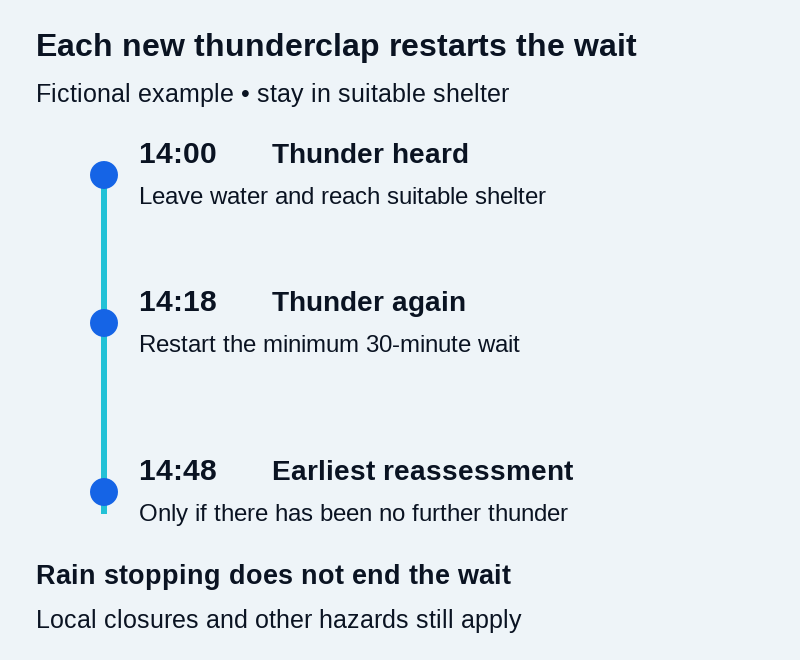
Figure 1. A fictional shelter timeline. A thunderclap at 14:00 starts a wait; another at 14:18 restarts it, so the earliest reassessment is 14:48. Everyone stays in suitable shelter. Thirty minutes is a minimum lightning wait, not automatic permission to swim or override a closure.
Atlas71 editorial illustration · Atlas71 original
Know what counts as shelter
A substantial building with enclosed walls is preferable to an exposed structure. An enclosed hard-topped vehicle with windows closed is an alternative when a suitable building is unavailable. Open vehicles, beach tents, pavilions and picnic shelters are not equivalent. Do not shelter under a lone tree or a small rocky overhang. [4, 5]
Inside a building, avoid contact with plumbing, wired electrical devices and windows during the storm. CDC advises against showers, bathing or washing dishes because lightning can travel through building systems. Staying indoors is a major reduction in risk, but how you behave there still matters. [4]
Within a vehicle, avoid touching conducting surfaces. NWS explains that an enclosed metal vehicle's outer structure provides the protection; rubber tyres are not the reason it is a suitable option. Convertibles and other open vehicles do not provide the same enclosure. [6]
These distinctions matter at beaches because many places that offer welcome shade or rain cover were not designed as lightning shelters. A roof alone should not be interpreted as clearance to wait under it.
Use forecasts and alerts before the emergency
Check the official forecast and warnings for the destination and the hours of the outing. Thunderstorm development and movement can change quickly, so keep monitoring conditions while outdoors. If storms threaten, finish early enough to be inside shelter before they arrive. [1]
A forecast probability describes uncertainty over its stated area and time. It is not a percentage guarantee that a particular beach will remain unaffected. Similarly, a lightning map displays detected activity, not a protective boundary around the last dot. An empty or delayed display cannot overrule thunder you can hear.
Do not wait for a severe-thunderstorm warning to take lightning seriously. In the United States, warning criteria do not depend simply on the amount of lightning; a thunderstorm can be dangerous to exposed people without meeting the severe criteria. Use thunder as an immediate action signal. [7]
For paddling or boating, check marine information and allow enough time to land before deterioration. An open craft may be far from any proper shelter. If a storm catches you out, follow local maritime emergency guidance and the instructions of a qualified operator; never jump into the water as a lightning-avoidance measure. Early avoidance is the reliable planning step. [2, 4]
Wait after the last thunder
NWS recommends remaining in suitable shelter for at least 30 minutes after the last thunder before resuming outdoor activity. Each new rumble starts that wait again. The clock does not begin when you leave the water or when the rain stops. [1, 2]
Before returning, reassess the complete situation: current warnings, further approaching storms, lifeguard instructions, wind, surf and access. A storm may leave unsuitable conditions even after the minimum lightning interval has elapsed. If the patrol has closed the beach or your planned route is affected, the expiry of a timer cannot reopen it.
Example 1 The rain never reaches the beach
Fictional worked example. The setting, forecast and people are invented.
A group is swimming at a managed beach. Dark clouds sit inland, while sunlight still reaches the water. The forecast had included a chance of afternoon thunderstorms. Someone hears a rumble and suggests staying until the first raindrops because the storm appears to be moving away.
The sound is enough to change the plan. The group leaves the water and follows the patrol's directions to suitable shelter. It does not debate whether the visible storm is five or ten kilometres away, and it does not move merely to an umbrella on the sand. [1, 5]
If rain never arrives, the decision was still appropriate. The relevant evidence was lightning close enough to produce audible thunder, not whether the towels became wet. The group remains sheltered for the required interval and follows any continuing closure.
Example 2 A second rumble resets the wait
Fictional worked example. All times are local and invented.
A family hears thunder at 14:00 and reaches an enclosed building. At 14:18, they hear another rumble. Rain stops at 14:25, and someone proposes returning at 14:30 because half an hour has passed since the first thunder.
The most recent thunder was at 14:18. Adding the minimum 30-minute interval gives 14:48 as the earliest time to reassess outdoor activity, provided no further thunder occurs. Rain ending at 14:25 does not change that calculation. [2]
At 14:48, they still check local instructions and the weather. If thunder recurs at 14:47, the waiting period restarts. If the beach remains closed, they stay away regardless of the timer. This is a timing exercise, not a prediction that the storm will end on schedule.
If someone is struck
Call the local emergency service and follow its instructions while considering the continuing lightning danger. A struck person does not retain an electrical charge and can be touched. CPR and an automated external defibrillator may be urgently needed; use your training and dispatcher guidance. Do not delay because of a fear that the person remains electrically charged. [8]
Before entering the water
- Check the official thunderstorm forecast and warnings for the full visit
- Identify reachable, accessible, suitable shelter and a practical route to it
- Leave early if storms threaten; act immediately when thunder is heard
- Keep away from water, trees and open shelters during the storm
- Stay sheltered at least 30 minutes after the last thunder
- Reassess the beach and obey continuing local restrictions before returning
Sources reviewed on 2 October 2026. Figure 1 and both worked examples are original educational illustrations. Follow current local instructions and emergency advice.