Understanding sargassum and seaweed on the shore
Does a line of seaweed mean a beach is polluted? Not by itself. Natural seaweed and other washed-up organic material are part of coastal ecosystems. Large sargassum accumulations can nevertheless create access, ecological and health concerns, especially as they decompose. Identify the kind of information you have, check local advice and avoid assuming that every brown strand has the same origin or significance. [2]
This guide helps visitors interpret seaweed reports and make practical choices. It does not identify a species from a photograph, forecast tomorrow's beach condition or authorise removal. The distinction between a natural strandline, a large inundation and mixed human-made debris matters.
Sargassum can be both habitat and a shoreline problem
Wind, waves and currents influence where it lands
Decomposition changes the experience
Three article-specific ideas from this guide. They explain the topic; they do not represent measured local conditions.
Atlas71 editorial illustration · Atlas71 original · Evidence basis: NOAA – Sargassum: From Sea to Shore ↗
What you will learn
- Floating Sargassum supports marine life in the open ocean.
- A large patch offshore does not guarantee a stranding at one beach.
- Large decomposing accumulations can produce strong odours and gases that may irritate some people.
Seaweed is a broad description
Sargassum is a group of brown algae; floating oceanic sargassum can form rafts that provide habitat, food and shelter for marine life. Winds and currents can bring large amounts towards land. Its value offshore and its potential problems when densely accumulated nearshore can both be true. [1]
Beach wrack is a broader term for natural material washed ashore, including seaweeds, seagrasses and some animal material. It supports coastal food webs, wildlife cover and dune development. Wrack belongs to the habitat rather than an ordinary waste stream. [2]
At an unfamiliar beach, use local identification information rather than calling all washed-up vegetation sargassum. A photograph of kelp on one coast does not demonstrate an Atlantic sargassum event. If you cannot identify the material, “brown seaweed along the upper strandline” is a useful description without a species claim.
Why accumulations can change quickly
Transport and beaching depend on wind, currents and the material already offshore. A broad regional abundance report therefore differs from an observation of one beach entrance. NOAA and partner products track sargassum and estimate where it may reach shore, but those products have defined coverage and forecasting purposes. [1]
When reading a report, distinguish floating material, material in shallow water and material already stranded on land. A beach photograph may show only one of those. A cleaned access strip is not evidence that offshore material has disappeared, and an offshore image does not prove the entire shoreline is covered.
The simplest useful record includes the beach section, observation time, whether material was floating or stranded, and approximate extent. A repeated photo from the same safe viewpoint can show a change. Do not present it as a complete measurement of a coast you have not surveyed.
What a large stranding can mean
Sargassum inundations can smother nearshore habitats and affect coastal infrastructure as well as recreation. Decomposition can release hydrogen sulfide, associated with a rotten-egg smell and respiratory irritation. NOAA also notes that the material can contain metals, contaminants and marine debris, which complicates management and reuse. [1, 3]
These are reasons for appropriate assessment, not reasons to declare every strandline acutely hazardous. The amount, condition, setting and official advice matter. Visitors should keep away from large decomposing piles and any restricted area rather than trying to determine exposure by standing beside the material.
Do not use smell as a meter. OSHA warns that the ability to detect hydrogen sulfide by smell can diminish even while the gas remains present. This occupational guidance is not a prediction of the concentration at a beach; it explains why “I cannot smell it now” is not a reliable clearance test. [4]
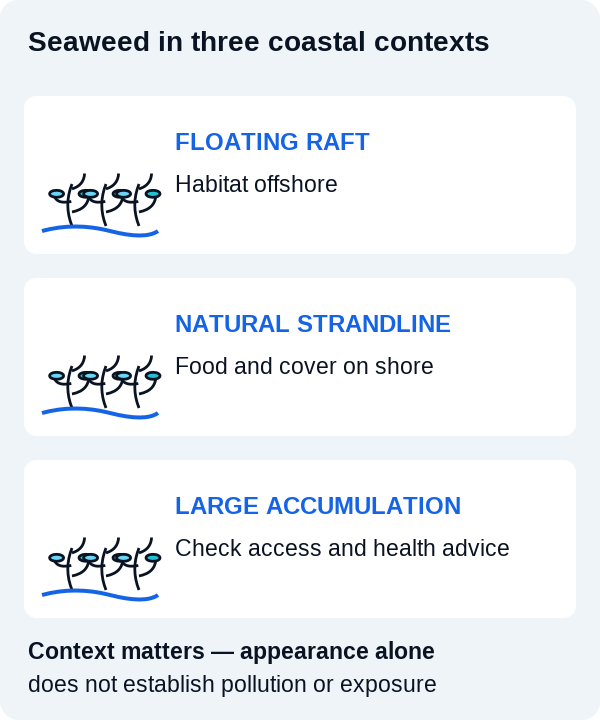
Enlarge diagram
Scroll sideways to read all labels in the original illustration.
Figure 1. Three coastal contexts: a floating sargassum raft, a natural strandline and a large decomposing accumulation. They call for different questions about habitat, access and current advice. The conceptual panels do not identify a real species, quantity or exposure level.
Atlas71 editorial illustration · Atlas71 original
Choose the visit around actual conditions
Check the beach manager's current notices and any local public-health advice. Ask about the specific access point you intend to use, rather than relying on a general statement that a long beach is open. Restricted sections, cleaning operations or wildlife protection areas may affect the route even when other sections are accessible.
Avoid direct contact with unfamiliar accumulations. Florida health guidance notes that small organisms living in sargassum can cause skin irritation. Do not let children dig through a heap or animals investigate stranded material. A protective shoe or glove does not make an unknown mixture suitable for handling. [5]
If the conditions cause discomfort, move away and choose another location. People with respiratory conditions should take local health advice seriously and seek individual clinical guidance when needed. Breathing difficulty or another medical emergency requires prompt emergency assistance, not a closer inspection to confirm what caused it.
A water-quality notice remains relevant even if seaweed is the most visible feature. Likewise, a seaweed report is not a bacterial test. Keep bathing advice, wildlife warnings, access information and seaweed observations together without treating one as a replacement for the others.
Example 1 A holiday photograph from the wrong week
Fictional worked example. The beach, dates and reports are invented.
A traveller sees a photograph labelled “East Palm Beach” with a thick band of brown material. It was posted yesterday but photographed twelve days earlier. A regional sargassum outlook also shows increased offshore abundance. The traveller assumes every part of the beach will be inaccessible throughout the holiday.
Neither source supports that precise conclusion. The photograph records one place at an older observation time. The outlook describes a wider area and a different kind of evidence. The traveller checks current local notices and asks the accommodation about the named public access point and nearby alternatives.
They keep flexible plans and recheck on arrival. A current report of a clearer section would still not guarantee the rest of the week. The useful decision is to plan around current site information and changeability, without turning either a dramatic photograph or a regional forecast into certainty.
Example 2 A cleanup group encounters natural wrack
Fictional worked example. The volunteer event and quantities are invented.
A group arrives to remove litter from a beach and finds seaweed mixed with bottles and wrappers. One volunteer proposes bagging everything and adding the weight to the plastic cleanup total. Another notices nesting-area signs nearby.
The organiser pauses and checks the beach manager's instructions. The group removes only permitted, safely accessible human-made litter from the agreed area, leaving natural wrack and protected habitat undisturbed. They do not move large piles or use machinery.
Their record separates 46 litter items from the natural material left in place. They do not claim that removing seaweed would improve the beach, or count its wet weight as plastic removed. The exercise shows how an apparently simple tidy-up can change meaning once habitat and measurement are considered. [2]
Cleanup and reuse need more than enthusiasm
Mechanical beach cleaning can disturb shorebirds, nests and small animals living in wrack. Local wildlife requirements, land-management permissions and the nature of the accumulation should shape any organised response. An ordinary visitor should not start moving large deposits or driving equipment onto the beach. [2]
Be cautious about suggestions to take stranded sargassum home for food, animal feed or garden use. Florida health guidance advises against cooking with it, and EPA discusses the contaminants and management challenges associated with inundation material. Suitability for any reuse requires appropriate assessment and local rules; “natural” is not a quality certificate. [3, 5]
Similarly, do not return mixed stranded material to the sea as an improvised solution. Unknown contaminants and debris need a managed response. Report an unusual accumulation or obstructed public access to the site manager and follow the disposal arrangements of an authorised cleanup.
A shoreline checklist
- Check the observation date, exact beach section and whether a report concerns floating or stranded material
- Read local access, public-health and wildlife notices before setting out and on arrival
- Recognise that natural wrack can be valuable habitat even when it looks untidy
- Keep away from large decomposing piles, unknown mixtures and cleanup machinery
- Do not rely on odour to establish the concentration or absence of a gas
- Avoid eating or repurposing stranded material without an appropriate, authorised assessment
- Record litter separately from natural seaweed and leave management of large accumulations to responsible operators
The goal is a better question than “Is seaweed good or bad?” Ask what is present, in what condition, at which place and time, and what current local advice says about the visit or action you are considering.
Source links reviewed on 2 October 2026. Both worked examples and Figure 1 are original educational illustrations, not current beach conditions.