Following litter from streets to the sea
How can a wrapper dropped far from the coast become a beach problem? Wind and runoff can move it into drainage networks and waterways, which may eventually connect to an estuary or the sea. The journey is not inevitable or identical for every item, but the connection makes prevention inland relevant to coastal protection. [1, 2]
This guide is about finding practical intervention points and documenting pathways responsibly. It does not invite you into drains, floodwater or restricted land. Nor does a litter hotspot prove who discarded its contents. Start with what can be observed safely, then use local drainage knowledge to decide what needs investigation.
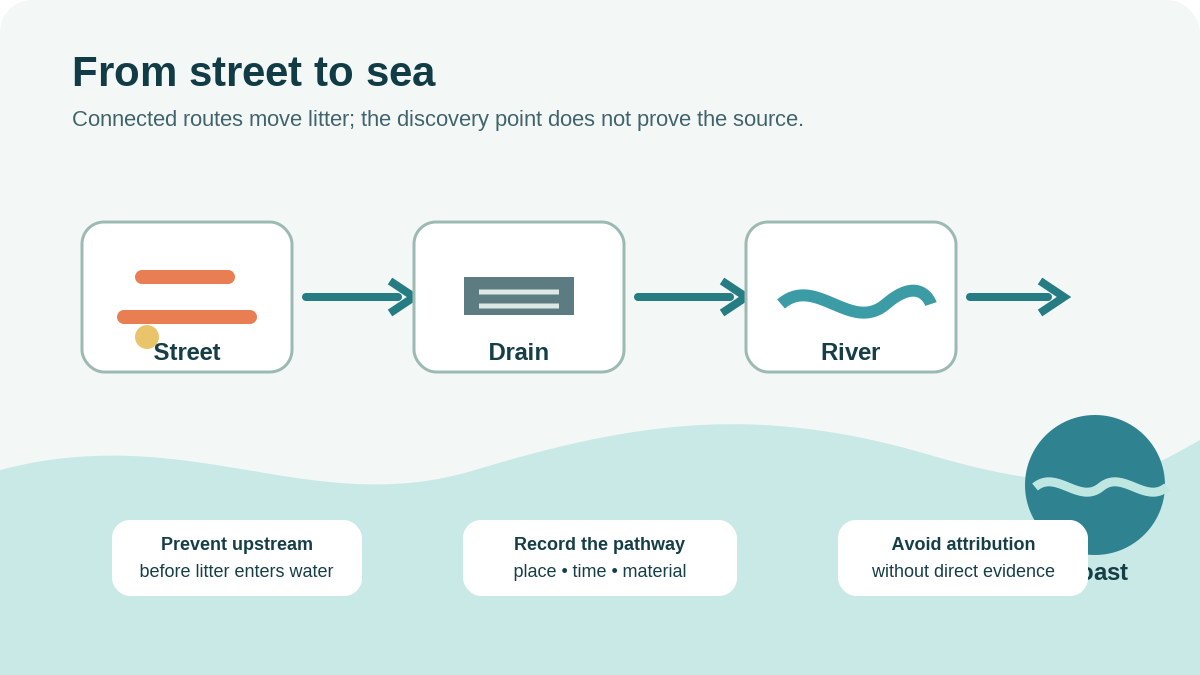
Litter moves through connected catchments; where it is found is not automatically where it entered the system.
Atlas71 editorial illustration · Atlas71 original · Evidence basis: UNEP – Source-to-sea approaches ↗
What you will learn
- Rain, wind, drains and rivers can move waste far from its entry point.
- Coasts redistribute debris after it reaches the sea.
- Record evidence without assigning an unsupported source or responsible party.
A pathway is a chain of connections
The first movement may be across dry ground. Lightweight material can blow from an unsecured bin, loading area or open vehicle. Rain can then carry loose litter from hard surfaces into gullies and drains. NOAA identifies wind and water transport as routes by which land-based debris can reach aquatic environments. [1]
In many places, separate storm drains discharge to local water bodies without passing through a wastewater-treatment plant. Pipes, ditches and other conveyances can all form part of that network. That is why putting waste down a roadside drain is not a disposal solution. [2]
Local systems differ. A visible drain may connect to a stream, a storage or treatment feature, a combined system, or another part of a network you cannot see. Do not draw a definite route from the nearest drain to the nearest beach without evidence. Ask the drainage authority or consult an appropriate published map.
Material may stop and move again
Litter can be trapped temporarily on vegetation, banks or structures and later remobilised. Material reaching the coast can also be redistributed by wind, waves and currents. A final resting place seen during one visit is therefore not necessarily the first place it entered the environment. [1, 3]
For an investigation, distinguish an input point from an accumulation point. An overflowing bin spilling onto pavement is a directly observed containment problem. A concentration at a river bend shows where material has gathered. Both are useful, but they support different actions.
The practical question becomes “Where can loss be prevented?” rather than “Which place looks dirtiest?” A small upstream improvement may prevent repeated downstream removal, while a downstream cleanup may still be necessary for material already present. These actions can complement one another without an unsupported claim about exactly how much ocean pollution each will prevent.
Build a modest evidence map
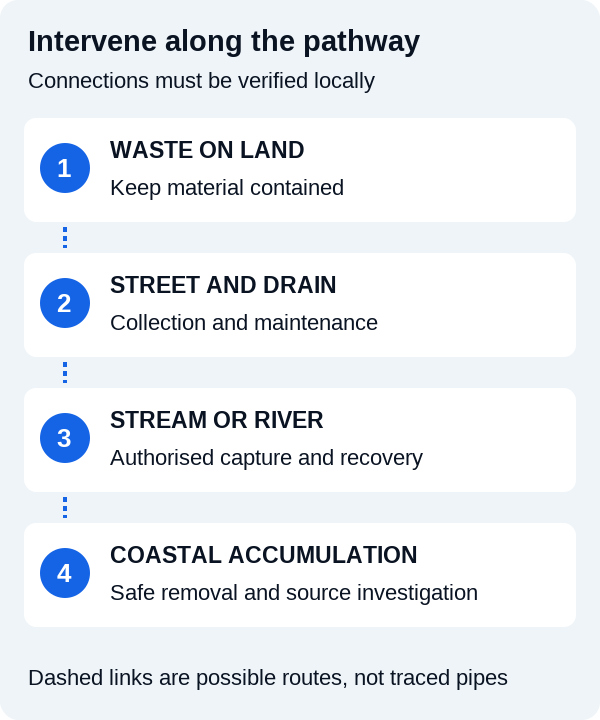
Start with a bounded area you can access safely, such as a park path and its public street frontage. Mark observed waste sources, accessible drains and the visible waterway. Label unknown connections as unknown. Do not let a neat arrow on a diagram imply that someone has traced the pipe.
For each observation, record the date, time, location, material and context. Was a bin open or overflowing? Was rainwater visibly carrying litter across a kerb? Was a drain blocked, or was the material merely nearby? Describe the difference. Photographs should show the relationship clearly without entering traffic or standing on a drain cover.
If you revisit, use a comparable route and note what changed: collection took place, an event ended, heavy rain occurred or access was closed. A record that includes these conditions is more useful than a series of isolated counts with no explanation of effort.
Enlarge diagram
Scroll sideways to read all labels in the original illustration.
Figure 1. A conceptual source-to-sea chain with four possible intervention points: containment, street collection, maintained drainage controls and downstream recovery. Dashed connections indicate routes that need local verification. The diagram is not a map of a real drainage network.
Atlas71 editorial illustration · Atlas71 original
Choose prevention at the earliest practical point
Secure storage and appropriate collection can keep waste from becoming mobile in the first place. At a community event, check whether bins are suitable for the expected use, positioned where people need them and serviced before they overflow. A plan that includes the end-of-event pickup is stronger than simply adding another container.
At home, a school or a business, reduce avoidable loose packaging and follow local recycling rules. Keep waste contained while awaiting collection. EPA's trash-pollution guidance encourages both reducing waste and community action; prevention works best when it addresses the actual materials and handling arrangements you observe. [4]
Do not assume every collected item can go into ordinary recycling. Local acceptance depends on the material and its condition. Agree the destination with the waste operator before a cleanup, and separate items according to its guidance. Moving litter from a riverbank to an unmanaged pile has only changed the point at which it can escape.
Drainage devices need professional ownership
Screens, catch basins, booms and other capture systems can intercept material, but design and maintenance matter. EPA describes site-specific considerations including hydrology, operational capacity and regular removal of captured waste. Some systems must accommodate high flows and avoid causing flooding. [3]
Do not fit improvised mesh over a public drain, open a manhole or place a boom across a stream. These actions can create hazards and interfere with infrastructure. Report a blockage or propose a device to the responsible authority, which can assess permissions, hydraulic effects and maintenance responsibilities.
For a proposed intervention, ask who will inspect it, who will empty it, where the recovered waste goes and what happens during a storm. A photograph of captured litter is not enough to establish that the device is suitable or that it can be left indefinitely.
Example 1 A bin beside the river path
Fictional worked example. The park, observations and timing are invented.
A walking group records snack wrappers along a 200-metre path on three Monday mornings. On each visit, one bin's lid cannot close and material lies around it. The group can see some wrappers being blown towards a public drainage channel, but cannot trace the channel beyond the park.
They send the land manager dated photographs and a location pin. The report describes an observed containment problem and a possible transport route, without claiming that every wrapper reaches the sea. The manager agrees to review collection timing and the bin's condition.
The group repeats the same walking route after the change, recording the date and whether the bin was recently emptied. A lower count would be encouraging local evidence, but one visit would not establish a long-term trend or a quantified reduction in ocean plastic. The action is useful even with those limits.
Example 2 More litter at the outfall after rain
Fictional worked example. The shoreline, counts and weather are invented.
Volunteers count 40 visible items near an outfall on a dry visit and 110 after a storm. A member proposes announcing that upstream littering increased by 175 percent. The arithmetic correctly describes the difference in the two counts, but the causal claim is unsupported.
Rain may have transported existing material, the searched area may differ, or the first visit may have followed a cleanup. The record does not establish the rate at which new litter was discarded. The group reports increased visible accumulation at this location after rain and asks whether the drainage catchment has known recurring waste problems.
It also avoids entering the outfall to investigate. The next useful step is a discussion with the authority about safe monitoring and possible source-control opportunities, rather than an attempt to trace a pipe from inside it.
Measure the action and test the outcome separately
A prevention record can state what was done: a lid repaired, collection frequency changed, a specified route cleaned or an event's waste arrangements revised. An outcome claim needs evidence appropriate to its scale. Fewer items found beside one bin does not demonstrate that an entire estuary became cleaner.
If your aim is comparison, choose a standardised protocol and consistent effort. NOAA explains why opportunistic observations and standardised surveys have different strengths. A volunteer snapshot may identify a problem; a planned series is better suited to testing whether conditions changed. [5]
Keep negative observations as well as dramatic ones when the protocol requires them. Recording “no visible litter on the surveyed route” is different from skipping a clean visit entirely. Also record inaccessible sections, since an incomplete survey should not look like a complete zero.
A source-to-sea action checklist
- Define a safe, accessible area and record actual observations before drawing a route
- Verify drainage connections through suitable local information and label unknowns
- Address containment and collection before relying only on downstream recovery
- Report blocked drains and leave infrastructure changes to responsible operators
- Use comparable monitoring if the goal is to evaluate a prevention measure
- Keep disposal arrangements, maintenance ownership and storm conditions in the plan
- Describe the effect at the scale your evidence supports
A source-to-sea approach is useful because it broadens the places where prevention can happen. Its value does not depend on tracing every piece of litter or assigning blame from a strandline.
Source links reviewed on 2 October 2026. Both worked examples and Figure 1 are original educational illustrations, not traced real-world drainage routes.