Coral reefs: why they matter and how visitors can reduce harm
How can a visitor help protect a coral reef? Start by treating it as a living habitat: keep fins, hands, anchors and equipment clear, follow local access rules and choose an activity you can control without touching the bottom. These actions reduce direct local damage. They sit alongside the larger work needed on warming, water quality and other pressures.
A careful visit cannot solve every threat, but it can avoid adding an unnecessary one. This guide explains what a reef is, why bleaching needs careful interpretation and which practical decisions matter before, during and after a trip.
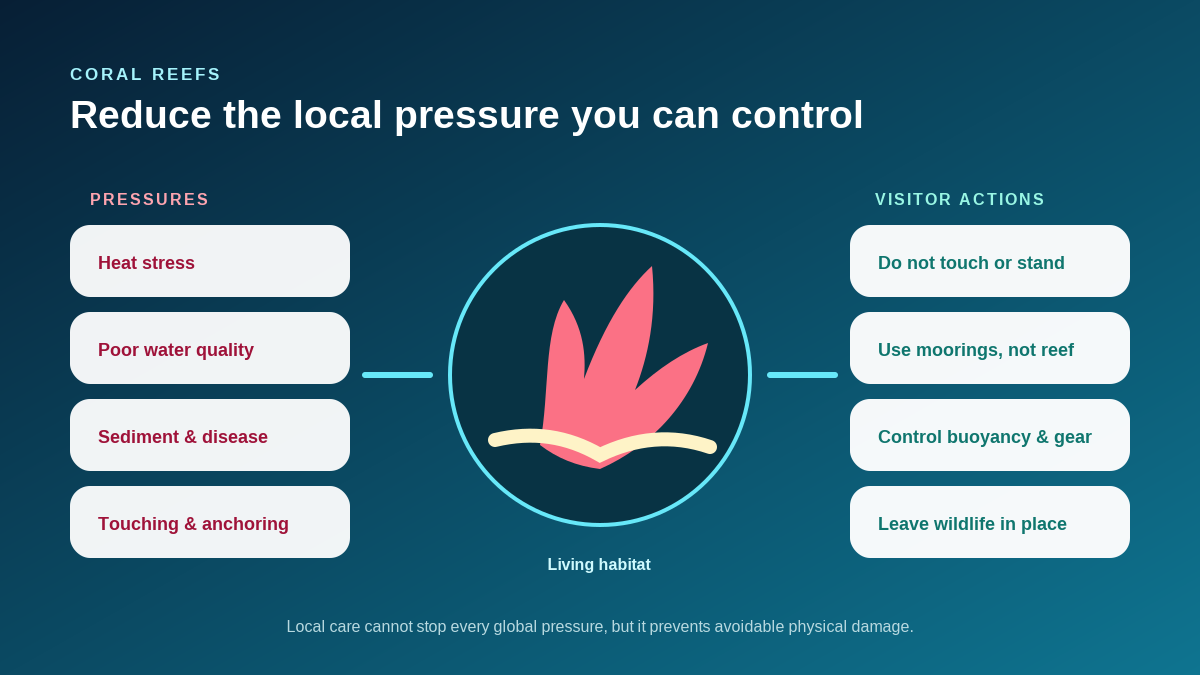
Visitors cannot remove global reef pressures alone, but careful access, buoyancy, anchoring and waste choices can avoid adding local damage.
Atlas71 editorial illustration · Atlas71 original · Evidence basis: NOAA Fisheries – Coral conservation ↗
What you will learn
- Corals are living animals forming habitat, not rock or decoration.
- Heat stress interacts with water quality, disease and physical damage.
- Do not touch, stand on, collect from or anchor on reef habitat.
A coral is an animal and a reef is a habitat
Corals are animals made of small organisms called polyps. Many familiar reef-building corals live as colonies and produce calcium-carbonate skeletons. Many shallow tropical corals also contain microscopic algae in their tissues; this partnership supplies important energy and contributes to their colour. Not every coral builds a tropical reef, and deep-water coral communities have different conditions and biology. [1]
The reef structure develops through biological growth and physical processes over time. Its surfaces, crevices and spaces support fish and many other organisms. What looks like a rock can have living tissue, young colonies or other attached life on it. A visitor should not decide that a patch is harmless to stand on from its colour alone.
Reefs matter to people as well as wildlife. They support fisheries, coastal livelihoods, recreation and cultural relationships. Their physical structure can reduce wave energy reaching shore, although the amount of protection depends on the reef and coastal setting. These benefits belong to functioning ecosystems, not simply to the presence of colourful coral in a photograph. [2]
Bleaching is a stress response, not an instant death diagnosis
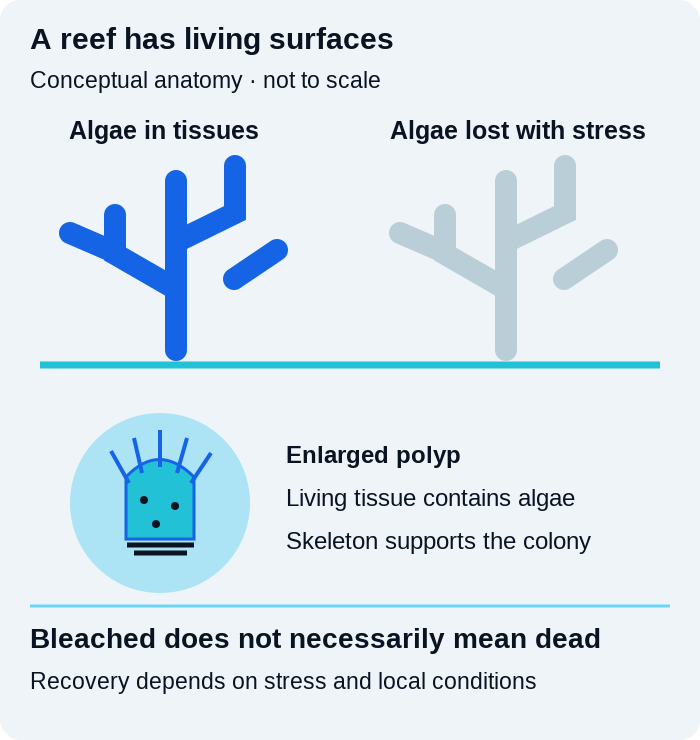
Under stress, corals can lose the algae living in their tissues and become pale or white as the skeleton shows through. Unusually warm water is a major cause of widespread bleaching, though other stresses can contribute. A bleached coral is not necessarily dead: it may recover if conditions improve, or die if stress persists. [3]
This makes a visitor's description important. “Several colonies appeared pale in this photograph” records an observation. “The whole reef has died” makes a much larger claim that a short visit cannot support. Lighting, species differences and naturally pale growth can complicate interpretation. Report suspected bleaching through the local manager's monitoring programme rather than trying to confirm it by touching or scraping a colony.
Recovery also means more than colour returning to one patch. Scientists and managers may examine survival, growth, recruitment, disease, habitat structure and the surrounding community. A single encouraging image cannot establish that a whole reef has recovered, just as one alarming image cannot measure its total loss.
Different pressures act through different mechanisms
Warming can disrupt the coral-algae partnership. Ocean acidification is a separate consequence of increased carbon dioxide: chemical changes reduce carbonate availability and can make building and maintaining calcium-carbonate structures more difficult. Acidification means a decline in pH; it does not mean the whole ocean has become an acid in the everyday sense. [4]
Local pressures include sediment, nutrient pollution, disease, unsustainable fishing and physical damage. Excess sediment can interfere with the light and conditions corals need, while changes to fish communities can affect reef processes. NOAA describes climate change, unsustainable fishing and pollution as major threats requiring different management responses. [2, 5]
Avoid the implication that choosing a particular sunscreen or joining one cleanup resolves those pressures. Equally, the scale of climate change does not excuse avoidable damage from a fin or anchor. Effective protection needs both wider action and careful local management, informed by the particular reef rather than a single global slogan.
Enlarge diagram
Scroll sideways to read all labels in the original illustration.
Figure 1. An original conceptual view of a coral colony, its living tissue and supporting skeleton, with an enlarged polyp and algae. A second pale colony illustrates bleaching as a stress response. The diagram is not a species-identification or health-diagnosis tool.
Atlas71 editorial illustration · Atlas71 original
Prepare your skills before approaching the reef
Choose a snorkelling or diving activity that matches your training and comfort in the day's conditions. If you cannot maintain position without standing or grabbing, ask the guide for a suitable alternative or finish the session. Photography should not take priority over control of your body and equipment.
The Great Barrier Reef Marine Park Authority advises practising buoyancy away from coral, securing equipment, moving deliberately and avoiding contact with the reef. It also advises against feeding fish or moving marine life for photographs. [6] The same habits are useful questions to discuss with a responsible operator elsewhere, while local rules remain decisive.
Before entering, ask where to go, what to avoid, how to signal difficulty and how to return. Check fins, straps and dangling accessories. Keep enough distance that a wave or unexpected movement does not put you onto the coral. There is no universal clearance distance that accounts for every swimmer, swell and reef shape.
A boat visit needs bottom awareness too
An anchor and its chain can damage coral even when the people aboard never enter the water. Use designated moorings where suitable and permitted, follow their vessel limits and respect no-anchoring areas. The Reef Authority's visitor guidance identifies moorings and site-specific management as important ways to protect reefs and seagrass. [7]
A patch that appears sandy from the surface still requires proper navigation and local assessment. Do not drop an anchor on the basis of a tourist map or an old aerial image. If an anchor is fouled or equipment is caught, avoid an improvised recovery that endangers people or tears through habitat. Get qualified local assistance.
As a passenger, useful questions include how the operator uses moorings, briefs visitors and handles someone who struggles in the water. A provider's willingness to change a site or cancel for conditions is valuable evidence of practical care. Advertising words alone do not establish its operating standards.
Protect skin while reducing avoidable exposure
Use shade, suitable protective clothing and effective sun protection. Do not stop protecting yourself from ultraviolet exposure in order to visit a reef. Check local sunscreen requirements and current official advice for the destination.
A “reef-friendly” label is not proof that a product cannot harm marine life. The US National Park Service warns that products using that label may still contain ingredients of concern and recommends protective clothing as part of sun protection. [8] Product chemistry and environmental exposure are complex; avoid broad claims that every mineral product is harmless or that one visitor's sunscreen caused a particular bleaching event.
Example 1 A photographer cannot hold position
Illustrative only. The reef, people and events are fictional.
A snorkeller joins a guided visit hoping to photograph a small fish beside branching coral. The surface is mildly choppy. While adjusting the camera, they drift towards the colony and feel tempted to stand on a pale-looking patch to steady themselves.
The pale patch is not an assessed standing area, and the camera is consuming attention needed for control. The snorkeller signals the guide, moves away without touching the reef and puts the camera aside. The guide offers an appropriate supported alternative within the session's safety arrangements.
If the snorkeller still cannot keep clear, they leave the water. The success is a changed decision before contact occurs, not obtaining the photograph at any cost. A flotation aid or protective footwear would not create permission to stand on living habitat.
Example 2 A pale patch becomes an exaggerated headline
Illustrative only. The observations and reporting process are fictional.
Two visitors see several pale colonies along one guided route and take photographs from the permitted distance. They consider posting “this reef is dead”. Their images cover only a small area, and neither visitor can identify the species or confirm whether the tissue is alive.
They instead provide the site, date, approximate depth and original photographs to the local reef monitoring programme, describing the colour change without diagnosing its cause. They explain that the report concerns several observed colonies, not a full reef survey.
Managers can compare the evidence with other observations and thermal conditions. The visitors have supplied useful information without collecting a sample, disturbing the colony or making a claim the evidence cannot support. If they share a public account, they retain that same limited, accurate wording.
A lower-impact reef visit
- Check the marine park or site authority's current access, activity and reporting rules.
- Choose an operator and session suited to your skills, with a clear briefing and practical support.
- Keep hands, fins and equipment off coral and other marine life; do not feed or reposition animals.
- Use permitted moorings and appropriate navigation rather than anchoring on sensitive habitat.
- Combine protective clothing and shade with effective, locally compliant sun protection.
- Report suspected damage, bleaching or pollution through the official local route, with time, place and cautious descriptions.
- Support credible management and restoration work without assuming that planting a coral offsets damage elsewhere.
Sources reviewed on 2 October 2026. Both worked examples and Figure 1 are original educational illustrations, not assessments of a real reef or product endorsements.