How to care for a place and track what changes
A place can look cleaner after one visit and still need attention next month. Stewardship means returning with a clear purpose, working with the people responsible for the site and keeping enough evidence to learn whether conditions improve. The useful question is “what should we check next, and what would count as progress?”
Separate a completed task from environmental recovery. A cleanup can be finished today. Recovery may require repeated evidence about habitat, water or wildlife over a much longer period. NOAA's restoration framework distinguishes whether work was implemented from whether it achieved its intended effects. That distinction is just as useful for a modest community project. [1]
A one-off action is not the same as recovery
Define a specific task
Stewardship adds accountability, not authority
Three article-specific ideas from this guide. They explain the topic; they do not represent measured local conditions.
Atlas71 editorial illustration · Atlas71 original · Evidence basis: EPA – Participatory Science Quality Assurance ↗
What you will learn
- A cleanup or intervention can be recorded immediately.
- Useful tasks address a real question or documented gap and include safety and access limits.
- Coordination alone does not grant authority over closures, wildlife or hazardous work.
Begin with the place and its responsibilities
Identify the landowner or manager, relevant authorities, local community groups and any existing monitoring or conservation programme. Find out what work is already happening before starting a parallel effort. A new group can be most useful by filling a recognised gap rather than duplicating records or disturbing an established survey.
Clarify permission and responsibility. A volunteer coordinator can organise an agreed activity, but that role does not grant authority to close a beach, handle protected wildlife, move hazardous material or undertake engineering work. Follow the site's access and habitat restrictions and use the appropriate official reporting channels. NOAA's field guidance explicitly places local laws, closures and sensitive habitat exclusions above a survey plan. [2]
Agree a realistic area of attention. A defined access path, short shoreline segment or established observation point is easier to revisit consistently than an entire coastline. Describe boundaries in terms another participant can recognise, with a map or fixed landmarks where suitable.
Establish a baseline that answers the question
A baseline describes conditions before an intervention or at the beginning of a monitoring period. It needs a method and a date, not just a memorable photograph. If the aim is to understand litter accumulation, record the relevant categories and sampling effort. If the aim is habitat restoration, seek qualified advice about appropriate ecological measurements.
NOAA restoration-monitoring guidance explains the role of pre-restoration observations and reference conditions. A reference can help define the desired state or interpret change, but it must be appropriate to the habitat and question. The nearest apparently healthy site is not automatically a valid comparison. [3, 4]
Be honest when a baseline is missing. A project can still document an action and begin follow-up, but it should not invent a before condition from memory. Historical photographs or earlier surveys may offer context if their dates, methods and limitations are retained.
Turn a broad goal into a specific task
“Protect this bay” is a goal. “Photograph the existing sign from the public path and record whether it is legible” is a bounded task. Useful tasks say what evidence is needed, where it can be collected, who will review it and what safety or access conditions stop the activity.
Other appropriate tasks might include checking whether a reported damaged step has been repaired, repeating an established litter survey or confirming that an agreed waste collection occurred. The next step should arise from an actual question or documented gap, not from a need to generate activity.
Keep observation tasks distinct from interventions. Recording the presence of a loose fishing net does not authorise pulling it free. Seeing vegetation in an unexpected place does not authorise removing it. If the proposed action could affect habitat, infrastructure, public health or wildlife, involve the responsible specialists before proceeding.
Enlarge diagram
Scroll sideways to read all labels in the original illustration.
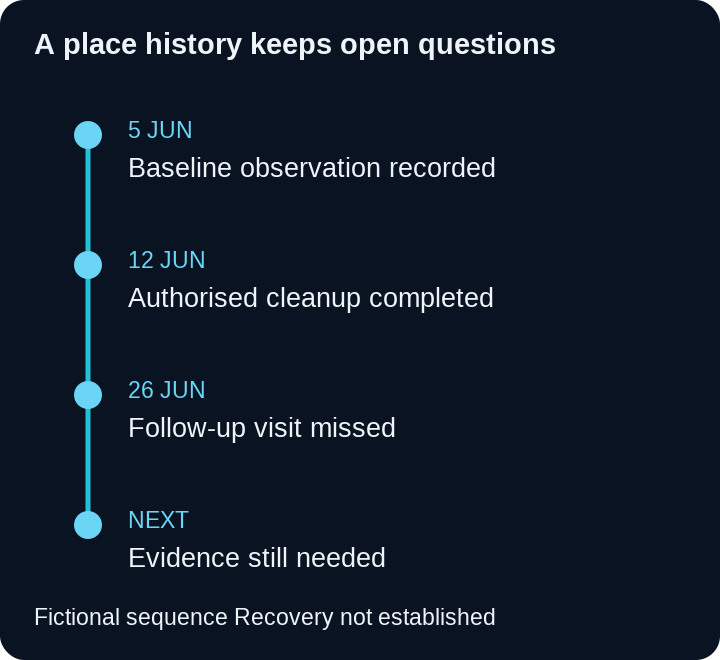
Figure 1. An invented place history separates an initial observation, an authorised action, a planned follow-up and a later evaluation. A missing follow-up is shown as an open question, not a recovery claim. Dates and events are illustrative.
Atlas71 editorial illustration · Atlas71 original
Plan follow-up before the first action
Choose the information that would show whether the task worked. A repaired sign can be checked for installation and readability. An ecological intervention may need a longer monitoring schedule, several parameters and specialist interpretation. Use a schedule suited to the process rather than checking frequently just because a reminder can be created.
NOAA's implementation-monitoring guidance connects objectives, measurements, timing and targets before work begins. Its formal requirements apply to its own programmes, but the planning principle is widely useful: decide how success will be assessed while the necessary evidence can still be collected. [5]
Assign an owner for the next check and a backup for unavailable participants. Record missed visits transparently. If storms, closures or wildlife restrictions prevent access, the project should preserve the gap and return only when appropriate. Maintaining a tidy schedule is never a reason to cross a safety boundary.
Read change in its wider context
A lower litter count after a cleanup is expected in the worked area, but later accumulation depends on new inputs, movement of water, wind, visitors and other activity. A single quiet week does not show that the source has been solved. Repeated observations using an appropriate method provide stronger evidence than a sequence of selectively chosen photographs. [6]
Likewise, the presence of one animal does not establish recovery of a population or habitat. A change may be seasonal or unrelated to the intervention. NOAA's adaptive-management guidance treats monitoring as a way to assess progress and adjust decisions, with uncertainty retained rather than ignored. [4]
State both encouraging and unfavourable results. If an action did not achieve its goal, investigate whether the method, target, timing or underlying cause needs reconsideration. A stewardship record is most valuable when it helps the next decision, including a decision to stop an ineffective or harmful approach.
Keep the record usable for the next person
Maintain a simple history of observations, permissions, actions, evidence and unresolved questions. Each entry should identify its date, location and source. Distinguish a volunteer report, a checked measurement, a professional assessment and an official notice.
Do not overwrite the earlier concern when it is resolved. Add the resolution evidence and date so a later reader can understand what changed. If a report was mistaken, correct it openly within the record. If the evidence is inconclusive, keep that status rather than forcing a binary “fixed” label.
Protect sensitive information. A public summary may need less location detail than the record shared with a qualified wildlife responder. Store only information relevant to the project and follow the responsible programme's data requirements. Sustainable stewardship includes a manageable handover, so the place history should not depend on one person's private recollection.
Example 1 The cleanup is complete but the source is not
Illustrative only. The site, dates and events below are fictional.
A local group and land manager agree a cleanup near a beach entrance. The group records 70 items removed on 5 June and the disposal receipt. On 19 June, a repeat observation using the same stated method finds a new concentration of wrappers near an overflowing bin.
The first action remains complete. The second observation shows an unresolved or recurring issue, not proof that the first record was false. The group reports the bin condition to the responsible manager and asks whether waste-storage arrangements need review. It does not claim that every wrapper came from that bin or publicly blame a particular business without evidence.
The next agreed check concerns the relevant management action and a suitable follow-up observation. The record separates removal, suspected pathway, confirmed response and later outcome.
Example 2 A greener photograph does not prove recovery
Illustrative only. The habitat project and observations below are fictional.
An authorised restoration project has a photograph from a dry month and another from a wet month showing more visible vegetation. A volunteer suggests marking the site as recovered. The project plan, however, calls for measurements of native plant survival and habitat conditions at specified intervals.
The photographs are retained as useful context, but the greener image does not replace those measurements. Seasonal growth, viewing angle and the species present could affect the appearance. The group follows the approved monitoring plan and asks the responsible specialist to evaluate the results.
If the target measurements are incomplete, the status remains “follow-up needed”. That is a useful statement of the next task. Declaring recovery early would hide the evidence still required to judge the project.
Before planning the next visit
- Confirm the responsible manager, permissions and existing work at the site
- Define a specific question and a bounded area
- Preserve the baseline and method, or state that they are missing
- Distinguish observing a problem from being authorised to intervene
- Assign a proportionate follow-up with safety and access limits
- Compare results using appropriate methods and account for other explanations
- Record completed actions, unresolved questions and supported outcomes separately
Sources reviewed on 2 October 2026. Both examples and Figure 1 are original educational illustrations. They describe general stewardship practice, not the assessment of a real place.