Beach flags and the instructions that matter locally
Does a familiar flag colour mean the same thing at every beach? Do not assume so. Read the local sign, establish who is on patrol and follow the lifeguard's current instructions. Some flags describe conditions; others mark the area for a particular activity. Neither a flag nor a forecast removes the need for supervision and judgement. [2, 9]
The most useful first question is “Where should we swim today, and what do we need to know?” Ask it before entering. A patrol may know about a new channel, a changing shorebreak or an incident that does not appear on a weather display. A local closure or direction to leave the water takes precedence over a reassuring forecast.
Flags are local operational information
Lifeguard instructions outrank modelled conditions
How Atlas71 should display flags
Three article-specific ideas from this guide. They explain the topic; they do not represent measured local conditions.
Atlas71 editorial illustration · Atlas71 original · Evidence basis: RNLI – Beach flags and signs ↗
What you will learn
- A beach flag is not a universal forecast score.
- A model can describe wind, waves, tide or other hazards, but a lifeguard can see local conditions and incidents that a model cannot.
- Show the current flag only when Atlas71 can identify the source and freshness.
Flags have different jobs
A warning flag communicates a hazard level or a particular concern under the system adopted at that beach. A zone flag marks where an activity belongs. An operational sign may say that lifeguards are off duty. These messages answer different questions, so identifying the colour is only the beginning. [9]
For example, two flags can mark the lateral limits of a swimming area. They do not mean the entire coast between two similarly coloured symbols on a regional map has been inspected. Nor does the area extend indefinitely offshore. Ask the patrol where to remain and whether any further limits apply.
Read nearby words and symbols, including temporary signs. A prohibition is an instruction that an activity is not allowed, not simply an invitation to decide whether you feel capable. Keep everyone in the group informed, especially when someone did not pass the entrance sign or cannot readily distinguish the colours.
An example from RNLI beaches
At RNLI-lifeguarded beaches in the UK and Channel Islands, red-and-yellow flags identify the patrolled swimming and bodyboarding area. Black-and-white chequered flags identify a zone for surfboards and other non-powered craft; swimming and bodyboarding do not belong there. A red flag means dangerous conditions and do not enter the water. [1]
The orange windsock warns of offshore or strong winds and means inflatables should not be used. These descriptions are specific to the cited system. They are useful preparation for an RNLI beach, but they should not be copied onto a foreign beach without checking its own legend. [1]
A board is not automatically allowed wherever another board is visible. Different craft create different collision and launch concerns. If the boundary or activity rule is unclear, ask before setting up at the waterline.
Other systems use other distinctions
Miami-Dade County's beach guidance describes green, yellow and red hazard flags, double red for closure to swimmers, and purple for dangerous marine life. Volusia County also publishes a local flag guide. These official examples show why a traveller should consult the destination's system rather than treat a remembered colour chart as universal. [2, 3]
A lower hazard category does not mean no hazard exists. The label is an operational summary, not a personalised assessment of swimming ability, medical needs, child supervision or the intended activity. A marine-life flag can also convey information different from the surf condition.
In Australia, healthdirect advises choosing a patrolled beach, swimming between red-and-yellow flags and avoiding a swim where those flags are absent. Follow the actual patrol and local notices, including temporary closures, rather than importing instructions from a different country. [4]
Enlarge diagram
Scroll sideways to read all labels in the original illustration.
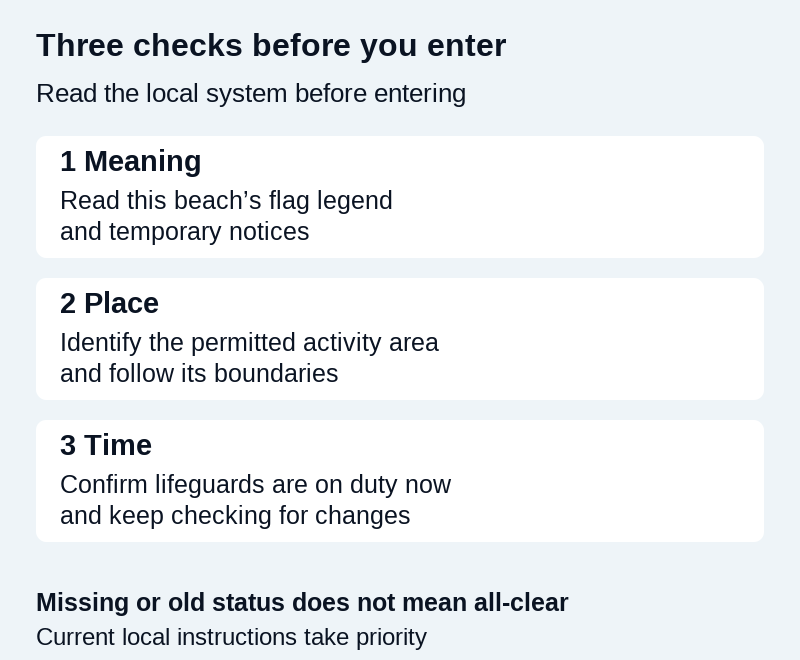
Figure 1. A three-question check before entering: what does this beach's legend say, where is the permitted swimming area, and are lifeguards on duty now? This is a reading sequence, not a flag-colour chart or a live status display.
Atlas71 editorial illustration · Atlas71 original
A lifeguarded beach has hours and boundaries
“Lifeguarded” in a directory is not a promise of supervision at every hour or in every season. RNLI describes lifeguards setting up and taking down safety equipment as part of the patrol day. Check the dates and hours for the exact beach, then confirm that patrols are operating when you arrive. [5]
An empty tower, a missing flag or a removed sign should not be interpreted as an all-clear. It may mean no service is operating, the location has changed or information is unavailable. If you cannot establish the local arrangement, choose another supervised option or stay ashore.
Ask again after a significant change. A marked area can be reassessed as the tide, waves or beach conditions change. Your photograph of the flags at arrival is not a permanent map for the day. Keep looking towards the patrol and respond promptly to whistles, announcements and direct instructions.
Lifeguards prevent incidents as well as respond
RNLI explains that prevention includes understanding a beach's geography, identifying hazards and advising visitors. Moving flags or asking people to relocate is part of that work. You do not need to see a dramatic rescue or an obvious hazard for the instruction to be important. [6]
Useful questions are specific: “We have a first-time sea swimmer; where should we stay?” or “Is the entry affected by shorebreak today?” Explain the activity and any relevant limitations rather than asking the broad question “Is it safe?” The answer may be to change the activity entirely.
A lifeguard's presence is an additional layer of protection, not a substitute for looking after the people you brought. CDC advises close and constant supervision of children even when lifeguards are present. Designate a responsible adult, avoid distractions and do not rely on another adult having silently taken over. [7]
Flotation toys do not replace suitable lifejackets or competent supervision. Nor do swimming lessons eliminate drowning risk. Match the outing to the least experienced member and be willing to remain on land if the group cannot follow the local arrangement comfortably. [7]
Read online flag reports carefully
An online flag report needs a beach name, issuing authority and update time. A photo may show what was flying when it was taken, while an official current notice may describe a later change. A forecast icon is a different kind of evidence again. These should not be merged into a single claim that the beach is open.
Check whether the report applies to the precise beach section and the planned time. Where an app and the on-site patrol disagree, follow the current local instruction. If there is an official closure for water quality or another hazard, a surf-condition flag does not cancel it. CDC advises checking and obeying beach closure and water-quality information before entering natural water. [8]
For someone sharing a photograph or condition report, include when and where it was observed and avoid presenting it as a continuing official clearance. The useful information is the observation with its limits, not a permanent green label.
Example 1 A quiet area beyond the flags
Fictional worked example. The beach and people are invented; this example uses the RNLI system.
A family arrives while lifeguards are on duty. The red-and-yellow swimming area is busy, so they consider walking beyond its boundary towards a quieter gap in the surf. A chequered flag stands farther along the beach.
The quieter area is not automatically a suitable swimming alternative. The chequered marker identifies a different activity zone, and the gap in breaking waves requires local assessment. The family asks the lifeguard where to swim and follows the current boundary rather than choosing by crowd size. [9]
They also agree who is supervising the children. Having a patrolled area does not transfer that responsibility to someone on a distant tower. If the group needs more space than the available arrangement allows, they choose another activity rather than expanding the swimming zone themselves. [7]
Example 2 A morning report and an afternoon closure
Fictional worked example. Times, reports and circumstances are invented.
At 09:00, a visitor sees an online report of favourable beach conditions. They arrive at 14:00 to find a closure sign and a lifeguard asking everyone to remain out of the water. The visitor suggests that the morning report proves the closure is overly cautious.
The report is five hours old, and its purpose may differ from the notice now in force. The closure is the relevant instruction for entry. The visitor stays out, asks where to find official updates and does not assume that another entrance without a visible sign provides an exception.
There is no need to determine whether the earlier report was wrong. It may have been accurate at the time. The decision changes because current operational information is available and takes priority.
Before entering
- Read the local flag legend and all temporary notices
- Confirm the patrol's actual hours and the currently designated activity area
- Ask specific questions about your group and activity
- Keep children under close supervision even within a patrolled area
- Respond promptly if flags, signs or instructions change
- Treat missing or stale status as unknown, not favourable
- Follow closures until the responsible authority changes them
Sources reviewed on 2 October 2026. Figure 1 and both examples are original educational illustrations, not current flag information for a real beach.