How to read SUP conditions before launching
Can you paddle back as easily as you can paddle out? That is the central question for a recreational stand-up paddleboard session. Smooth water and sunshine can hide offshore wind, tidal flow or a more exposed return. Read the wind, route, waves and water together, and choose a plan within the ability of the least experienced person.
This guide focuses on recreational coastal and sheltered-water SUP planning. It is not instruction for whitewater, surf SUP, racing or downwind crossings. Those environments require their own training, equipment and safety arrangements. A board that floats does not make every stretch of water a suitable venue.
Wind direction relative to shore is critical
Flat near shore does not mean flat farther out
Current and temperature affect the consequence of a fall
Three article-specific ideas from this guide. They explain the topic; they do not represent measured local conditions.
Atlas71 editorial illustration · Atlas71 original · Evidence basis: RNLI – Paddleboarding ↗
What you will learn
- A modest offshore wind can carry a paddler away from land and make the return unexpectedly demanding.
- Headlands, buildings or vegetation can shelter the launch while stronger wind or chop exists outside the protected area.
- Current can change the route back to shore, while cold water increases the consequence of unexpected immersion.
Start with wind direction at your shoreline
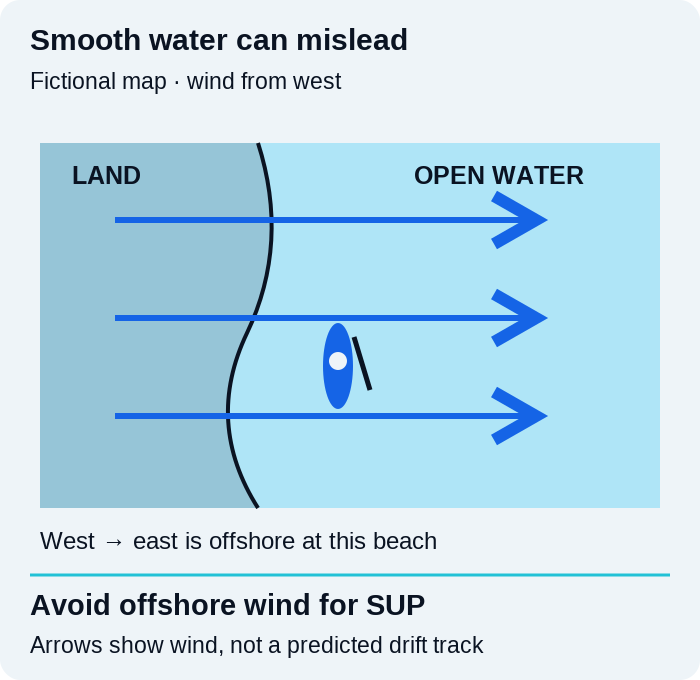
Offshore wind blows from land towards open water. It can flatten the nearshore surface while pushing the paddler away from shore. RNLI's advice is to avoid offshore winds. A calm-looking launch is not an exception: the very appearance that attracts a beginner may conceal the problem. [1]
Check direction on a map of the actual bay. A northerly wind comes from the north; whether it is onshore, offshore or cross-shore depends on where you launch. A curved shoreline can change that relationship during the same trip. Shelter behind a wall or trees can also make conditions beside the car park unrepresentative of the water farther out.
Read gusts as well as average speed and look through the whole proposed session. Do not choose a universal maximum wind speed from a stranger's experience. The same forecast can have different consequences for a small beginner, a larger paddler, different boards and different routes. Paddle UK's offshore-wind research explicitly notes that body profile, board type, gusts and tidal influences affect drift. [2]
Plan the return before choosing the outward leg
A tailwind or following current can make early progress feel effortless. That gives little information about what the reverse journey will require. The useful question is not “How far can I get in half an hour?” but “What assistance am I receiving, and will it still help when I turn?”
Mark the proposed route, landing options and any point beyond which returning becomes more difficult. Check that alternatives are real, permitted and accessible. A beach visible across a bay may sit below cliffs with no usable exit. A convenient-looking pontoon may be private or surrounded by moving vessels.
Leave time and energy for changes, but do not use a percentage reserve as a substitute for a viable plan. Turning halfway through a booked session does not guarantee a return within the other half. For new paddlers, a qualified local lesson in an appropriate supervised area is a better way to establish skills than an unsupported exploratory trip.
Waves depend on more than local wind
Wind waves grow according to wind strength, duration and fetch, the stretch of open water over which wind acts. A bay can have little chop at its sheltered edge and more towards the open side. Swell may also arrive from a distant weather system even when local wind is light. [3]
Read wave height, period and direction, then assess the launch and landing. Breaking waves, boat wakes and reflected water beside walls can demand skills that a flat-water session has not taught. Do not assume that a board described as “all-round” makes those conditions suitable for you.
A marine warning is important, but the absence of one is not a SUP recommendation. National Weather Service small-craft criteria vary by area and consider vessel characteristics and operator experience. A paddler can encounter unsuitable conditions below formal advisory thresholds. [4]
Enlarge diagram
Scroll sideways to read all labels in the original illustration.
Figure 1. A fictional east-facing shore with wind from west blowing towards open water. The nearshore surface is drawn smooth to show why appearance can mislead. The arrow depicts wind direction, not a predicted drift track or a route to attempt.
Atlas71 editorial illustration · Atlas71 original
Tide height and current need separate answers
Water level determines whether you can use a beach, steps or slipway. Current determines how water moves across your route. They are related, but their timing is local: slack current does not always occur at high or low water. [5]
At an unfamiliar tidal site, ask a qualified local provider about the current, channel entrances and changes during your session. If you cannot understand how a current affects the return, choose a supervised alternative. A phone's tide curve does not reveal every eddy, harbour flow or current beside a fixed object.
Estuaries and tidal rivers deserve particular care. A broad, smooth reach can still contain powerful flow and obstacles. Weirs, sluices, moored boats, pontoons and lines create additional hazards. Do not venture into such an environment simply because the sea outside looks rougher. It requires a separate assessment and suitable competence.
Match the leash to the environment
A leash helps keep a paddler connected to a board, but the wrong system can create entrapment risk. An ankle leash can be difficult to release when current holds the paddler against an obstruction. For flowing-water environments such as tidal rivers and estuaries, Paddle UK describes an appropriately fitted quick-release waist system, with training in its use. Buying the device is not the same as learning to release it in the relevant conditions. [6]
Whitewater is outside this coastal guide. Paddle UK's August 2026 leash guidance recommends that paddlers who cannot make specialist whitewater judgments do not wear a leash in that environment; its earlier 2023 safety alert warned against any leash system. Do not turn either source into a general “always wear a leash” rule. Seek current specialist instruction and follow the applicable provider and training rules before planning whitewater SUP. [6, 7]
Wear a correctly fitted buoyancy aid and keep a waterproof means of calling for help on your person, where you can reach it if separated from the board. RNLI identifies these, the correct leash and avoiding offshore wind as four central precautions. [1] Thermal protection must suit possible immersion, not just the air temperature while standing dry.
Example 1 Flat water on the wrong side of the bay
Illustrative only. The bay, forecast and paddlers are fictional.
Two beginners choose an east-facing beach because an image shows smooth water. The forecast gives wind from west at 9 knots, gusting 15 knots, during their rental. They interpret the lower number as “light enough” and plan to paddle towards a buoy offshore.
The map supplies the crucial missing fact: wind from west blows from the land towards open water at this beach. It is offshore. The gust value is also stronger than the headline average, but there is no need to calculate an exact drift distance to change the decision.
They follow the avoid-offshore-wind advice and ask the provider for an alternative lesson at an appropriate sheltered venue. The opposite side of the bay is not automatically suitable, because its waves, access and currents need their own assessment. If the provider cannot offer a suitable option, they postpone.
Example 2 A fast outward paddle hides the return
Illustrative only. The route, timings and observations are fictional.
A pair plans a one-hour outing along a sheltered inlet. They hope to reach a small beach in 30 minutes and reverse the route. Local current information shows flow towards that beach during the outward leg and a strengthening opposing flow on the proposed return. One paddler has never practised getting back onto the board after a fall.
A quick outward journey would not demonstrate sufficient ability for the return. The current arrangement undermines the simple half-time turnaround, and the unpractised recovery adds another unresolved requirement. They choose a shorter supervised session in an appropriate area instead of committing to the inlet route.
The revised plan is useful because it changes the exposure and support. It is not a claim that 20 minutes would have been a safe substitute for 30, or that a different leash alone would solve the route problem.
Before inflating or launching
- Confirm access, local restrictions, official warnings and the conditions for the whole outing.
- Establish wind direction relative to every exposed part of the route. Avoid offshore wind; inspect gusts and expected changes.
- Check waves, currents, tide-dependent access, water temperature and weather hazards such as thunderstorms or fog.
- Choose a board and equipment appropriate to the activity, within manufacturer limits, and inspect the board, paddle, fin, inflation and fittings as applicable.
- Wear a suitable buoyancy aid, obtain environment-specific leash advice, and learn recovery skills with qualified instruction.
- Agree the route, usable exits, a shore contact and an emergency plan. Carry an accessible waterproof communication device and know its coverage limits.
If you cannot make progress back, do not wait until exhausted to call for help. Stay with the board when possible and follow emergency-service instructions. Techniques for lowering wind exposure and self-recovery should be learnt and practised under suitable supervision; they are contingency skills, not a reason to launch in conditions you should avoid. [2]
Sources reviewed on 2 October 2026. Both worked examples and Figure 1 are original educational illustrations, not a forecast, current prediction or recommended route.