How to read conditions for open-water swimming
Is today suitable for an open-water swim? Start with the place, the whole session and the swimmer, then check the forecast. A low wave number cannot compensate for an unsafe exit, a pollution closure, cold water beyond your preparation or a current you cannot manage. The decision is only as strong as its least resolved important question.
This guide helps recreational swimmers organise that assessment. It does not prescribe a safe temperature, distance or duration. Pool fitness, experience at another beach and a previous successful swim do not certify today's plan. For a new activity or site, obtain appropriate instruction and local advice before committing.
Define the swim before judging the conditions
Separate water movement into its parts
Entry and exit can decide the session
Three article-specific ideas from this guide. They explain the topic; they do not represent measured local conditions.
Atlas71 editorial illustration · Atlas71 original · Evidence basis: RNLI. Open water swimming. ↗
What you will learn
- “Going swimming” can mean a brief supervised dip, laps in a managed lake or a long coastal route.
- Read wind, waves and currents as distinct influences.
- Assess getting out as carefully as getting in.
Define the swim before judging the conditions
“Going swimming” can mean a brief supervised dip, laps in a managed lake or a long coastal route. These require different arrangements. Write down the planned entry, permitted swimming area, return point and expected finish time. Identify who is swimming, who is accompanying or supervising them and how help could be summoned.
Then ask what would happen if someone needed to stop early. Is there a usable exit throughout, or would they have to continue past rocks, a seawall or a deep bank? Can the shore contact actually see the route? Does the plan cross boat traffic? A route with no practical early exit deserves a different decision from swimming within a supervised area, even when the weather values match.
Prefer a lifeguarded venue and confirm that the service will be operating during the visit. RNLI recommends swimming with a buddy, telling someone ashore the plan and carrying a means of calling for help. Equipment and companionship support a suitable plan; they do not make an unsuitable venue appropriate. [1]
Separate water movement into its parts
Read wind, waves and currents as distinct influences. Wind direction must be interpreted against the actual shoreline, and gusts can be stronger than the average wind. A sheltered corner at the start may tell you little about a route beyond the headland. Check the conditions expected near the end, when you may have less energy.
A wave forecast may describe offshore seas rather than the breaking waves at your entry. Period and direction help explain how that wave energy reaches the shore. Met Office beach guidance distinguishes offshore wave information from expected surf and notes the significance of longer periods. Read the provider's definitions before treating two similar-looking numbers as equivalent. [2]
Breaking waves also create currents. Rip currents can carry swimmers away from the beach and may be hard to identify. A smooth gap between breaking waves can contain flow; a quiet-looking sea or a low regional risk category does not establish its absence. Use lifeguard guidance rather than trying to confirm a suspected rip by entering. [3]
Tidal current is a separate issue, especially around channels, headlands and estuaries. High or low water does not universally coincide with slack current. A tide-height curve tells you about changing level, not the speed of water along the proposed swim. Seek site-specific current advice where that matters. [4]
Entry and exit can decide the session
Assess getting out as carefully as getting in. Small-looking waves that collapse abruptly at a steep beach can cause serious injury. Shorebreak does not need to reach the threshold for a high-surf warning to be dangerous. A ladder, shingle slope or rock platform can also become a different proposition as water level changes. [5]
On arrival, check from a safe position and talk to the lifeguard or venue operator. If the planned exit is being washed by waves, do not assume that determination, a shorter swim or more flotation solves the problem. The appropriate response may be to choose an entirely different supervised venue or remain ashore.
Enlarge diagram
Scroll sideways to read all labels in the original illustration.
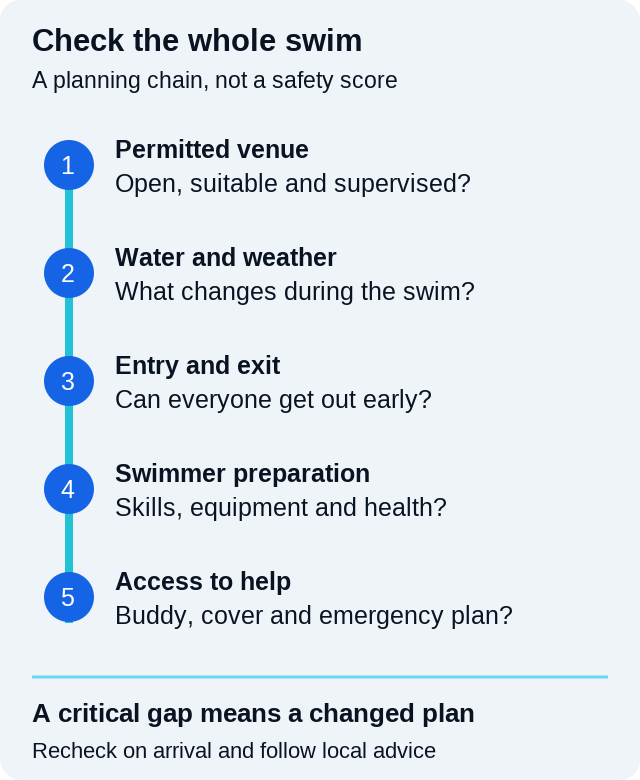
Figure 1. A fictional swim plan viewed as a chain: permitted venue, conditions, entry and exit, swimmer preparation, and help. A missing link prompts a changed plan. This is a planning aid, not a scoring system or a sequence that grants permission to swim.
Atlas71 editorial illustration · Atlas71 original
Cold water changes the problem immediately
Air temperature is a poor substitute for water temperature. Sudden cold immersion can trigger an involuntary gasp and rapid breathing, while longer exposure can impair movement and contribute to hypothermia. RNLI highlights particular danger at 15°C and below; that is not a guarantee of safety above 15°C. Individual responses and exposure differ. [6]
Do not use a formula such as “one minute per degree” to set a session. An acclimatised friend's usual duration is not your allowance, and a wetsuit does not remove the need for a conservative decision. Enter gradually rather than jumping or diving into unfamiliar water. Plan the exit and dry, sheltered change before entering. [1, 6]
If you have relevant health concerns or are starting cold-water swimming, discuss suitability with a healthcare professional. Stop and seek help if you feel unwell. This article cannot assess an individual's fitness or provide medical clearance, and a forecast cannot do that either.
Check water quality and weather hazards independently
Read current official recreational-water advisories and site notices, particularly after rain. Clear water can still contain contamination; a previous good classification does not cancel a current closure. CDC recommends checking whether a swimming area is monitored and whether health or safety advisories are active. [7]
Look beyond wind and temperature for thunderstorms, fog and deteriorating visibility. If thunder is heard, leave the water and seek a substantial building or enclosed hard-topped vehicle. An open beach shelter is not suitable lightning protection. NWS advises waiting at least 30 minutes after the last thunder before resuming outdoor activity. [8]
A tow float and bright cap can make a swimmer easier to notice, but neither guarantees detection by vessels nor supplies rescue cover. Check the device's actual purpose and limitations. Visibility to others, visibility of the shore and underwater visibility are separate questions; good performance on one cannot be assumed on the others.
Example 1 A promising forecast and an unusable exit
Illustrative only. The venue, readings and people are fictional.
Two friends plan a 40-minute swim from a beach to a stone landing and back. Their forecast lists light wind and 0.4 m offshore significant wave height. The tide is rising throughout. One friend treats those two numbers as enough evidence because the route felt easy last month.
At the beach, they discover that the stone landing's lower steps are being washed by breaking waves and the upper gate is locked. That removes the only planned intermediate exit. They also learn that today's lifeguarded swimming area lies away from their intended route.
They abandon the point-to-point plan and ask the lifeguard about swimming within the designated area instead. They have not calculated that 0.4 m is safe or unsafe in general. They have recognised that the route no longer meets their own access and support assumptions. If the alternative is unsuitable too, they stay out.
Example 2 A colder lake than the afternoon suggests
Illustrative only. All values, arrangements and observations are fictional.
A managed lake reports water at 12°C while the afternoon air reaches 22°C. A first-time open-water swimmer proposes the same 1,500 m distance they usually swim in a pool. The venue offers an introductory supervised session, but the swimmer worries that choosing it would mean wasting the warm day.
The 10°C difference is a comparison of two temperatures, not an exposure calculation. Warm air does not establish how the swimmer will respond in cold water, and pool distance does not measure cold-water competence. They speak to the operator, follow the venue's entry requirements and choose instruction rather than committing to the distance.
If health concerns or the operator's assessment make even that option unsuitable, they postpone. A smaller distance is not automatically the answer; the useful change is to replace an unsupported assumption with an appropriate assessment and preparation.
A final check before leaving shore
- Confirm permission, patrol or venue hours, current notices and the exact swimming area.
- Check the forecast's place, issue time, valid period and units. Read the full session, including the return.
- Review waves, wind and gusts, local currents, water level, water temperature, water quality and visibility.
- Verify both the planned exit and what happens if someone needs to stop early.
- Agree buddy contact, appropriate equipment, a shore contact and the local emergency procedure.
- Reassess on arrival. Follow the local flags and instructions, and be prepared to cancel without trying a test swim.
At RNLI-lifeguarded beaches, red-and-yellow flags mark the swimming area and a red flag means do not enter. Systems differ elsewhere; ask locally. [9] If someone is in trouble, alert the lifeguard or emergency service rather than entering after them. If caught in a rip, conserve energy, float and signal; do not exhaust yourself fighting straight against the flow. [3]
Sources reviewed on 2 October 2026. Both worked examples and Figure 1 are original educational illustrations, not assessments of a real venue or swimmer.