How to read diving conditions: entry, current, visibility and surface safety
Is a dive suitable because visibility is good? Visibility is only one part of the decision. A complete assessment includes getting to the site, entering, working underwater, ascending, being found at the surface and getting out. Conditions must fit the divers' qualifications, recent experience, equipment and the operation supporting them.
This guide helps certified recreational scuba divers ask useful planning questions. It does not provide certification, medical clearance, gas calculations, decompression instructions or rescue training. Follow your training agency's procedures, current local operational guidance and the limits agreed with your buddy and dive leader. Any diver should be able to end or decline a dive without pressure.
Conditions begin before entering the water
Current and visibility change the dive plan
Atlas71 should inform, not clear a dive
Three article-specific ideas from this guide. They explain the topic; they do not represent measured local conditions.
Atlas71 editorial illustration · Atlas71 original · Evidence basis: RNLI – Scuba diving safety ↗
What you will learn
- Check weather, tides, sea state and local site information before committing to a dive.
- Low visibility can make buddy separation and navigation harder.
- Atlas71 can organise environmental evidence and show uncertainty, but it should not present a universal green light for diving.
Begin with the dive and its support arrangements
Identify whether the plan is a shore dive, a boat dive returning to a fixed point or a drift dive with active pickup. The same current has different consequences under each arrangement. A location appropriate to a well-equipped boat operation may be inappropriate for an unsupported shore entry.
Confirm the intended site, depth and route within your qualification and experience. Establish who is leading, who is your buddy, what the surface team expects and how the group will communicate. DAN's planning guidance calls for learning the site, considering surface support and agreeing a plan that can prevent and manage foreseeable incidents. [1]
Ask what happens if the normal exit cannot be used, someone ends the dive early or a buddy pair surfaces away from the expected point. “The boat will find us” is not a recovery plan unless the crew has explained how it monitors divers and what you should do. Resolve unanswered questions before kitting up, while changing the plan is still straightforward.
Read entry and exit as separate conditions
For a shore dive, inspect the route across land and through the waterline. Rocks, steps, surf, slippery footing and the weight of equipment all affect access. Ask how the exit changes with tide and swell. A place that is manageable on entry may be washed by waves by the time you return.
DAN's shore-diving guidance emphasises entry and exit assessment, equipment management and informing a non-diving contact of the plan. [2] Apply that thinking to the actual divers rather than assuming that a popular site is suitable for every group. A video of someone else using a rocky entry does not establish your ability to do so today.
For boat diving, discuss boarding arrangements, ladder use, surface conditions and the skipper's instructions. What is routine in a calm harbour may be difficult after a dive in chop. Do not solve a surface problem by deciding informally to stay deeper or extend the dive; the underwater plan and ascent obligations still apply.
Current can change with depth and time
Surface movement does not necessarily represent the flow deeper down. Currents can differ in direction and strength through the water column, and tidal flows can change during a dive. DAN advises a site-specific briefing and highlights how current can increase effort, gas use and difficulty returning to the boat. [3]
Distinguish tide-height information from current information. A nearby high-water time is not, by itself, a slack-water prediction for the dive site. Ask which current station, local correction or operator knowledge supports the proposed window, and how uncertainty or a delayed arrival affects the plan.
A drift dive must be planned as a drift dive. It needs suitable training, signalling and surface recovery arrangements; it is not an improvised answer to finding that the current is stronger than expected. Likewise, a general rule to start against the current cannot guarantee a return if the current reverses, varies with depth or exceeds the group's ability.
Treat actual conditions that differ materially from the briefing as a reason to stop and reassess through your trained procedures. Do not increase effort, depth or distance simply to recover a planned photograph or reach the advertised feature. The site will remain there for another suitable day.
Visibility affects communication and orientation
Underwater visibility can vary between locations, depths and moments. Sediment, plankton, lighting and water movement affect the view, and a diver's own fins or equipment can stir a silty bottom. A clear surface layer may hide poorer conditions beneath it.
Low visibility changes the practical demands of buddy contact, navigation and recognising hazards. A brighter torch is not always a cure: suspended particles can reflect its light back towards the diver. DAN emphasises preparation, appropriate training, communication and ending a dive that exceeds the diver's ability. [4]
Ask when and where a visibility estimate was made, whether it was horizontal and whether conditions have changed since. Then agree the communication, separation and abort procedures taught by your training agency. Do not improvise a line system or enter an overhead environment to solve a visibility problem. Wreck penetration and caves require separate specialist training and equipment.
Enlarge diagram
Scroll sideways to read all labels in the original illustration.
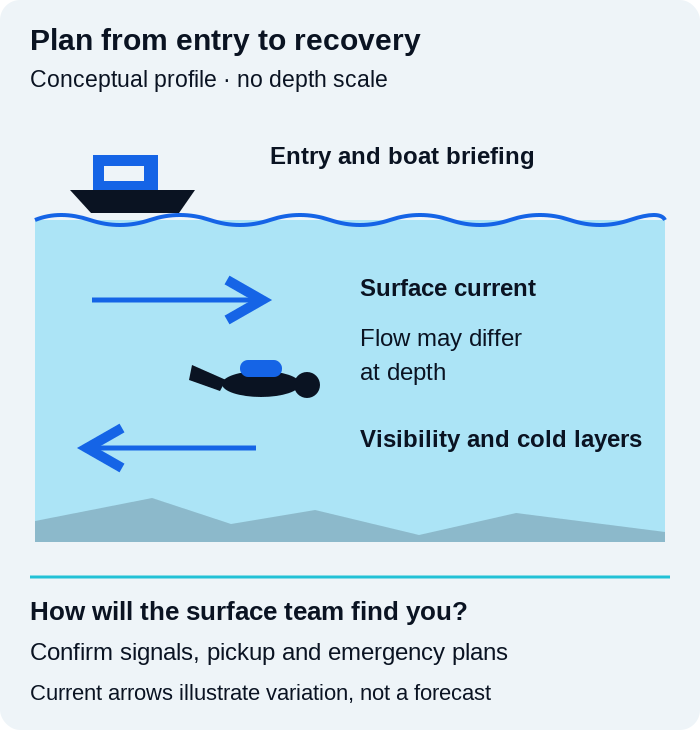
Figure 1. A conceptual dive-environment profile linking shore or boat entry, the water column, the dive site and surface recovery. Arrows at different depths point in different directions to illustrate possible current variation. They are not a prediction for any site or an instruction to enter current.
Atlas71 editorial illustration · Atlas71 original
Temperature, workload and fitness belong in the plan
A surface water-temperature report may not describe conditions at the planned depth. Ask the operator about colder layers and choose exposure protection appropriate to the dive and your training. Being comfortable while waiting on deck does not establish comfort after immersion and an extended surface recovery.
Cold, exertion and unfamiliar conditions can combine into a more demanding dive than its maximum depth suggests. Discuss recent diving experience honestly. If equipment, buoyancy control or basic skills need a refresher, arrange that in an appropriate supervised setting before adding a challenging environment.
RNLI encourages divers to assess their fitness and seek qualified medical advice where needed. [5] Do not use an article or a general fitness tracker to self-clear a health concern. Symptoms, illness or uncertainty about medication need appropriate professional advice, and being certified does not remove the need to reconsider fitness on the day.
Surface safety continues after ascent
Review how the surface team tracks divers, verifies everyone is back and responds to a missing diver. Confirm appropriate visual and audible signalling equipment and competence in its use. Carrying a surface marker buoy without knowing how to deploy it safely does not satisfy that requirement.
The emergency plan should identify the local emergency number, communication coverage, trained assistance, oxygen and evacuation arrangements appropriate to the operation. DAN's operator guidance treats shore, boat and site procedures as parts of the same safety system, and advises contacting local emergency medical services first in an emergency. [6]
Do not assume that a familiar international assistance number replaces the local emergency response. If a diver becomes unwell, activate the plan and obtain professional help. This guide is not a treatment protocol and does not advise underwater recompression or a return to the water to address symptoms.
Example 1 Clear water and a deteriorating ladder
Illustrative only. The site, schedule and conditions are fictional.
A buddy pair books a shore dive from a stone quay. The operator reports excellent morning visibility. Their planned entry is at 11:00, but the dive and return would overlap rising water and increasing swell. On arrival, the lower ladder rungs are already being struck by waves.
The attractive visibility answers a different question from the exit. The pair asks whether a suitable alternative has been assessed. None is available within the agreed plan, and neither diver is trained or equipped for an alternative boat recovery.
They cancel the dive. Shortening it by a guessed number of minutes would not establish a reliable exit window. The important decision is that the complete entry-to-return plan no longer fits the conditions, despite an appealing underwater view.
Example 2 A current window and a delayed departure
Illustrative only. The times, site and arrangements are fictional.
A boat briefing proposes entering at 09:20 within an operator-assessed period of reduced flow. A technical delay means departure is 45 minutes late. One diver suggests keeping the planned underwater route because the surface still looks smooth.
The original assessment applied to the original timing. A 45-minute delay cannot be dismissed simply because the sea looks flat, and a tide-height display does not establish how the current has changed at depth. The skipper and dive leader reassess the site using appropriate local information.
They select a different site only after a new briefing confirms suitable conditions, limits and recovery arrangements for everyone. A diver who is not comfortable declines. If no suitable revised plan exists, the trip does not become an improvised drift dive to preserve the booking.
Before committing
- Check site permission, marine warnings, weather, sea state and the forecast through recovery.
- Verify the entry, exit, local current window and the consequences of delay.
- Discuss visibility and temperature at depth, recent reports and known entanglement or overhead hazards.
- Match the plan to qualifications, recent skills, health, equipment and buddy competence.
- Agree limits, gas planning, communication, separation and abort procedures through your training and dive operation.
- Confirm surface tracking, pickup, emergency contacts and evacuation arrangements. Reassess when conditions or timing change.
Sources reviewed on 2 October 2026. Both worked examples and Figure 1 are original educational illustrations, not dive plans or predictions for a real site.