UV Index and sun protection at the beach
Can you get sunburnt on a cool, breezy beach day? Yes. Ultraviolet radiation is not the warmth you feel, and UV can reach you through cloud. Water and sand can also reflect it. Use the UV Index to plan protection, rather than waiting until you feel hot or notice your skin changing. [1]
The index describes the intensity of sunburn-producing UV at the Earth's surface. It is useful for choosing when to be outdoors and how to cover up, but it is not a personal countdown to sunburn. WHO recommends sun protection when the index is 3 or higher. Someone with particular medical needs may require additional precautions at lower values. [2]
The UV Index is about radiation, not heat
Why beaches deserve extra attention
Keep local guidance visible
Three article-specific ideas from this guide. They explain the topic; they do not represent measured local conditions.
Atlas71 editorial illustration · Atlas71 original · Evidence basis: WHO – Ultraviolet radiation and the UV Index ↗
What you will learn
- A cool or windy day can still have high ultraviolet radiation.
- People often stay exposed for long periods, wear less covering and may underestimate sun strength because of wind or water.
- Keep local guidance visible
What the index measures
Sunlight includes ultraviolet wavelengths that are invisible to us. The UV Index weights those wavelengths according to their potential to cause sunburn and expresses the result as a simple number. A higher index means stronger sunburn-effective radiation at that place and time, not a higher air temperature or a longer day. [3]
Forecast calculations account for the sun's angle, ozone, cloud and elevation. Latitude, season and time of day therefore matter. A beach holiday at a different latitude can involve a very different UV pattern from home, even if the weather feels familiar. The position of the sun around midday is especially important. [3]
A forecast can show the expected daily maximum or values for individual hours. Those are different products. If an app shows “8” without an obvious time, find out whether it means now or the peak later in the day. Comparing a current reading of 2 with a daily maximum of 8 without their labels would make a normal daily change look like disagreement.
Read categories as protection guidance
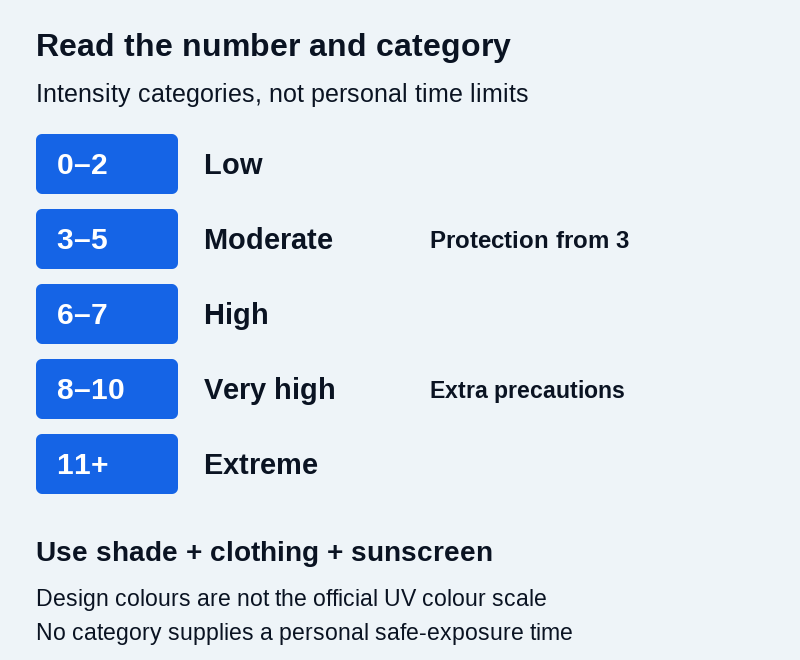
The usual international categories are low at 0–2, moderate at 3–5, high at 6–7, very high at 8–10 and extreme at 11 and above. The scale does not stop at 11. These bands communicate increasing exposure intensity; they do not specify an allowed number of minutes for an individual. [4]
At 3 and above, organise shade, clothing and sunscreen before exposure. At very high or extreme levels, make stronger use of indoor or well-shaded alternatives around the middle of the day. The goal is to reduce exposure, not to find a product that makes an unlimited beach stay acceptable. [2, 5]
A low value does not mean the UV is literally zero, and a value below a category boundary is not a guarantee against harm. An all-day exposure, a photosensitising medicine or an individual health condition changes the practical question. Ask a pharmacist or clinician if you have been advised that your skin or eyes are especially sensitive.
Enlarge diagram
Scroll sideways to read all labels in the original illustration.
Figure 1. UV Index categories shown with numbers and labels. Protection is recommended from 3, with extra precautions at the highest levels. The Atlas71 colour palette is used for layout; these are not the standard international category colours. No band gives a personal safe-exposure time.
Atlas71 editorial illustration · Atlas71 original
Why a beach can disguise the exposure
Wind and a swim can make you feel cooler without reliably reducing incoming UV. Cloud cover can change while you are outside, and reflected radiation can still reach you in shade. CDC recommends combining shade with clothing and sunscreen rather than relying on an umbrella alone. [1]
The length of the visit matters as well as the intensity at one moment. Time walking to the beach, waiting for a lesson, paddling and eating lunch all contributes to the day's outdoor exposure. A short swim does not make the rest of the day disappear from the assessment.
Look at where shade will be when you need it. A small patch that works early may not cover the group later. If the only shade is too far from the supervised swimming area, plan separate covered-up breaks rather than placing children out of sight. Sun protection and water supervision have to work together.
Build protection around the activity
Use covering clothing, a broad-brimmed hat and sunglasses with appropriate UV protection, and seek shade. For time in the water, a suitable covering swim top can reduce the amount of exposed skin; it still needs to be appropriate for the activity. Sunscreen belongs on exposed areas rather than replacing these measures. [2, 6]
Public-health recommendations vary slightly by jurisdiction. NHS advice is to choose at least SPF 30 with adequate UVA protection, expressed in the UK as at least four stars or an appropriate UVA mark. Read the local label and your health authority's guidance rather than assuming all rating systems mean the same thing. [6]
“Broad spectrum” means protection against both UVA and UVB. SPF primarily describes protection against sunburn under test conditions. It is not a multiplier for the number of hours you may stay out. Applying too little, missing areas or losing product during activity can reduce practical protection. [7]
Follow the product's application and reapplication directions. Cover commonly missed areas, such as ears, the back of the neck and tops of the feet. Do not stretch the next application because the sky has clouded over or the breeze feels cooler.
Water resistant does not mean waterproof
In the United States, a water-resistant sunscreen label states whether its tested resistance is for 40 or 80 minutes of swimming or sweating. These are product-test claims, not instructions to swim that long or permission to ignore reapplication. No sunscreen is waterproof. [8]
Follow the label after swimming, sweating and towel drying, as well as its ordinary reapplication interval. FDA guidance recommends reapplying at least every two hours and more frequently when swimming or sweating. Keep the bottle available rather than packed away where nobody can use it during the outing. [7]
Children need adult help with protection. Infants have additional needs: keep babies out of direct sun and seek appropriate medical advice about sunscreen for those under six months. For anyone with a skin condition or prescribed treatment, individual medical advice takes precedence over general beach-planning guidance. [6, 7]
Example 1 A comfortable day with a high index
Fictional worked example. All weather values, people and times are invented.
A family plans to be at the beach from 10:00 until 15:00. The air forecast is 19°C with a pleasant breeze. The hourly UV forecast rises from 4 at arrival to 8 around the middle of the day, then declines later.
The air temperature describes comfort, while the UV values describe a radiation hazard. The family should not use the cool breeze to discount the later peak. They plan a covered-up visit, bring appropriate sunscreen and move lunch to substantial shade or indoors during the high-exposure part of the day. [1, 2]
They still apply protection before arrival because the starting index is already above 3. The later decline does not undo exposure received earlier. This example illustrates planning around the time series without pretending to calculate anyone's burn time.
Example 2 A water-resistance label and a towel
Fictional worked example. The product label and activity are invented to explain a decision; this is not a product recommendation.
A swimmer applies a sunscreen whose local label specifies 80 minutes of water resistance. After a 20-minute swim, they towel dry and prepare to sit on the sand. They assume the remaining 60 minutes on the label means they can ignore the bottle.
That subtraction misuses the label. Water resistance describes performance under defined testing, while towel drying and the instructions for reapplication are separate considerations. The swimmer reads and follows the label, reapplies as directed after drying, and adds clothing and shade for the break. [8]
They also check the UV forecast for the remaining stay. The outcome is a workable protection routine, not a claim that reapplication resets accumulated exposure or makes the afternoon unlimited.
Before a beach day
- Check the UV Index for the destination and distinguish hourly values from the daily maximum
- Plan protection from 3 upwards and account for individual medical advice
- Arrange shade and covering clothing alongside water supervision
- Choose appropriate UVA and UVB protection and follow the sunscreen label
- Reapply after water activity and towel drying as directed
- Protect eyes and commonly missed skin areas
- Keep sun protection separate from heat, surf and water-quality decisions
A lower UV forecast does not make hazardous water suitable, and comfortable water does not remove sun exposure. Use the index for the question it answers, then plan the whole outing.
Sources reviewed on 2 October 2026. Figure 1 and both worked examples are original educational illustrations, not personal medical advice or a UV forecast for a real date.