How to make a useful report from the shore
What makes a beach report useful to someone arriving later? A clear description of what was observed, where it was observed and when it happened. “Water looked brown beside the eastern stream at 09:20” carries more information than “bad beach”. It also leaves room for the cause to remain unknown.
Community observations can reveal a change worth checking and add detail that a distant sensor misses. Their value depends on context and limits. A report does not become an official warning because it has many reactions, and an absence of recent reports does not establish that a place has no hazards.
Structured observations are more useful than vague comments
Time and location are part of the evidence
Verification should be visible
Three article-specific ideas from this guide. They explain the topic; they do not represent measured local conditions.
Atlas71 editorial illustration · Atlas71 original · Evidence basis: US EPA – Participatory Science Quality Assurance Handbook and Toolkit ↗
What you will learn
- A report such as 'bad water today' is difficult to interpret.
- Many beach conditions change quickly.
- Atlas71 should distinguish an unverified community report from corroborated evidence and from an official warning.
Describe the observation before the explanation
Separate what you directly noticed from what you think caused it. A smell, discoloured patch, line of floating material, damaged access step or posted flag can be described without diagnosing pollution, identifying a species or predicting danger across an entire bay.
For example, “three jellyfish-like organisms beside the slipway” preserves an observation while acknowledging uncertain identification. “Toxic jellyfish infestation” adds claims that the observer may not be able to support. Likewise, “brown water flowing from the stream” does not prove the source is sewage. A photo can help someone investigate, but its colours and visible features do not test water for pathogens. CDC advises checking official notices and avoiding unusually discoloured or foul-smelling water; a community explanation is not required before taking that precaution. [1]
Use ordinary descriptions. If you cannot estimate a count, describe the extent or distribution without inventing a number. If you are reporting a sign, quote its actual message accurately and state where it stands. Do not rewrite a local instruction into a broader rule for other beaches.
Give the report its time and place
Record the observation time separately from the posting time. A photo uploaded on Friday may have been taken on Wednesday. Include a time zone when the report could be read across regions, and explain if a time is approximate. A precise-looking timestamp is not helpful if it describes the upload rather than the event.
Identify the feature or stretch of shore. A named beach may span several kilometres; “beside the north access steps” is more useful than a town name alone. Where a map pin is used, check that it points to the observation rather than the car park or your current location. State uncertainty instead of moving the pin to a plausible-looking place.
This is part of provenance: the information needed to understand where a record came from. EPA's participatory-science guidance emphasises planning and documentation appropriate to the intended use of the data. Context that seems obvious to the contributor often becomes essential when another person reviews it later. [2]
Say how you know
A measured water temperature, an estimate by touch and a copied forecast are different evidence. Label them accordingly. A measurement should retain its unit, instrument or method, location and time. A forecast should retain its source and valid time. A personal impression should remain a personal impression.
For wildlife, a confident identification and a tentative one are also different. iNaturalist, for example, assesses the date, location and supporting media of an observation and uses community identification in its own quality process. Its “Research Grade” designation is a platform-specific data category, not a beach safety certificate. [3]
If several people independently observe the same event, their reports can strengthen the evidence that something occurred. Ten copies of one photo are still one original observation. When sharing another person's report, preserve the link and attribution rather than presenting yourself as an independent witness.
Enlarge diagram
Scroll sideways to read all labels in the original illustration.
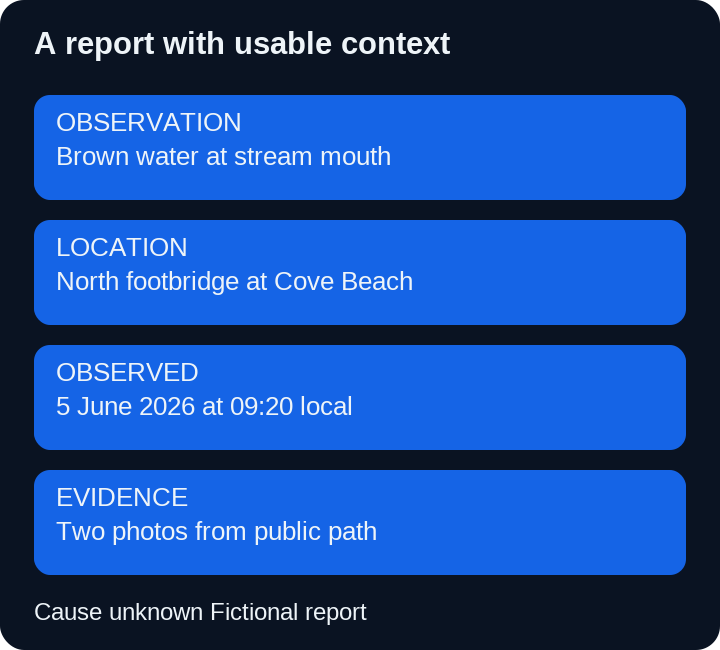
Figure 1. An invented report is broken into four fields: observation, location, observation time and evidence. The report describes brown water at a stream mouth without identifying its cause. The diagram shows how to preserve context, not how to issue an official advisory.
Atlas71 editorial illustration · Atlas71 original
Keep photographs useful and safe
Take photographs only from a position you can occupy safely and lawfully. Do not approach a cliff edge, enter closed water, handle wildlife or touch an unknown object to improve a record. NOAA's debris-handling guidance advises leaving unknown or hazardous material untouched and reporting it to the appropriate authority. [4]
A wider view can establish the location; a detail can show the feature if it is visible from that same safe position. Retain the original file when possible. If you crop, annotate or adjust it for clarity, explain the change and keep an unaltered copy for review. Do not add objects, remove conflicting details or use a generated illustration as evidence of a real event.
Consider what else appears in the image. Avoid publishing identifiable bystanders, private information or precise locations of sensitive wildlife unnecessarily. Share the detail needed by the responsible reporting service and use its privacy options. The purpose is to make the observation understandable without creating avoidable exposure for people or wildlife.
Understand what a later reader can conclude
An observation has a scope. A flag seen at one access point at 10:00 does not describe every flag later that afternoon. A litter photograph proves that material was visible in the frame; it does not count the whole beach. A calm surface at the shoreline does not measure currents offshore.
Some information changes quickly, while other information is relatively stable. A crowd report may lose practical relevance within hours; a broken access ramp may remain relevant until repaired. There is no universal expiry time that fits both. A later reader should check whether the event has been updated, resolved or superseded before acting on it.
Quality also depends on purpose. A casual observation may be enough to suggest that a caretaker inspect a damaged sign. A scientific trend or a health decision needs a more controlled process. EPA's systematic-planning framework starts from the question and intended data use, then defines collection and review requirements. [5]
Example 1 A report that can be checked
Illustrative only. The location, times and event below are fictional.
At 09:20, a walker sees brown water entering the northern end of Cove Beach from a stream. From the public path, they take one wide photograph showing the bridge and one closer view. At 10:10 they submit the report: “Observed 09:20 local time, beneath the footbridge at the north end. Brown plume extending into the bay. Cause unknown. Photos taken from the path.”
The report gives the recipient something concrete to investigate. It does not claim a laboratory result or estimate the affected area beyond what the walker could see. Because a public-health issue may be involved, the walker also checks the official local reporting route rather than assuming a community post will summon a response.
A visitor reading it at 16:00 should seek current official information and any update. The timestamp makes that need visible. Neither a lack of comments nor the passage of several hours proves the event has ended.
Example 2 Five posts from one old photograph
Illustrative only. The photographs, people and dates are fictional.
A photo of stinging organisms is posted by one beach visitor on Monday. On Saturday, five other accounts share it with “watch out today”. A reader sees six posts and assumes six recent independent sightings.
Checking the original reveals a single Monday observation. The image may still be useful background, but the copied posts do not establish current presence or six separate events. The reader retains the original date, avoids repeating the unsupported “today” claim and checks the responsible local authority for current advice.
If a genuinely new observer sees similar organisms on Saturday, that is a separate record with its own time, location and evidence. It should not be merged with Monday's event merely because the photos look similar. Keeping those histories separate allows a reviewer to ask a better question about recurrence.
Before submitting or relying on a report
- State what was actually observed and label interpretation or identification uncertainty
- Include observation time, location and relevant units or method
- Preserve the original evidence and distinguish a first-hand report from a repost
- Use a safe viewing position and avoid disturbing people, wildlife or unknown material
- Send urgent hazards through the responsible local channel; a public post is not emergency dispatch
- Check later updates, official notices and the report's exact scope before using it for a decision
A useful report does not need dramatic language. Its strength is that another person can understand the evidence, recognise its limits and decide what should happen next.
Sources reviewed on 2 October 2026. Both examples and Figure 1 are original educational illustrations, not reports of real incidents.